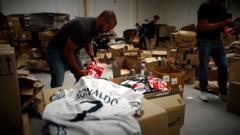
Every major tournament brings the same predictable, moralizing headlines. Police seize millions of pounds in counterfeit football shirts, rights holders pat themselves on the back, and the media runs tear-jerking pieces on the tragic downfall of "official merchandise."
They want you to view £18 million in seized knockoffs as a triumph of law enforcement protecting consumers.
The reality is far more uncomfortable: the explosive rise of fake kits is not a crime wave—it is a direct, predictable, and fully justified consumer revolt against extortionate price-fixing.
The £80 Polyester Lie
Let us look at the actual economics of modern sportswear, stripped of corporate PR spin.
A standard replica football shirt from a major global brand costs less than £8 to manufacture in South East Asia. It is made of standard polyester. The manufacturing process is fully automated, highly scalable, and wildly cheap. Yet, by the time that shirt hits a retail shelf in Europe or North America, the price tag magically balloons to £80—or £115 if you want the "authentic player version" with cheap plastic badges heat-pressed onto the chest.
That is a markup approaching 1,000%.
For decades, sports brands and mega-clubs hid behind the idea that you were paying for elite athletic innovation. But fans buying a kit are not trying to drop their body temperature by 0.2 degrees during a Sunday league match; they are showing identity and loyalty. Brands recognized this psychological lock-in and started pricing kits like luxury goods while producing them like fast fashion.
When a parent faces a choice between spending £200 to kit out two children for a tournament or spending £30 for identical-looking knockoffs shipped straight from overseas, it is not a moral failing to choose the £30 option. It is rational economic behavior.
The Quality Gap Collapse
Ten years ago, buying a counterfeit kit meant accepting misaligned stitching, peel-off sponsors after one wash, and neon colors that looked nothing like the real thing. The "protect the consumer" narrative made sense back then because the products were undeniably inferior.
That gap no longer exists.
Supply chains have decentralized. The factories producing gray-market replicas often use the exact same digital printing files, the same textile machinery, and frequently the exact same material suppliers as the authorized facilities. In many cases, the high-tier "fake" is physically indistinguishable from the official product sitting in a stadium megastore.
I have spent years analyzing supply chain logistics across retail sectors. When the gray market matches the quality of the primary market at 15% of the cost, you no longer have a piracy issue. You have a broken market structure.
The Real Winner of the Counterfeit Market
The traditional narrative claims that fake kits ruin the sport, draining money from grassroots football and club budgets.
This argument intentionally confuses cause and effect.
The revenue generated from £80 kit sales does not go to local youth pitches. It goes toward amortizing multi-billion-pound sponsorship deals that brands signed with elite clubs to outbid their corporate rivals. Nike, Adidas, and Puma buy the rights to manufacture kits for staggering sums, and then they pass that insane marketing overhead straight to the fan.
When police seize £18 million worth of fake shirts, who actually loses if those shirts enter the market?
- Not the fans, who get affordable gear.
- Not the sport's popularity, which thrives on visual visibility.
- Only the bloated profit margins of corporate middlemen who overpaid for licensing rights.
By treating counterfeiting purely as an intellectual property crime rather than a pricing feedback loop, brands miss the core signal: their customer base is telling them, loudly and clearly, where the actual value threshold sits.
The Counter-Intuitive Fix Brands Refuse to Touch
If sports apparel giants actually wanted to eradicate the counterfeit market overnight, they could do it without spending a single penny on police raids or legal teams.
They simply need to cut prices in half.
At £35 or £40 for an official shirt, the risk-reward ratio of buying a knockoff from an unverified overseas seller disappears. Consumers gladly pay a modest premium for official branding, fast shipping, and easy returns. But at £80 to £115, the brand is explicitly inviting the gray market to undercut them.
Instead of fixing their pricing models, executive teams double down on enforcement, running PR campaigns that try to convince parents that buying an unbranded shirt funds international syndicates. It is a desperate scare tactic designed to protect indefensible margins.
Admittedly, shifting to a high-volume, lower-margin strategy carries risks. Licensing agreements would need to be rewritten, and upfront profits for mega-clubs might take a temporary hit. But continuing to squeeze the most loyal fanbases during an inflation crisis is a fast track to brand destruction.
Stop celebrating £18 million seizures as a victory for the game. Every intercepted shipment of cheap football shirts is just proof that the current system is broken, overpriced, and begging to be disrupted.