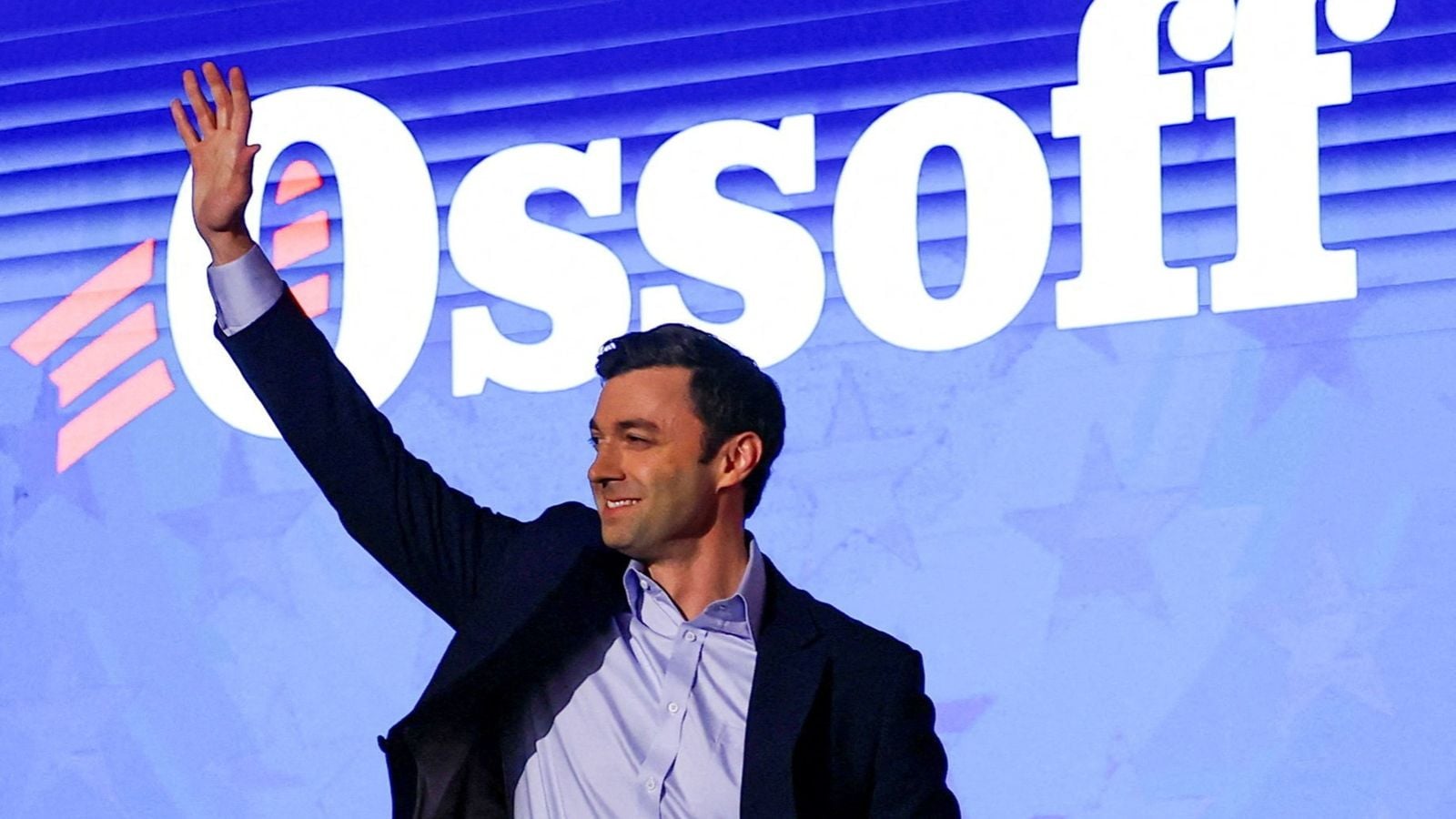
On November 3, 2026, Georgia Senator Jon Ossoff did not merely survive a perilous reelection bid in a state Donald Trump carried two years earlier. He obliterated Republican challenger Mike Collins by 18 percentage points, claiming the largest margin of victory for a Georgia Democrat since Zell Miller in 2000 and instantly vaulting himself to the top tier of early 2028 presidential polling. Despite Ossoff repeatedly insisting throughout the autumn that he has "zero interest" in seeking the White House, his landslide victory in a premier battleground state has forced national Democratic strategists, donors, and voters to confront an unmistakable reality.
Most political coverage treats this sudden 2028 momentum as a standard post-election sugar high. That reading misses the structural mechanics of what actually happened in Georgia. A 39-year-old incumbent defending the only Democratic Senate seat in a 2024 Trump state did not win by double digits by accident, nor did he do it solely because Republicans nominated a flawed candidate. Ossoff engineered a financial, operational, and rhetorical blueprint that solved the Democratic Party's most acute post-2024 vulnerability: winning back suburban independents and rural pragmatists without alienating the progressive base.
The Financial Juggernaut Behind the Landslide
To understand why national operatives are ignoring Ossoff's denials, start with the balance sheet. Campaign finance filings covering the cycle through mid-October 2026 show Ossoff's principal campaign committee raised more than $115.9 million and spent over $105.7 million. By comparison, Mike Collins raised roughly $10.7 million. Even when accounting for outside super PAC expenditures, money benefiting Ossoff accounted for more than 81 percent of the $154.3 million poured into the general election.
Sheer volume is only half the story. The composition of that war chest reveals a national fundraising machine already operating at presidential scale.
- Small-dollar dominance: More than $55.3 million of Ossoff's receipts came from unitemized individual contributions—donors giving $200 or less. In the third quarter of 2026 alone, his campaign logged over 760,000 small-dollar donations at an average of $46 apiece, with nearly 97 percent coming in at $100 or under.
- Geographic saturation: While coastal bundlers certainly wrote checks, Ossoff's campaign recorded contributions from all 159 counties in Georgia, signaling grassroots penetration deep into territory typically written off by statewide Democrats.
- Cash reserves: Entering the final weeks of the race, Ossoff sat on tens of millions in cash on hand, allowing him to saturate television and digital airwaves while simultaneously subsidizing coordinated party infrastructure up and down the Georgia ballot.
A Senate campaign that builds a donor list of hundreds of thousands of recurring small-dollar contributors does not simply turn off the servers in November. In modern American politics, an email and SMS file of that magnitude is the functional equivalent of an Iowa caucus organization. Whether Ossoff wants to run for president or not, he now possesses the exact financial architecture required to launch a national campaign overnight.
Constituent Service as Asymmetric Warfare
Money buys airtime, but it does not explain why Republican mayors in South Georgia—including the GOP leaders of Valdosta and Tifton—publicly endorsed a Democrat. Nor does it explain how Ossoff captured 59 percent of the statewide vote while Democratic gubernatorial nominee Keisha Lance Bottoms ran behind his vote share.
During his first term, Ossoff treated constituent casework and hyper-local appropriations not as routine administrative duties, but as an aggressive political strategy. While national cable news fixated on culture-war flashpoints, Ossoff's Senate offices ran mobile casework clinics across rural, heavily Republican counties, untangling Veterans Affairs backlogs, Social Security disputes, and IRS snafus for voters who had never cast a ballot for a Democrat.
"He doesn't flip open his notes," Brunswick Mayor Pro Tem Lance Sabbe told reporters when explaining why he backed Ossoff despite a history of splitting tickets. "It's like he honestly cares and knows."
That reputation was reinforced by relentless, unglamorous legislative delivery. Throughout 2025 and 2026, Ossoff stacked up bipartisan bills and federal grants targeting rural hospitals, clean water emergency response, timber exports, fertilizer costs, and port upgrades in Savannah and Brunswick. When a senator consistently delivers tangible federal dollars to county commissioners in deep-red districts, national party labels lose their potency. Voters stop viewing him as an ideological avatar and start viewing him as an effective local advocate.
How Ossoff Solved the Democratic Messaging Trap
For years, Democratic candidates in swing states have struggled with a binary choice. Lean into aggressive confrontation against Donald Trump and risk alienating moderate swing voters exhausted by partisan trench warfare, or adopt cautious, poll-tested moderation and watch base turnout collapse.
Ossoff refused the binary. He split his public persona into two distinct, mutually reinforcing tracks.
In Washington, he used his seat on Senate investigative committees to prosecute high-profile, viral interrogations of Trump administration officials and nominees. Those sharp, prosecutorial moments gave frustrated Democratic donors and progressive activists the combative champion they craved, driving millions of views and fueling his small-dollar fundraising surges. At the same time, he anchored his investigative work in bipartisan, kitchen-table oversight—exposing abuse in foster care systems, dangerous prison conditions, and maternal mortality rates.
On the campaign trail in Georgia, he pivoted seamlessly to economic pragmatism and institutional competence. When Mike Collins attacked him as a "trust fund kid" and attempted to paint him as the leader of the Democratic Socialists of America, the caricatures bounced off. Voters in suburban Atlanta and coastal Georgia had spent six years watching Ossoff focus on infrastructure, military housing, and healthcare access. Attempts to brand him a radical simply lacked credibility.
The Structural Tailwinds and the Collins Factor
Any honest forensic accounting of the 2026 Georgia Senate race must acknowledge the environment in which it occurred. Ossoff's 18-point margin was a genuine political earthquake, yet it did not happen in a vacuum.
Midterm elections historically punish the party holding the White House, and 2026 delivered a sweeping blue wave across Georgia. Democrats did not just reelect Ossoff; they won the governorship, swept down-ballot statewide offices from lieutenant governor to insurance commissioner, and flipped control of the electricity rate-setting Public Service Commission. Massive mobilization efforts led by Black women and grassroots community organizations turned out voters in decisive numbers across metro Atlanta and the Black Belt.
Furthermore, Georgia Republicans handed Ossoff an ideal foil. Rather than nominating a mainstream, business-friendly conservative aligned with outgoing Governor Brian Kemp, GOP primary voters selected Congressman Mike Collins after a bruising primary and runoff. Collins entered the general election burdened by his continued denial of the 2020 presidential election results and controversy surrounding white nationalist and antisemitic social media posts by his son-in-law that Collins declined to disavow. For college-educated suburbanites in Cobb, Gwinnett, and North Fulton counties—voters who had willingly backed Brian Kemp in 2022—Collins represented a bridge too far.
Skeptics within the Democratic establishment point to these exact factors when cautioning against premature 2028 coronation talk. Winning a midterm referendum against an unpopular national administration and a polarizing GOP nominee in your home state is vastly different from surviving a brutal, multi-state presidential primary gauntlet.
Why the 2028 Numbers Refuse to Cool Down
Despite those caveats, early polling confirms that Ossoff's victory has fundamentally altered the 2028 chessboard. A post-election Emerson College survey placed Ossoff at 17 percent in a hypothetical 2028 Democratic primary field—edging out former Vice President Kamala Harris and New York Representative Alexandria Ocasio-Cortez, and finishing ahead of former Transportation Secretary Pete Buttigieg and California Governor Gavin Newsom.
Look closer at the coalition behind that 17 percent figure. Unlike Newsom or Buttigieg, who carry heavy ideological or establishment baggage from previous national cycles, Ossoff enters the conversation as a blank slate to much of the country, backed by hard empirical proof that he can win in the Sun Belt.
- The Electability Argument: After bruising losses in 2016 and 2024, Democratic primary voters are obsessed with nominating a candidate who can actually win electoral votes in swing states. A two-term senator from Georgia who just won by double digits holds an unmatched trump card in that debate.
- Generational Contrast: Born in 1987, Ossoff will be 41 years old on Election Day 2028. For a party whose aging leadership has been a chronic liability over the past decade, he offers immediate generational renewal without sacrificing institutional governing experience.
- Factional Bridge-Building: Polling indicates Ossoff draws simultaneous interest from moderate pragmatists and progressive voters. In a fractured primary field, a candidate acceptable to both wings of the party possesses a clear path to accumulating delegates.
Even inside Georgia, voters are already pushing him toward the national stage. An Atlanta Journal-Constitution survey taken shortly before the election found that 84 percent of likely Democratic voters in the state wanted Ossoff to run for president in 2028, alongside nearly half of likely independents. Notably, his fellow Georgia senator, Raphael Warnock—who has openly flirted with a White House bid—registered lower enthusiasm and significantly higher intraparty opposition in the exact same poll.
The Limits of the Shermanesque Denial
Throughout the 2026 campaign, Ossoff delivered a disciplined, repetitive answer whenever reporters asked about 2028. He stated he had "zero interest" in running for president—in television interviews, in newspaper sit-downs, and on the debate stage.
Veteran political observers take such pledges with an entire shaker of salt. During a competitive Senate campaign, any hint of presidential ambition is political poison; voters rightly resent incumbents who treat a six-year Senate term as a two-year stepping stone to Iowa and New Hampshire. Saying "zero interest" was a tactical necessity to protect his 2026 reelection.
Now that the ballots are counted and the margin is certified, the political gravity shifts entirely. Over the next twelve months, major Democratic donors disillusioned with the party's coastal establishment will beat a path to Atlanta. Consultants, state party chairs in early primary states, and interest groups will pressure him to reconsider.
Ossoff does not need to form an exploratory committee tomorrow, nor does he need to walk back his debate-stage denials anytime soon. By winning Georgia by 18 points, he has already achieved the hardest part of any presidential campaign: proving to a skeptical party that he knows how to win where it counts.