The frost on Wild Horse Plain does not care about human math. It forms in thin, brittle sheets across the mud, locking the earth into a temporary silence before the noon sun beats down and turns everything back into a sticky, peat-heavy sponge.
Walk here, and you feel it immediately: the ground breathes. It yields beneath your boots with a spongy, unsettling give, as if you are walking across the chest of a sleeping giant. Beneath that surface lies a library of water and ancient sediment, holding thousands of years of climate history in layers of dark, compressed organic matter.
Then you hear the hoofbeats.
Heavy. Unforgiving. Dozens of them moving across the delicate high-altitude flats with a careless rhythm.
To understand why Australia spent $187,000 on an electric fence stretching across a seemingly empty stretch of wilderness, you have to get down on your knees. You have to look past the dramatic peaks of the Snowy Mountains and focus entirely on something smaller than your thumbnail: a tiny, emerald-green cushion of sphagnum moss.
The Weight of Hooves on Liquid Earth
Dr. Elena Vance spent twenty years watching this landscape unspool. When she first walked Wild Horse Plain in the late nineties, she didn't see a romantic frontier of untamed freedom. She saw a bathtub with the plug pulled out.
"People talk about brumbies like they belong to a fairy tale," Elena told me last autumn, wiping mud from her glasses as a freezing wind whipped off the ridge. "They picture a majestic stallion standing against the horizon. But romanticism doesn't build soil. Hooves do something entirely different."
Imagine a wet sponge. Now imagine dropping a four-hundred-kilogram animal onto it repeatedly, day after day, through summer droughts and spring thaws.
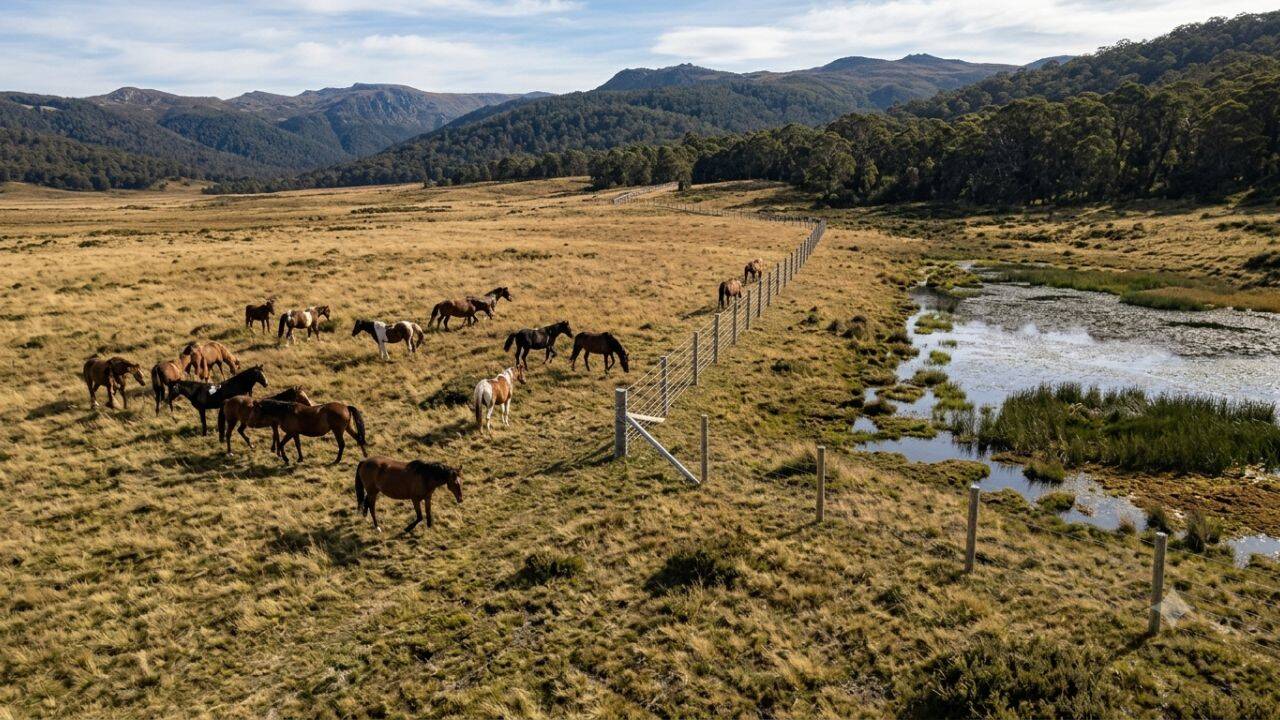
The brumbies—feral horses that have roamed the Australian Alps for generations—come to these alpine wetlands for one reason: green pick. When the surrounding eucalyptus forests dry out, the high-altitude bogs remain lush. The horses congregate here by the dozens. They graze down the native tussock grasses to the dirt, but worse, they trample the fragile peat bogs.
Peat is essentially compressed, half-decomposed plant matter. It acts as a giant natural sponge, soaking up winter snowmelt and releasing it slowly through the dry months down into the Murray-Darling river system. It is the literal heartbeat of Australia’s primary agricultural water supply.
When horses churn up that peat, the sponge breaks. The intricate matrix of roots, mosses, and ancient organic layers shatters. The water drains away too fast, leaving behind barren channels of dry, eroded mud that blow away in the wind or wash down the slopes in the next heavy rain.
The fence wasn't built to keep out ghosts. It was built to stop a slow-motion hemorrhage.
Anatomy of a Barrier
The structure itself is deceptively simple. It is a high-tensile electric fence, powered by solar arrays tucked discreetly behind granite outcrops, designed to deliver a sharp, harmless deterrent that teaches large mammals to look for food elsewhere.
At $187,000, it raised eyebrows in local pubs across regional New South Wales. Critics pointed to the price tag, asking why thousands of dollars were being poured into wire and insulators when the horses had roamed these ranges for over a century.
Consider what happens next if you do nothing.
When the peat dries out, it loses its ability to hold water. The native alpine sphagnum frog—a critically endangered creature that relies on these exact bog ecosystems for its entire life cycle—loses its breeding pools. The native flora, adapted to acidic, waterlogged conditions, dies off, replaced by opportunistic weeds. The soil oxidizes, releasing centuries of stored carbon back into the atmosphere.
The fence is not an aesthetic choice. It is a tourniquet.
When conservation crews finished stringing the final lines of wire across the plain, the local ecology didn't instantly heal. Nature does not work on political election cycles or quarterly budgets. Recovery here takes decades of patient, quiet invisibility.
Beneath the Surface
If you crouch down beside the fence line today, the contrast is stark.
On one side, where the horses still roam freely, the ground is beaten smooth, scarred with deep hoof ruts that fill with muddy runoff when it rains. The vegetation is sparse, cropped low to the earth like a poorly maintained lawn.
On the other side, protected by the $187,000 current running through the wire, the recovery has begun. Tall alpine water ferns are pushing up through the damp thatch. Sphagnum moss is creeping back across bare patches of peat, its pale green tips glowing in the filtered mountain light.
It is easy to look at a wild horse and see only freedom. It is harder to look at a patch of wet dirt and see the survival of an entire watershed. But the water coming out of your tap hundred of miles away, the rivers flowing through the dry inland plains, and the survival of species found nowhere else on Earth depend entirely on which side of that fence the landscape is on.
The frost returns to Wild Horse Plain as the sun dips below the western ridge. The metal wire hums softly in the wind, carrying its invisible current through the freezing air, guarding the dark, wet earth beneath.