Modern computing did not begin in Silicon Valley, nor did it start with the British military intelligence teams at Bletchley Park. The foundational math that drives every artificial intelligence model, every microchip, and every digital transaction tracking your life today was lifted from 3,000-year-old Chinese philosophy.
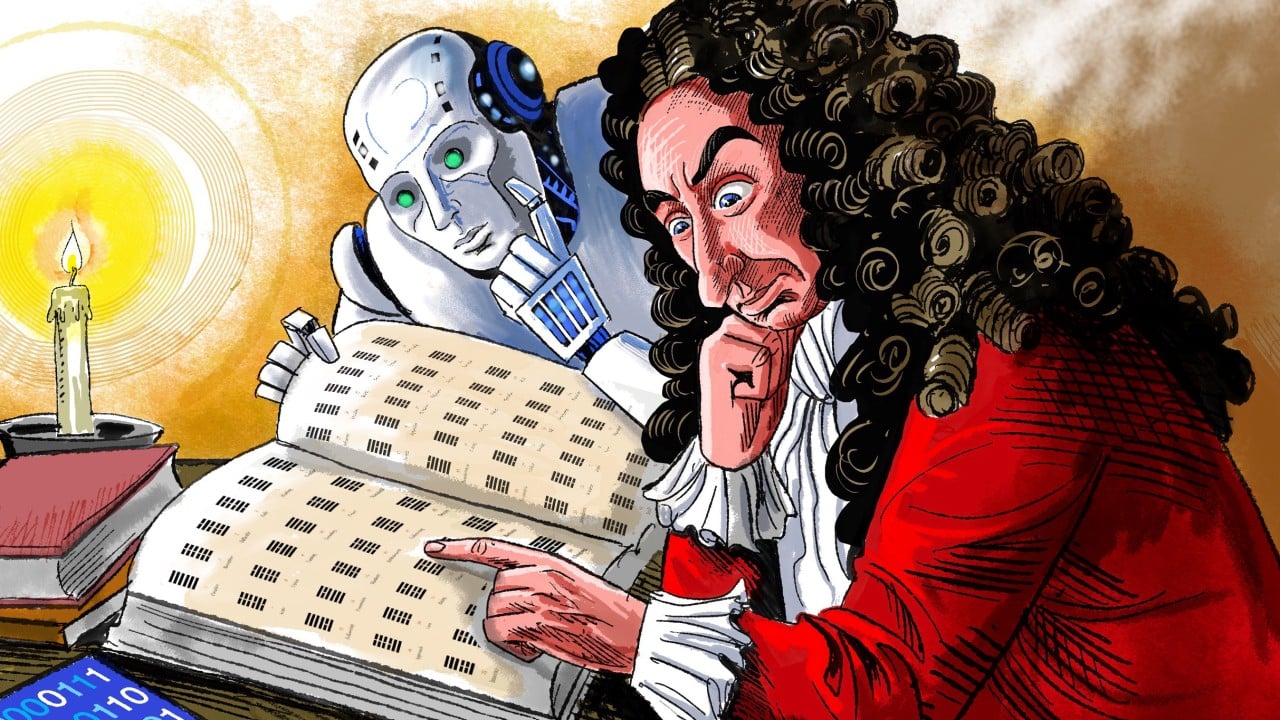
Gottfried Wilhelm Leibniz, the 17th-century mathematical giant, officially invented the binary system—the ones and zeros that power our digital world. However, historical archives reveal he did not create it in a vacuum. He lifted the framework directly from the I Ching (Book of Changes), an ancient Chinese divination text. This was not a casual inspiration. It was a direct translation of an ancient system of trigrams into Western mathematics, a historical pivot point that tech companies routinely ignore when bragging about modern innovation.
The current narrative frames artificial intelligence as a fresh product of Western tech hubs. The reality is far more cyclical. Modern data processing is the continuation of a global intellectual pipeline that Western academia colonized centuries ago.
The Missionaries and the Mathematician
By the late 1600s, Leibniz was obsessed with finding a universal language. He wanted a system of logic that could eliminate human error and settle theological arguments with pure calculation. He had already developed a base-2 numerical system, but he viewed it as a mathematical curiosity rather than a revolutionary breakthrough. It lacked a real-world proof of concept.
Enter Joachim Bouvet. Bouvet was a French Jesuit missionary stationed at the court of the Kangxi Emperor in Beijing. For years, Bouvet studied the I Ching, looking for ways to bridge Christian theology with classical Chinese thought. When Bouvet began corresponding with Leibniz, he noticed something startling in the German mathematician’s early binary drafts. The configurations of lines in the ancient Chinese text matched Leibniz’s ones and zeros perfectly.
In 1701, Bouvet sent Leibniz a diagram showing the 64 hexagrams of the I Ching, arranged in a specific sequence attributed to the scholar Shao Yong. The layout was systematic. Leibniz realized that if you substituted the broken lines (Yin) with 0 and the solid lines (Yang) with 1, the hexagrams read exactly as a sequential count from 0 to 63 in binary code.
The ancient Chinese philosophers had mapped out binary progression millennia before the invention of the electricity that would eventually make it functional. Leibniz used this realization to validate his work, publishing his definitive paper on binary arithmetic in 1703. He explicitly credited the I Ching sequence, viewing it as evidence that the universe's ultimate structure was baked into ancient human wisdom.
Deconstructing the Hexagram Code
To understand why this matters for modern technology, you have to look at how data moves through a modern transistor. A computer chip processes information using millions of tiny electrical switches that can either be off (0) or on (1).
The I Ching operates on the exact same structural logic. At its core are two fundamental forces: Yin and Yang.
- Yin represents the passive, receptive, and dark principle, symbolized by a broken line:
-- --. - Yang represents the active, creative, and light principle, symbolized by a solid line:
————.
By stacking these lines in groups of three, the ancients created eight trigrams. Stacking them in groups of six created 64 hexagrams. Each hexagram represents a specific state of being, a transition, or a data point in a broader system of changes.
Shao Yong Sequence (Partial Example):
Hexagram 1 (All Yin):    -- --  -- --  -- --  -- --  -- --  -- --  ->  000000 (Binary 0)
Hexagram 2 (One Yang):   -- --  -- --  -- --  -- --  -- --  ————  ->  000001 (Binary 1)
Hexagram 3 (Shifted):    -- --  -- --  -- --  -- --  ————  -- --  ->  000010 (Binary 2)
This is not a vague metaphor. It is an identical algorithmic structure. When an AI model processes natural language today, it breaks words down into vectors—long strings of numbers that represent meaning across different dimensions. The I Ching did this with human experience, breaking down complex situational dynamics into a six-bit binary vector.
The Erasure of Eastern Logic from Tech History
If the connection is so explicit, why is it relegated to a footnote in tech history? The answer lies in the institutional shift that occurred during the European Enlightenment and the subsequent rise of industrial capitalism.
As Western nations built empires, they rewritten the history of science to justify their dominance. The narrative shifted. Science and rigorous logic became exclusively Western inventions, while Eastern systems of thought were rebranded as purely mystical, superstitious, or spiritual. The I Ching was dismissed in the West as a fortune-telling tool used by street diviners, ignoring the sophisticated mathematical matrix that underpinned its creation.
This intellectual erasure persists in how we talk about tech innovation today. We attribute the computer revolution to Alan Turing, John von Neumann, and the Silicon Valley pioneers of the mid-20th century. While their engineering feats were monumental, their machines ran on a logical track laid down centuries earlier through cross-cultural extraction.
Silicon Valley's Blind Spot
The tech industry's failure to recognize its historical roots causes real-world problems in how we develop artificial intelligence. Current AI development operates on a philosophy of brute force. Companies throw massive computational power and trillions of tokens of data at neural networks, hoping that sheer scale will produce true intelligence.
This approach treats data as static, isolated bits of information that can be mined and monetized. The I Ching, by contrast, presents binary logic as an interconnected web of relationships where every state is defined by its transition to the next. It assumes that change is the only constant.
By ignoring the holistic philosophy that birthed binary logic, modern tech developers have built systems that struggle with context, nuance, and long-term consequences. We have machines that can calculate everything but understand nothing. They optimize for short-term engagement and immediate metrics because their underlying philosophical architecture has been stripped of its original purpose: understanding balance and systemic stability.
The Physical Limit of On and Off
The irony is that modern computing is currently hitting a wall that the I Ching anticipated. As silicon chips reach their physical limits, engineers are struggling to make transistors any smaller without running into quantum tunneling, where electrons slip through barriers and corrupt the binary data.
This has forced the industry to look toward quantum computing. Instead of rigid bits that are strictly 0 or 1, quantum computers use qubits, which can exist in a superposition of both states simultaneously.
The ancient Chinese texts never viewed Yin and Yang as absolute, permanent states. They were dynamic forces constantly transforming into one another. A solid line contains the seed of a broken line; a state of maximum energy inevitably decays into rest. The rigid Western interpretation of Leibniz’s binary system—treating 0 and 1 as absolute opposites that must never blur—is exactly what quantum computing is now trying to dismantle.
Tech executives spent the last decade convincing the public that they are inventing the future from scratch. They are not. They are merely iterating on an ancient framework, using faster hardware to process a logical language that was perfected in the Yellow River valley thousands of years ago. The next breakthrough in computing will not come from inventing a entirely new logic, but from finally understanding the fluid, relational logic we discarded three centuries ago.