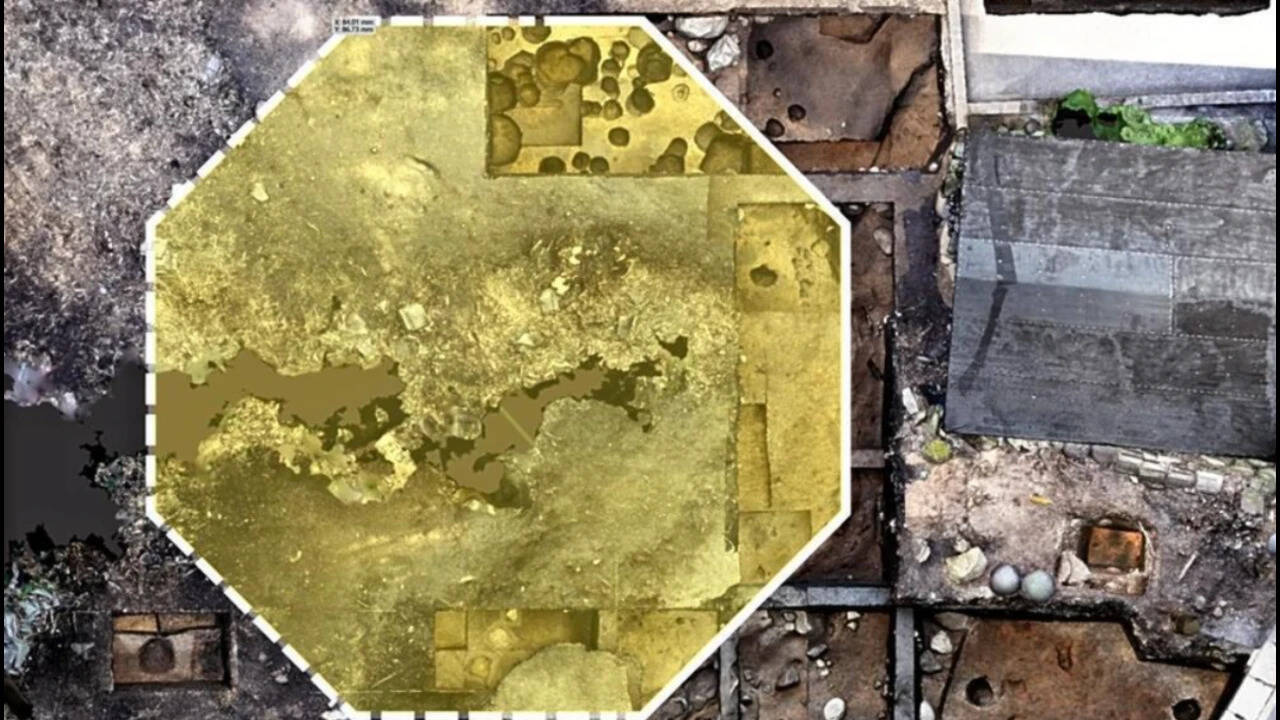
Archaeologists working on Oshima, a small, isolated island off the coast of Fukuoka Prefecture in southern Japan, have unearthed the remains of a 900-year-old octagonal building—a rare architectural form in twelfth-century Japan that points directly to elite Buddhist ritual, maritime trade networks, and regional political power during the late Heian period. Rather than being an inexplicable anomaly, the foundation stones and structural footprint indicate a deliberate, high-status monument built at a strategic chokepoint along the Genkai Sea.
The discovery immediately triggered the usual wave of breathless headlines calling the structure mysterious. It is not mysterious if you understand how medieval Japanese elites projected authority across water. When local municipal researchers and prefectural archaeologists cleared the soil layers on Oshima, they exposed the post-hole alignments and foundation layout of an eight-sided wooden hall dating to the twelfth century. In the architectural vocabulary of classical and early medieval Japan, an octagon is never an accident. Builders did not choose eight sides because they ran out of square timber or wanted to experiment with geometry on a windswept rock in the sea.
Why an Octagon on a Remote Island Matters
To understand why an eight-sided building on Oshima is a major historical signal, you have to look at what hakkakudo—octagonal halls—meant in the Heian period (794–1185). On the Japanese mainland, particularly in the imperial capital of Kyoto and the ancient religious center of Nara, octagonal halls were among the most prestigious structures an aristocratic family or monastic institution could commission. They were overwhelmingly associated with memorial worship, esoteric Buddhist ritual, and the commemoration of high-ranking nobles.
The Yumedono (Hall of Dreams) at Horyu-ji in Nara is the most famous surviving example, built in the eighth century to honor Prince Shotoku. By the eleventh and twelfth centuries, Fujiwara regents and retired emperors were constructing octagonal halls at major temple complexes like Hossho-ji and Byodo-in to house Buddhist icons and anchor spiritual merit for their lineages. Constructing an octagon required advanced carpentry, precise radial joinery, and specialized roof framing that standard rectangular halls did not demand.
Finding that exact architectural signature on Oshima changes how historians have to read the periphery of late Heian Japan. Oshima is not a blank spot on the map. Sitting roughly six kilometers off the coast of Munakata in northern Kyushu, the island forms part of the sacred maritime triad of Munakata Taisha, one of the oldest and most politically consequential Shinto-Buddhist shrine complexes in the Japanese archipelago.
The Munakata Maritime Network and Continental Trade
For centuries, the Munakata clan controlled the sea lanes linking northern Kyushu to the Korean Peninsula and Song-dynasty China. The three shrines of Munakata Taisha—Hetsu-miya on the Kyushu mainland, Nakatsu-miya on Oshima, and Okitsu-miya on the far-flung island of Okinoshima—marked a physical and spiritual corridor across the Genkai Sea. Ships carrying ceramics, bronze mirrors, silk, medicinal herbs, and Buddhist texts passed directly through these waters.
By the twelfth century, when the Oshima octagonal building was erected, this maritime corridor was booming. Private Chinese merchants from Ningbo and Quanzhou were regularly docking at Hakata Bay, just down the coast from Munakata. Local warlords, shrine administrators, and aristocratic estate managers in northern Kyushu were accumulating immense wealth by taxing, financing, and protecting this trade.
Architecture was how those regional power brokers converted mercantile wealth into permanent legitimacy. A 900-year-old octagonal building on Oshima was not built by subsistence fishermen. It required capital, imported or mainland-trained master carpenters, and institutional backing from the elites who governed the Munakata shrine-temple complex.
The Architecture of Syncretism
One detail that popular coverage routinely flattens is the religious identity of sites like Oshima during the twelfth century. Modern visitors see Munakata Taisha as a purely Shinto institution because of the Meiji-era separation of Shinto and Buddhism in the late nineteenth century. In the 1100s, no such division existed.
Under the system of shinbutsu-shugo (the syncretic fusion of kami worship and Buddhism), major shrines were seamlessly integrated with Buddhist temples, sutra mounds, and memorial halls. Kami were understood as local manifestations of buddhas and bodhisattvas. Building a Buddhist-style octagonal hall on an island sacred to the Munakata sea deities was completely consistent with twelfth-century religious logic.
In practical terms, an octagonal hall on Oshima likely served one of three functions, or a combination of all three:
- A memorial chapel dedicated to a prominent leader of the Munakata shrine hierarchy or a Kyoto court patron with estate holdings in Kyushu.
- A ritual hall for maritime safety, where priests chanted sutras to calm the notoriously treacherous currents of the Genkai Sea before diplomatic or merchant vessels set sail toward the continent.
- A reliquary or sutra repository, housing sacred texts and gilt-bronze ritual implements brought back from Song China.
Archaeologists routinely find buried sutra mounds (kyozuka) across northern Kyushu from this exact century, reflecting the widespread belief that the world had entered mappo—the degenerate age of the Buddhist law—prompting elites to bury texts and build durable monuments to preserve the dharma.
Reading the Dirt Without Romanticism
Excavating on an island like Oshima is grueling, unglamorous work. Unlike monumental stone ruins in the Mediterranean, medieval Japanese timber architecture leaves behind almost no standing masonry. What survives in the ground are soseki (foundation stones) or hottate-bashira (earth-fast pillar holes), subtle discolorations in soil stratigraphy, roof tile fragments, and scattered shards of trade ceramics.
When archaeologists announce a 900-year-old octagonal building, they are reading geometric relationships across meters of excavated trench. Eight corner post positions or foundation pads arranged in a regular polygon tell a clear structural story. The spacing between those points allows specialists to calculate the diameter of the hall, estimate the load-bearing capacity of the pillars, and determine whether the building carried a heavy clay-tiled roof or lighter cypress bark shingles.
There are real limits to what soil traces can prove, and good field archaeologists are blunt about those gray areas. Without an intact dedication plaque or inscribed roof tile recovered directly from the destruction layer, researchers cannot name the exact individual who paid for the timber or the exact year the first pillar was raised. Dating relies on diagnostic artifacts—such as twelfth-century Chinese white porcelain bowls or locally fired Haji ware recovered from the post-hole fill—paired with radiocarbon analysis if charcoal is present.
That means a date of "900 years old" is an archaeological bracket pointing to the twelfth century, specifically the late Heian period, rather than a single calendar year. Anyone claiming to know the secret ritual performed inside on a specific night is selling fiction.
What Other Coverage Misses About Twelfth-Century Japan
The standard media narrative treats rural and island discoveries in Japan as isolated curiosities disconnected from national history. That framing gets the twelfth century completely backward.
The 1100s were not a quiet, static era. They were the decade-by-decade unraveling of centralized court rule in Kyoto and the violent birth of samurai governance. As the imperial court's tax system eroded, wealthy provinces and coastal estates gained unprecedented autonomy. Northern Kyushu was arguably the most globally connected region in Japan during this transition.
Look at who was operating in northern Kyushu during the twelfth century:
- The Taira clan, led by Taira no Kiyomori, who aggressively monopolized maritime trade with Song China, dredged shipping channels, and built alliances with coastal shrine networks.
- The Munakata daiguji (chief priests), who functioned less like quiet monks and more like maritime lords, commanding armed retainers, managing tax-exempt estates (shoen), and intermarrying with both Kyoto aristocrats and rising warrior families.
- Song Chinese merchant syndicates, who maintained residential quarters in Hakata and funded local religious institutions to secure spiritual protection and commercial goodwill.
Seen in this context, an octagonal hall on Oshima is physical evidence of how far capital-grade architecture and metropolitan religious culture had decentralized. You did not have to travel to Kyoto to see elite Buddhist geometry. The wealth generated by cross-sea commerce allowed island elites to import the architectural grammar of the imperial capital directly onto a strategic outpost overlooking the shipping lanes.
The Structural Challenge of Building Eight Sides
To appreciate the investment behind this find, consider what it actually took to erect an octagonal building in 1150.
Traditional Japanese timber framing is overwhelmingly orthogonal. Beams meet posts at ninety-degree angles. Carpenters lay out buildings using standard modular bay measurements (ken), scaling structures up or down along a predictable rectangular grid.
An octagon breaks that grid entirely. Every corner angle shifts from 90 degrees to 135 degrees. Hip rafters must converge cleanly at a central king post or octagonal ring beam without twisting under the dead weight of the roof. If the foundation stones settle unevenly—a constant hazard on coastal islands exposed to typhoons and salt spray—the roof geometry warps and the joinery splits.
Commissioning such a building on Oshima meant transporting seasoned timber, specialized iron woodworking tools, and master builders across open water. It meant maintaining a structure constantly battered by winter winds blowing straight off the Sea of Japan. The sheer maintenance cost proves that the hall was not a temporary shrine erected by passing sailors; it was an institutional asset backed by sustained revenue.
How This Changes Future Excavations in the Genkai Sea
The Oshima discovery forces a hard rethink of how archaeologists survey Japan's outer islands. For decades, research across the Munakata region focused heavily on the extraordinary ritual deposits on Okinoshima—where over 80,000 votive artifacts from the fourth to ninth centuries earned the island UNESCO World Heritage status—or on the main precinct at Hetsu-miya on the mainland.
Oshima, sitting squarely in the middle of that sacred axis, was often treated primarily as a waypoint or a vantage point from which pilgrims worshiped Okinoshima from afar. Unearthing a sophisticated twelfth-century octagonal hall demonstrates that Oshima itself was a major architectural stage during the late Heian period.
Field teams now have a clear mandate to expand subsurface surveys around the Nakatsu-miya precinct and adjacent coastal terraces. Ground-penetrating radar and targeted test trenches across similar island complexes in northern Kyushu will almost certainly reveal that medieval maritime shrines were far denser, wealthier, and more architecturally ambitious than surviving surface ruins suggest.
When the dirt is scraped back to reveal eight deliberate points in the earth, the message is unmistakable: medieval Japan's islands were not the edge of the world, they were its front door.