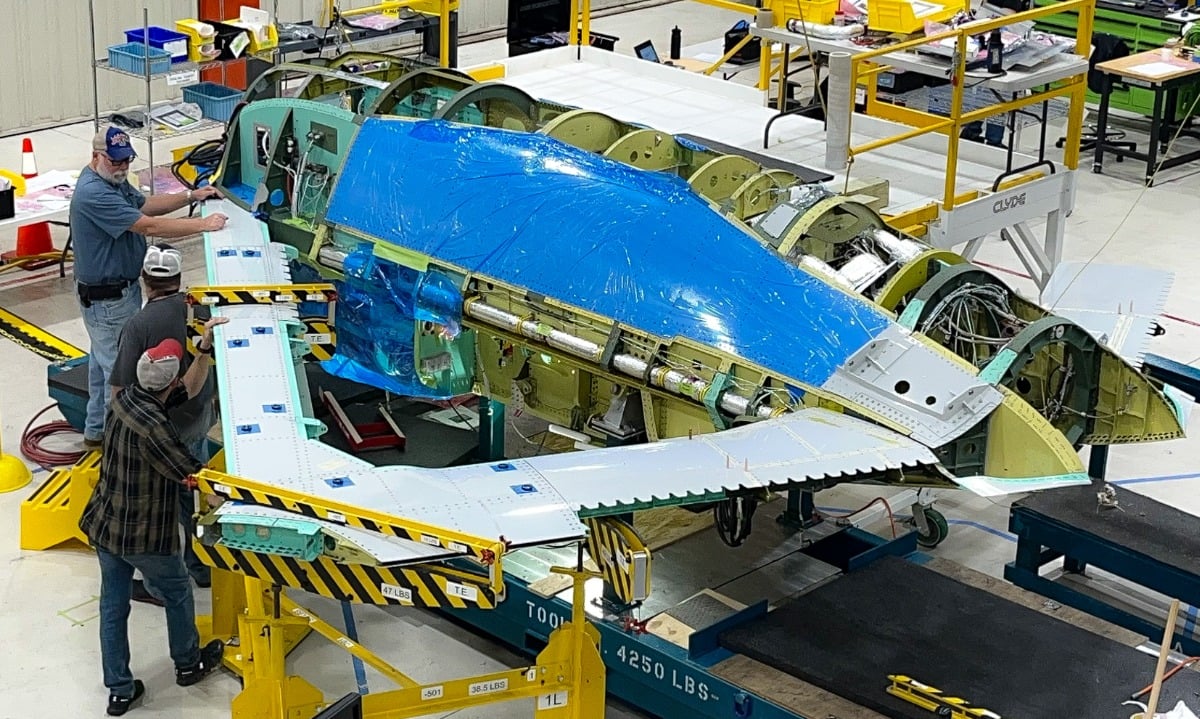
The Defense Advanced Research Projects Agency (DARPA) and Aurora Flight Sciences are attempting to eliminate mechanical flight control surfaces—the flaps, slats, rudders, and ailerons that have dictated aircraft design for over a century. The X-65 experimental aircraft, developed under the Control of Revolutionary Aircraft with Novel Effectors (CRANE) program, isolates pneumatic actuation as the primary mechanism for aerodynamic vectoring. By using pressurized air bursts to manipulate boundary layer physics, the platform seeks to prove that active flow control (AFC) can manage roll, pitch, and yaw at tactical scales up to Mach 0.7.
However, moving a theoretical fluid-dynamics concept from high-performance computing clusters to a physical 7,000-pound airframe introduces severe engineering friction. The fundamental trade-off of the X-65 lies between mechanical simplicity and systemic pneumatic complexity. While deleting traditional hinges and hydraulic actuators removes parasitic radar reflections and dead weight, it requires a highly complex internal pneumatic ducting network, specialized compressor integration, and a sophisticated flight control computer capable of microsecond-level pneumatic metering.
Analysis of the program's restructuring reveals that the transition from computational fluid dynamics (CFD) to a flight-ready asset creates predictable execution bottlenecks. The X-65 program has experienced a two-year slip in its inaugural flight timeline, shifting from an initial target of 2025 to late 2027. This schedule expansion stems directly from the realities of scaling experimental pneumatics, supply chain constraints, and the safety architectures demanded by airworthiness certification.
The Three Pillars of Active Flow Control Architecture
To understand the engineering framework of the X-65, the aircraft must be broken down into three interdependent subsystems that replace legacy mechanical control surfaces.
          +-----------------------------------------+
          |         Central Propulsion Unit         |
          +-----------------------------------------+
                               | (Bleed / Core Air)
                               v
          +-----------------------------------------+
          |    Pneumatic Distribution Network       |
          +-----------------------------------------+
                               | (High-Pressure Ducting)
                               v
          +-----------------------------------------+
          | 14 Embedded Active Flow Control Effectors|
          +-----------------------------------------+
1. The Primary Actuation Mechanism
The system relies on 14 embedded AFC effectors distributed across the flying surfaces of the aircraft’s Co-Planar Joined Wing (CJW) diamond planform and twin vertical tails. These effectors are essentially specialized nozzles or slots that inject high-velocity streams of air directly into the boundary layer. By pulsing or metering these air discharges, the system locally modifies air velocity and pressure distribution, creating a localized aerodynamic blockage—a "virtual speed bump." This alteration shifts the flow field, generating the localized aerodynamic force required to induce a moment (pitch, roll, or yaw) without deflecting a physical surface.
2. The Internal Pneumatic Distribution Infrastructure
Deleting external mechanical linkages requires the addition of an internal pneumatic network. The X-65 routes high-pressure air from its single turbojet engine through a dedicated internal manifold system. This requires structural volume inside the airframe that would typically hold fuel or avionics. Because the outboard wings must be modular and replaceable to test alternative AFC geometries, these high-pressure pneumatic lines require quick-disconnect, high-temperature seals capable of maintaining structural integrity under structural deflection and thermal stress.
3. The Flight Control Processing Core
Traditional flight control software translates pilot inputs into discrete angular deflections of ailerons or rudders based on well-understood aerodynamic coefficients. The X-65 flight computer must execute a far more complex optimization loop. It must translate desired aircraft maneuvers into precise mass-flow rates and pulsing frequencies across 14 distinct pneumatic ports simultaneously. Because pneumatic response times are governed by fluid dynamics rather than the mechanical transit speed of a hydraulic piston, the software must account for transport delays within the internal ducting to avoid pilot-induced oscillations.
The Volume and Weight Trade-Off Function
The removal of traditional actuators reduces structural weight at the wing trailing edges, which reduces the structural bending moments and permits a lighter wing spar. However, the net system weight and volume benefits are non-linear and subject to a rigid cost function.
$$W_{\text{net}} = (W_{\text{actuators}} + W_{\text{hydraulics}}) - (W_{\text{ducting}} + W_{\text{valves}} + W_{\text{compressor_mods}})$$
If the weight of the pneumatic manifold, fast-acting control valves, and engine bleed-air modifications exceeds the saved mass of the deleted hydraulic rams and mechanical hinges, the vehicle suffers a net performance penalty.
Volumetric efficiency introduces an even tighter constraint. In a conventional aircraft, the wet wing provides the primary storage volume for aviation fuel. On the X-65, the necessity of routing internal pneumatic ducting through the wings, combined with the requirement for modular, swappable outboard wing sections, eliminates the wings as viable fuel storage zones. As a consequence, Aurora engineers were forced to consolidate the primary fuel tanks entirely within the central fuselage.
This structural layout creates a strict volume bottleneck. The cross-sectional area of the fuselage must expand to accommodate both the engine core, the internal fuel cell, the landing gear bays, and the primary pneumatic manifold. This expanding fuselage volume increases the total wetted area of the aircraft, introducing parasitic zero-lift drag that partially counteracts the aerodynamic drag reductions achieved by removing mechanical gaps and hinges.
Risk Mitigation via Control Redundancy
A primary question regarding full-scale AFC deployment is the failure state of a purely pneumatic system. If an engine flameout occurs, or if a main pneumatic line ruptures, a vehicle relying exclusively on air bursts loses all control authority. To achieve Federal Aviation Administration (FAA) experimental flight certification and protect the asset during high-risk envelopes, the X-65 utilizes a dual-layered control architecture.
The aircraft is constructed with traditional mechanical control surfaces running in parallel with the AFC effectors. This creates a critical safety net for early flight testing:
- Pneumatic Regime (Primary Test State): The flight control computer commands the 14 AFC effectors to execute the flight profile, keeping the mechanical surfaces locked in a neutral, faired position to capture unadulterated aerodynamic data.
- Mechanical Regime (Fallback State): In the event of an engine compressor stall, a sudden loss of manifold pressure, or an uncommanded divergence in flight attitude, the system reverts instantly to a standard hydraulic actuator system to control the flaps and rudders.
This redundancy is essential for a flight demonstrator, but it highlights the programmatic reality: the current iteration of the X-65 carries the weight, complexity, and cost penalties of both legacy mechanical systems and experimental pneumatic systems. The true efficiency gains of AFC will only be unlocked in future iterations that completely remove the mechanical safety net.
The Cost Structure and Restructuring Realities
The transition of the CRANE program from a $42 million detailed design contract in January 2023 to a restructured co-investment model by late 2025 points to significant technical roadblocks during the critical design review phase. Experimental aircraft programs typically experience cost growth when computational fluid dynamics models fail to match real-world physical realities during subscale wind tunnel verification.
Department of Defense budget documents indicate a declining direct DARPA investment curve, moving from $38.3 million in fiscal year 2024 down to $23.9 million in fiscal year 2025, and tapering sharply to $4 million in 2026. This steep decline in agency funding, paired with the August 2025 announcement of a co-investment agreement between Aurora Flight Sciences and DARPA, indicates a program restructuring. Under this model, Boeing/Aurora absorbs a portion of the financial burden to carry the platform through manufacturing completion and ground testing.
This financial sharing shifts the program's risk profile. Aurora is incentivized to complete the airframe because the flight test data represents proprietary foundational intellectual property for next-generation military contracts, specifically low-observable uncrewed combat aerial vehicles (UCAVs).
Operational Validation Sequencing
The path to the late 2027 flight test follows a rigid, non-parallelizable testing sequence dictated by the unique risks of fluidic flight control.
- Fuselage and Wing Integration (Mid 2026): Mating the 30-foot wingspan co-planar joined wing to the central fuselage, followed by pressure-testing the internal manifold lines up to maximum operating temperatures and pressures to identify structural leakage.
- Ground-Based Hardware-in-the-Loop (HIL) Bench Testing (Late 2026): Integrating the flight control computer with physical pneumatic valves and simulating aerodynamic loads. This phase validates the flight software's ability to meter air flows based on inputs derived from over a billion hours of accumulated CFD simulation data.
- Integrated Ground and Taxi Testing (Early 2027): Low- and high-speed taxi runs to evaluate the ground-effect characteristics of the CJW design and to verify that engine throttle transients do not induce destabilizing fluctuations in the bleed-air manifold pressure supplying the AFC effectors.
- Inaugural Flight Test (Late 2027): A remote pilot executes a conventional takeoff using standard mechanical control surfaces. At a safe altitude and stable airspeed (approaching the Mach 0.7 limit), control authority will be incrementally handed over to the 14 pneumatic effectors to validate virtual control surfaces under real-world atmospheric turbulence.
The strategic play for Aurora Flight Sciences does not terminate with a successful flight demonstration. The long-term objective is the creation of a modular, reusable aerodynamic testbed. If the underlying data validates that pneumatic vectoring can reliably handle high-rate transients during the late 2027 flight campaign, the design trade space for military aviation shifts. Designers will have the empirical framework required to eliminate heavy mechanical tails and flaps entirely on low-observable airframes, trading mechanical vulnerability for software-defined pneumatic control.