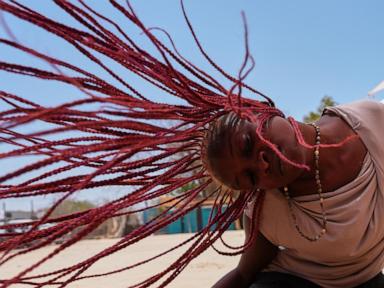
Stop looking for the "vibrant colors" of Senegal.
The travel industry has a voyeurism problem. Every year, Western editors dispatch photographers to Abéné or Saint-Louis with a single directive: find the brightness. They want the neon fishing boats, the painted murals of the Bassari Country, and the "erupting color" of local festivals. They treat West Africa like a giant, sun-baked Instagram backdrop, completely ignoring the gritty, industrial, and spiritual reality that actually drives these movements.
When you frame a cultural event like the Abéné Festival solely through the lens of its visual "explosion," you aren't celebrating it. You are flattening it. You are reducing centuries of Mandinka tradition, complex social hierarchies, and the brutal economics of West African tourism into a color palette.
It is time to look past the saturation slider.
The Tourism Trap of Cultural Stagnation
The "lazy consensus" among travel writers is that these festivals are a pure expression of local joy. That is a fantasy designed to sell plane tickets. In reality, many of these "organic" eruptions of color are increasingly curated for the white gaze.
I have seen this play out from the Casamance to the coast of Ghana. When a village realizes that Europeans only take photos of the "traditional" dancers and not the kids wearing Messi jerseys and listening to French drill music, they lean into the performance. They preserve a version of themselves that no longer exists in daily life just to satisfy a tourist's need for "authenticity."
This creates a museum effect. It freezes a living, breathing culture in a state of perpetual "tradition." If the art doesn't look like what a traveler saw in a glossy magazine, they call it "diluted" or "modernized" with a sneer. But culture that doesn't evolve is a corpse. By demanding the "vibrant" and the "unchanged," we are effectively asking these communities to stop progressing so our vacation photos look better.
The Economics of the Spectacle
Let’s talk about the money. The narrative suggests these festivals are "community-led" triumphs. While the spirit is local, the infrastructure is often a precarious balancing act of NGO funding and foreign "cultural preservation" grants.
- The Grant Cycle: Many festivals are beholden to European cultural institutes. To keep the funding, they must emphasize certain aesthetic markers that align with Western ideas of "African Art."
- The Leakage Effect: For every dollar spent on a "sun-baked" festival, a significant portion leaks back out of the country via foreign-owned airlines, booking platforms, and high-end eco-lodges that the locals can't afford to enter.
- The Gig Economy of Tradition: Performers often earn more in one week of "performing color" for foreigners than they do in three months of local labor. This creates a brain drain where the best artists stop innovating for their peers and start catering to what sells at the boutique hotels.
If you want to support Senegalese art, stop looking for the festival. Start looking for the industrial design in Dakar or the digital artists in Thiès who are using 3D modeling to redefine African futurism. They don't wear "vibrant" robes, and they don't care about your aesthetic.
Why "Vibrant" is a Coded Insult
In the world of art criticism, "vibrant" is the word you use when you don’t understand the technique. It is a patronizing shortcut. It suggests that the beauty of a Senegalese festival is accidental—a byproduct of "natural rhythm" and "innate soul" rather than rigorous practice, mathematical drumming patterns, and complex choreography.
Take the djembe and sabar drumming found at these gatherings. To the untrained ear (and the average travel blogger), it’s just a "wall of sound." In reality, it is a sophisticated language. The rhythms are based on specific proverbs and historical lineages.
When we focus on the "color" of the event, we ignore the intellect behind it. We treat the participants like birds with bright plumage rather than masters of their craft. It is a subtle form of dehumanization masked as a compliment.
The Brutal Truth of the "Sun-Baked Village"
The phrase "sun-baked village" is a romanticization of rural poverty. Writers love the grit of a dirt road because it feels "real." To the people living there, that dust is a logistical nightmare. It represents a lack of infrastructure, limited healthcare access, and the crushing weight of the Sahara's desertification.
The "vibrant colors" of the festival are often a mask for the environmental reality of the region. Senegal is on the front lines of climate change. The "color" is frequently synthetic—cheap plastic imports that have replaced organic dyes because they are the only things the local economy can sustain.
If you are going to write about the festival, write about the plastic. Write about the salt-water intrusion killing the mangroves in the Casamance. Write about why the youth are leaving these "vibrant" villages for the treacherous sea route to Spain. To mention the beauty without the struggle is not journalism; it’s a brochure.
How to Actually Engage with West African Culture
If you want to move beyond the superficial "eruption of color," you have to change your entire approach to travel and consumption.
- Follow the Intellectual, Not the Visual: Read the works of Senegalese philosopher Souleymane Bachir Diagne. Understand the concept of "The African Renaissance." If you don't know the politics, you don't see the art.
- Ignore the "Main Stages": The real innovation in Senegalese culture isn't happening on the government-sanctioned festival stages. It’s happening in the side alleys where kids are mixing traditional Mbalax with trap music on cracked laptops.
- Accept the "Ugly": A concrete building with rebar sticking out of the top is just as "African" as a mud-brick hut with a thatched roof. If you find yourself disappointed that a village looks "too modern," you are the problem.
- Pay for Insight, Not Just Access: Don't just tip a dancer. Hire a local historian or a musicologist to explain the specific griot lineage of the performance. Turn your voyeurism into an education.
The High Cost of the "Experience"
The contrarian take here isn't that the festivals are bad. It’s that our consumption of them is toxic. We seek "experiences" that make us feel something, but we rarely care if our presence contributes to the erosion of the very thing we admire.
Every time a major publication runs a "hidden gem" or "vibrant festival" piece, they trigger a wave of extractive tourism. Prices for locals go up. The "authentic" performances get shorter and more frequent to accommodate tour bus schedules. The soul of the event is traded for a higher volume of spectators.
I've seen villages in the Casamance that were once centers of deep spiritual ritual turn into "cultural centers" where the sacred is sold for twenty Euros a head. It’s a tragedy dressed in bright fabric.
Stop Trying to "Find Yourself" in Senegal
Senegal doesn't exist to be your spiritual awakening. The Abéné Festival isn't a "celebration of life" designed to cure your Western burnout. It is a complex, local social mechanism used for conflict resolution, rite of passage, and community bonding.
When you show up looking for the "energy" and the "color," you are taking up space in a conversation you don't understand.
The next time you see an article praising the "sun-baked" beauty of a foreign land, ask yourself what they aren't showing you. Ask why the author needs the subjects to be "vibrant" instead of "powerful," "complex," or even "angry."
Africa is not a color palette. It is a powerhouse of intellect and grit that is succeeding despite our obsession with its aesthetic.
If you can't handle the gray, the dust, and the data, you don't deserve the color.