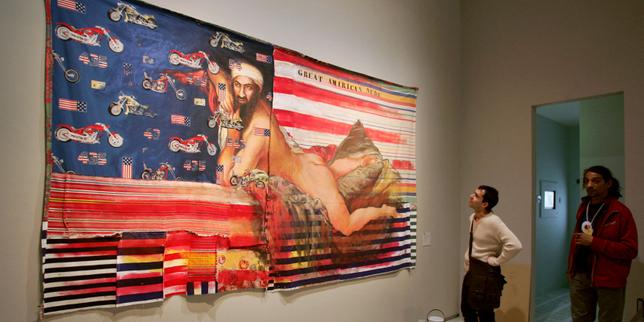
Twenty-five years after the collapse of the World Trade Center towers, the cultural residue left by September 11 has transitioned from immediate trauma response to historical taxonomy. When a cataclysmic structural failure occurs on live global television, the velocity of documentation instantly exceeds the human cognitive capacity to process it. Society turns to its visual creators—painters, sculptors, installation architects, and conceptual photographers—not to record the event, but to deconstruct its semiotic collapse. Traditional journalism captures the objective perimeter of disaster, while contemporary visual artists operate within the subjective interior, mapping how a society reorganizes its symbolic lexicon following systemic shock.
Understanding this trajectory requires examining how visual culture operates as a stress-test for civic memory. The initial weeks following 2001 generated an immediate, reflexive aesthetic paralysis. Galleries and museums faced a fundamental operational crisis: how to exhibit or create objects in a public sphere saturated with hyper-real trauma. When the primary visual text is an airliner striking a skyscraper, any subsequent artistic output risks redundancy or trivialization.
The Three Phases of Post-Disaster Artistic Production
The quarter-century timeline splits into distinct operational phases, each governed by different psychological mechanisms and societal demands.
The first phase spans the immediate aftermath, lasting roughly from late 2001 through 2005. During this window, artistic engagement was overwhelmingly reactive, characterized by grief-work, monument proposals, and archival collection. Creators acted as forensic archivists, gathering ephemera, missing posters, and ash. The focus centered on physical absence. The absence of mass volume, the absence of human bodies, and the physical voids left in the lower Manhattan skyline. Works from this era frequently utilized minimalist methodologies because any baroque or decorative addition felt morally indefensible. The conceptual framework was simple: preserve the immediate witness state before institutional narratives hardened.
The second phase, extending from roughly 2006 to 2015, marked the pivot toward institutional critique and geopolitical analysis. As the initial grief gave way to systemic policy shifts—the establishment of the Department of Homeland Security, the Patriot Act, and overseas military campaigns—visual artists shifted their lens from the local footprint to the infrastructural superstructure. Sculptors and conceptual artists began interrogating surveillance architecture, airport security checkpoints, and the invisible borders defining the post-9/11 security state. The art stopped looking at the dust of the towers and started looking at the invisible walls constructed to prevent a recurrence.
The third phase, covering the decade leading up to the twenty-fifth anniversary, operates through temporal distancing and speculative archivism. Current practitioners treat the event less as a specific historical date and more as a foundational stressor that permanently reconfigured late-capitalist visual infrastructure. The art produced today examines the digitization of memory, the archival decay of early internet reactions, and the ways algorithmic feeds handle collective trauma.
The Economics and Semiotics of Absence
To evaluate how visual artists engaged with the event, one must analyze the tension between monumentalism and ephemeral installation. Traditional memorials rely on permanence—bronze, granite, and immutable geometry intended to outlast generations. Conversely, the immediate artistic response to September 11 frequently embraced ephemerality.
Consider the Tribute in Light installation, which projected two vertical columns of high-intensity searchlights into the night sky from the footprint of the towers. This intervention bypassed traditional sculptural permanence entirely. It functioned through luminous subtraction. By rendering the missing mass visible via projected photons, the work avoided the trap of fascist monumentalism. It did not declare victory or mourn permanently in stone; it occupied space temporarily, acknowledging that the void could not be filled, only illuminated.
This operational choice reflects a broader shift in late-modern visual strategy. When physical structures built to project financial and industrial dominance are pulverized into dust, building a heavy, permanent replacement is semiotically contradictory. Artists recognized that the appropriate response to the erasure of monumental architecture was a counter-aesthetic built on transience, fragility, and transparency.
The Institutionalization of Trauma
As public funding and museum curation absorbed these works, a distinct friction emerged between independent artistic critique and institutional commemoration. Museums are risk-averse entities designed to preserve cultural consensus. When contemporary creators attempted to critique the political mobilization of the attacks—such as the rapid deployment of nationalist iconography or the erosion of civil liberties—they frequently encountered institutional friction.
The mechanism of censorship in the post-9/11 art world rarely took the form of direct state prohibition. Instead, it operated through curation inertia and market reluctance. Collectors and institutions favored works that offered emotional catharsis over structural interrogation. Consequently, a vast ecosystem of radical, critical art regarding the security state found its home outside traditional commercial galleries, moving into independent project spaces, digital platforms, and guerrilla interventions.
This divergence created two parallel tracks in the visual arts. The first track supplied the official, sanitized aesthetic of remembrance—safe, emotionally resonant, and aligned with civic mourning rituals. The second track pursued the harder, more adversarial work of examining how the event altered state power, media saturation, and public paranoia.
The Digital Archive as Medium
In the twenty-five years since the event, the primary medium of transmission has shifted from physical canvas and gallery sculpture to digital data streams. The initial shock of 2001 occurred at the precise inflection point between analog broadcast television and the consumer internet. Millions of citizens recorded the falling towers on early digital cameras and home video formats, creating a decentralized, chaotic archive.
Contemporary artists working with this material do not paint the event; they re-stitch the archive. They isolate single frames from news broadcasts, subject them to digital compression analysis, or compile user-uploaded footage into hyper-dense montages. This methodology treats the internet itself as a massive, unstable sculptural material. By exposing the degradation of digital files over time, these works mirror the decay of collective memory. They demonstrate how historical trauma is digitized, compressed, commodified, and eventually buried beneath successive layers of online content.
Strategic Assessment for Cultural Preservation
The twenty-five-year marker provides sufficient temporal distance to evaluate which artistic interventions succeeded in altering cultural understanding and which merely exploited the emotional resonance of the date.
Artistic practices that relied purely on shock value or literal representation of destruction have largely faded from relevance, proving incapable of sustaining critical engagement. Conversely, works that isolated systemic shifts—such as the normalization of constant surveillance, the militarization of public space, and the transformation of the news cycle into an engine of continuous anxiety—have retained their analytical power.
Future cultural institutions examining this era must shift away from treating September 11 as an isolated historical anomaly. The visual evidence compiled by contemporary artists over the past quarter-century indicates that the event served as a structural catalyst. It accelerated trends in media saturation, state control, and spatial anxiety that continue to define contemporary life. The ultimate legacy of these artists is not that they helped society heal through expression, but that they forced an unflinching look at the machinery of modern vulnerability.