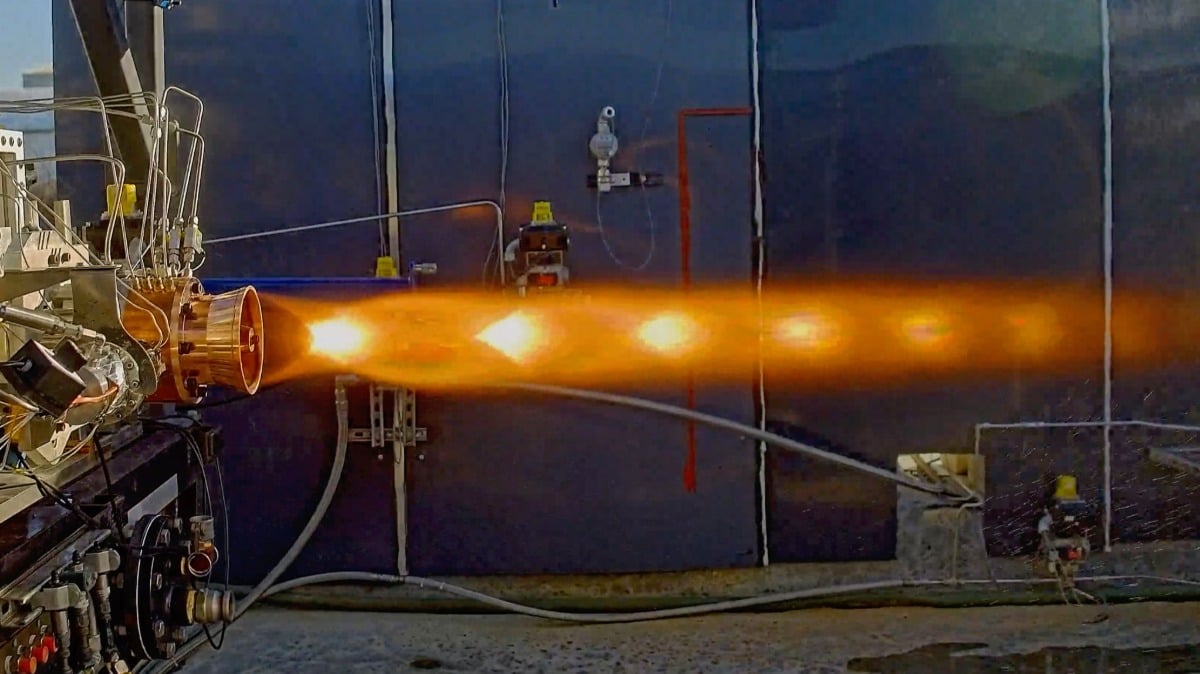
The United States Air Force is once again hunting for a holy grail that does not exist.
The latest obsession coming out of Wright-Patterson Air Force Base and defense tech startups is the dream of a hybrid engine. They want a single propulsion system that breathes air like a jet at low altitudes, transitions to a rocket at high speeds, and flies all the way to orbit or across continents in minutes.
It sounds brilliant on a PowerPoint slide. It makes for fantastic congressional testimony.
It is also a thermodynamic nightmare that ignores the most basic laws of aerospace engineering.
For decades, the defense-industrial complex has poured billions into Rocket-Based Combined Cycle (RBCC) and Turbine-Based Combined Cycle (TBCC) concepts. Every single time, these programs hit the same brick wall of physics. Yet, like clockwork, a new generation of procurement officers and venture-backed founders arrives to claim that this time, with better simulation software and additive manufacturing, they will make the "jet-rocket" fly.
They won't. The pursuit of a rocket that flies like a jet is a structural and thermodynamic trap. Here is the unvarnished reality of why this engineering fantasy continues to burn capital while delivering absolutely nothing to the runway.
The Tyranny of the Dead Weight Penalty
To understand why hybrid engines fail, you must first understand the brutal math of the rocket equation.
The Tsiolkovsky rocket equation dictates that a vehicle's change in velocity is directly proportional to the exhaust velocity of its propellant and the natural logarithm of its mass ratio:
$$\Delta v = I_{sp} g_0 \ln \left( \frac{m_0}{m_f} \right)$$
In this equation, $m_0$ is the initial wet mass (including propellant) and $m_f$ is the final dry mass (the structural weight of the vehicle, engines, and payload). To get to space, or even to sustain high hypersonic flight, your dry mass $m_f$ must be as small as humanly possible.
This is where the hybrid engine concept implodes.
A jet engine requires massive compressors, heavy rotating turbines, complex air intakes, and variable-geometry inlets to operate in the atmosphere. A rocket engine, by contrast, requires none of this. It is essentially a high-pressure combustion chamber and a nozzle. Rockets are incredibly light for the thrust they produce; they have thrust-to-weight ratios often exceeding 100:1. Jets struggle to exceed 10:1.
When you build an engine that attempts to do both, you commit the ultimate weight sin.
During the rocket phase of flight, when the vehicle is screaming through the upper atmosphere and into space, you are forced to carry thousands of pounds of dead jet machinery—turbines, compressors, and pre-coolers—that are completely useless in a vacuum. You are burning precious rocket propellant just to accelerate heavy, idle jet parts.
Conversely, during the jet phase, you are carrying massive rocket thrust chambers and heavy, empty oxidizer tanks through the dense lower atmosphere, fighting aerodynamic drag every foot of the way.
Instead of getting the best of both worlds, you get the worst: an underpowered jet carrying a rocket, and an overweight rocket carrying a jet.
The Thermodynamic Nightmare of Pre-Cooling
The current darling of the hybrid engine crowd is the pre-cooled air-breathing rocket. The premise is simple: as air enters an engine intake at Mach 5, aerodynamic compression heats it to over 1,000°C. This air is too hot to compress or burn safely without melting the engine.
To solve this, developers use a heat exchanger (a pre-cooler) to plunge the air temperature from 1,000°C to sub-zero temperatures in milliseconds before it enters the engine.
On paper, this keeps the machinery from melting. In practice, you have just engineered the world's most fragile radiator and placed it in the path of a supersonic hurricane.
I have seen engineering teams spend years trying to manufacture these micro-tubing heat exchangers. To cool the air fast enough, the tubes must have walls thinner than a human hair. They must carry cryogenic helium or liquid hydrogen at extreme pressures.
Consider what happens when a vehicle flying through the actual atmosphere—not a pristine vacuum chamber—passes through a cloud, high-altitude moisture, or dust. The moment water vapor hits a pre-cooler operating at sub-zero temperatures at Mach 5, you get instantaneous icing. The micro-tubes block, airflow chokes, the thermal balance goes haywire, and the engine suffers a catastrophic unstart or explodes.
Even if you solve the icing problem with chemical sprays or complex purging cycles, the structural weight of these heat exchangers ruins the vehicle's mass fraction. You have added hundreds of kilograms of high-pressure plumbing, valves, and cryogenic fluids to a vehicle that needs to be as light as a soda can to reach its target.
The Historical Graveyard of the Air-Breathing Rocket
The aerospace industry has a short memory. We have walked down this path before, spent the money, and buried the projects.
- The National Aero-Space Plane (NASP / X-30): In the 1980s and early 90s, the U.S. government spent billions trying to build a single-stage-to-orbit spaceplane using scramjets and rocket hybrids. It was canceled after engineers realized that the drag of flying through the atmosphere long enough to breathe oxygen outweighed the benefit of not carrying oxidizer from the ground.
- Reaction Engines' SABRE: The British company Reaction Engines spent decades developing the Synergetic Air-Breathing Rocket Engine (SABRE), utilizing highly touted pre-cooler technology. Despite hundreds of millions of dollars in backing from defense giants and governments, the project crashed into reality. The system was too complex, the weight penalties too severe, and the market utility too narrow. The company ultimately slipped into administration because the physics simply did not close commercially.
We are repeating these exact mistakes today. Startups promise that advanced 3D printing and silicon carbide composites will succeed where the X-30 and SABRE failed. But new materials do not change the fundamental thermodynamic limits of gas turbine cycles or the brutal reality of supersonic drag.
The Real-World Alternative: Staging is a Feature, Not a Bug
Why are we so obsessed with making a single vehicle do everything?
The desire for a rocket that flies like a jet stems from a deeply flawed operational premise: that staging is inherently inefficient and that "single-stage" operations will make flight as cheap and routine as commercial aviation.
This is a fundamental misunderstanding of physics. Staging is not an engineering failure; it is a elegant solution to the rocket equation.
By dropping empty fuel tanks and heavy engines as you climb, you constantly optimize your mass ratio. Trying to build a single vehicle that takes off from a runway, flies through the atmosphere, enters space, and returns to land on that same runway is fighting the universe.
If the Air Force wants rapid, global, high-speed response, the solution is not a fragile, hyper-complex hybrid engine. The solution is simple, mass-produced, multi-stage liquid rockets combined with rapidly reusable boosters.
| Propulsion Approach | Technical Complexity | Dry Mass Fraction | Operational Risk |
|---|---|---|---|
| Hybrid Jet-Rocket (TBCC/RBCC) | Extreme (Variable inlets, pre-coolers, dual fuel systems) | Very High (Dead weight carried to high altitudes) | High (Choking, unstarts, thermal barrier limits) |
| Two-Stage Rocket (Rapidly Reusable) | Low to Moderate (Standard liquid/gas cycles, staging) | Low (Dead weight is discarded or landed immediately) | Low to Moderate (Proven aerodynamics, zero atmospheric transition risk) |
To put it bluntly: a two-stage rocket system where the first stage is flying back to land while the second stage delivers the payload is vastly more efficient, cheaper to build, and aerodynamically sound than a single-stage vehicle carrying an entire jet engine to orbit.
Dismantling the Defense Procurement Myth
Why does the military continue to fund these dead-end concepts?
Because defense procurement is driven by "capability requirements" rather than physical feasibility. A program officer writes down a requirement: "We need a vehicle that can take off from a standard 10,000-foot runway, cruise at Mach 6, enter low Earth orbit, deploy a payload, and land back at the original base."
Once that requirement is codified, contractors line up to build it. They don't tell the customer that the physics are a disaster. Instead, they accept the research grants, build beautiful computer models, run sub-scale component tests in clean-air wind tunnels, and collect their fees.
When the program inevitably runs over budget and behind schedule because the full-scale engine cannot handle the heat or weighs twice its target limit, the project is quietly rebranded, scaled back, or canceled. A few years later, the cycle repeats under a different acronym.
Stop trying to force rockets to be jets. They are fundamentally different machines designed for entirely different environments. A jet thrives in the thick, oxygen-rich lower atmosphere by processing massive volumes of air at low pressures. A rocket thrives by discarding the atmosphere entirely, burning high-pressure propellants in a vacuum.
Attempting to fuse them into a single propulsion unit is an engineering trap that yields an aircraft too heavy to fly efficiently and a rocket too heavy to reach space. We must abandon this thermodynamic delusion, accept the physical reality of staging, and build simpler, specialized systems that actually work.