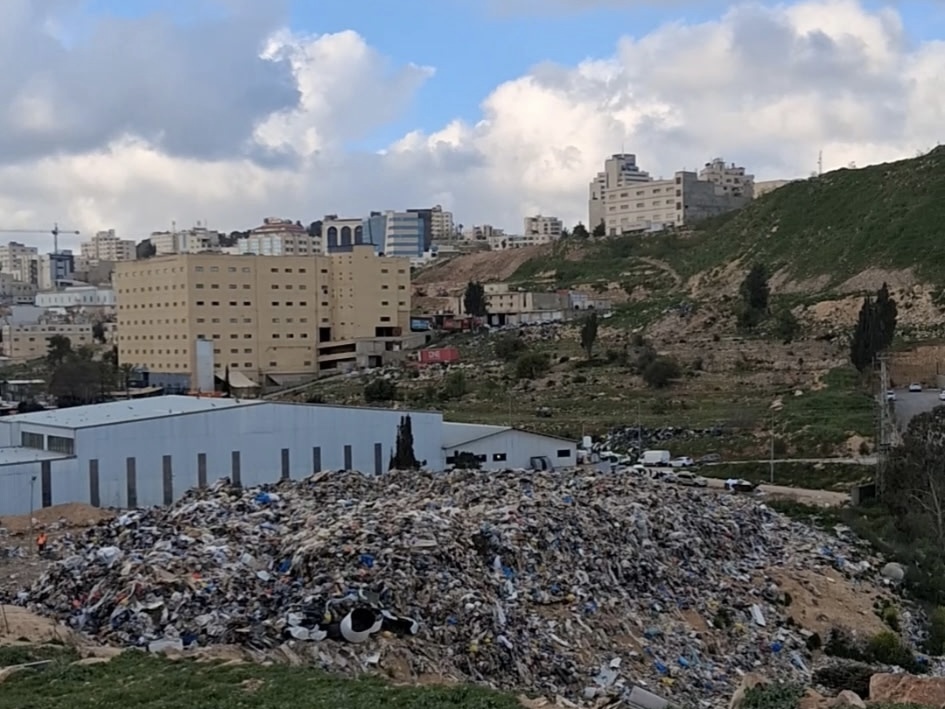
The heat in Hebron does not just sit on your skin. It heavy-logs the lungs, thick with the scent of sun-baked plastic, rotting citrus, and the sharp, metallic tang of uncollected refuse. In the West Bank, trash is not something you throw away. Away does not exist. Every plastic bottle, every discarded aluminum can, and every shredded tire is trapped in a geographic vice, a claustrophobic reality dictated by lines drawn on maps and soldiers at checkpoints.
Consider a man named Tariq. He is a hypothetical composite of the dozens of Palestinians currently watching their backyards turn into open-air dumps, but his daily choices are entirely real. Tariq wakes up at dawn, not to the sound of birds, but to the low hum of flies settling over a mound of waste just thirty yards from his kitchen window. For years, his municipality sent trucks to haul this stuff to central landfills. Now, those trucks sit idle, their routes severed by sudden road closures, permits denied by Israeli authorities, and the complex geometry of Area C—the 60 percent of the West Bank under full Israeli administrative and security control.
When a community is denied the right to manage its own filth, waste ceases to be an inconvenience. It becomes an existential threat.
The Geography of Suffocation
To understand why the West Bank is drowning in its own discarded remnants, one must look at the soil beneath Tariq’s feet. Under the Oslo Accords, the West Bank was carved into a jigsaw puzzle of jurisdictions. Palestinians hold varying degrees of civil control in Areas A and B, but these are isolated islands in a sea of Area C, where Israel retains veto power over virtually all infrastructure.
Building a modern, sanitary landfill requires space, environmental planning, and, crucially, access to Area C. When the Palestinian Authority attempts to develop waste management facilities, they face an administrative wall. Permit applications languish for years, often ending in outright rejections. Meanwhile, the existing landfills, like the one at Al-Minya, are pushed far past their engineered capacities.
The math of a trash crisis is brutal and simple. The West Bank produces roughly 3,900 tons of municipal solid waste every single day. When the roads to official dump sites are blocked by military checkpoints or sudden blockades, that waste has nowhere to go. It piles up in village squares. It spills into olive groves.
But the crisis is not symmetrical. While Palestinian trucks are turned back, illegal Israeli dumpsites operate within the same territory, frequently absorbing hazardous electronic and industrial waste trucked in from inside Israel. It is a system of environmental displacement, where the land is shared but the burden of its degradation is sharply divided.
The Chemistry of Backyard Pyres
Left with no structural alternatives, communities face a terrifying choice: live with the rot, or burn it.
Tariq knows the consequences of the match. He has watched his neighbor’s daughter develop a persistent, raspy cough that never truly leaves her, a symptom shared by dozens of children in the village. When you ignite a pile of mixed municipal waste, you are not just destroying trash; you are creating a toxic cloud. Plastics release dioxins and furans, chemical compounds that hitch a ride on the wind, settle into the soil, and seep into the shallow aquifers supplying the village wells.
The air turns a greasy, yellow-gray. The smoke sticks to clothes, seasons the food, and embeds itself in the lungs of anyone breathing within a five-mile radius. It is a slow, invisible poisoning.
The true horror of this reality is its predictability. It is a manufactured disaster. When a modern society is stripped of the dull, bureaucratic mechanisms of waste disposal—the weekly garbage truck, the regional recycling plant, the regulated landfill—it reverts to survival tactics that actively destroy its own future.
Yet, humans are stubborn creatures. When you deny them a system, they build a counter-system out of the very debris meant to bury them.
The Plastic Alchemists
In the heart of this constriction, a quiet rebellion has taken root. It does not look like a protest. It looks like a workshop filled with the deafening roar of a makeshift shredder.
Since the formal channels of recycling are largely blocked by restrictions on importing machinery and exporting raw materials, Palestinian innovators have turned to grassroots engineering. Small-scale initiatives are popping up across Bethlehem and Ramallah, driven by necessity and a refusal to let the land die.
Imagine taking the very plastic bottles that choke the local valleys and transforming them into building blocks. This is no longer a metaphor. Local engineers have begun collected high-density polyethylene (HDPE) containers—the heavy plastic used for shampoo and detergent—and crushing them into dense flakes. These flakes are melted down and compressed, not into cheap trinkets, but into durable pavers, tiles, and even filament for 3D printers.
[Raw Plastic Waste] -> [Manual Sorting] -> [Grassroots Shredding] -> [Thermal Compression] -> [Building Materials]
This is not the sanitized, corporate recycling seen in Western metropolises, where citizens sort their bins with the vague hope that someone, somewhere, handles the rest. This is survival recycling. It is a frantic, hands-on effort to intercept the poison before it hits the flame.
But the scale of the solution remains dwarfed by the scale of the restriction. A single workshop can process a few hundred pounds of plastic a week. The West Bank produces thousands of tons. To scale up requires industrial equipment—extruders, large-scale sorters, specialized shredders—the very items that routinely get flagged by authorities as "dual-use" goods, blocked at ports of entry under the guise of security concerns.
The Intimate Stakes of the Soil
The tragedy of the Palestinian trash crisis is that it forces a deeply agrarian culture into a toxic relationship with its own landscape. For centuries, the relationship with the soil was defined by the olive harvest, by the ancient stone terraces that climb the hillsides of Samaria and Judea. The land was an heirloom.
Now, an olive tree that has stood for three hundred years might have its roots wrapped around a degraded plastic bag.
This creates a profound psychological rupture. When Tariq walks through his family’s grove and finds the soil littered with wind-blown debris from an unregulated dump site up the hill, it feels like a erasure of identity. The occupation is not just an abstract political reality or a soldier at a gate; it is the physical degradation of the earth his grandfather tilled.
The doubts creep in during the quiet hours. Is the oil from these olives safe? Will the water from the spring eventually turn against the people who rely on it? There are no easy answers because the systematic monitoring of environmental health in the West Bank is fragmented, underfunded, and actively obstructed.
Beyond the Waste Margin
What happens when a population runs out of room to hide its waste? The crisis breaks past its geographic boundaries. Environmental degradation does not respect checkpoints. The burning plastic in a West Bank village carries its toxins into the shared air shed, drifting over Israeli settlements and into Israeli cities along the coast. The contaminated runoff from illegal dumpsites flows downhill, filtering into the shared mountain aquifer that both Israelis and Palestinians rely on for drinking water.
The current policy of containment and restriction is an illusion. It treats waste management as a political leverage point rather than a fundamental human right and a ecological necessity. By choking the infrastructure needed to handle the refuse of millions of people, a shared ecosystem is systematically dismantled.
Tariq stands at the edge of his property as the sun dips below the horizon, casting long, dramatic shadows across the valley. The air is temporarily clear, a brief respite before the evening fires begin elsewhere. He holds a small, dense tile in his hand—smooth, gray, and heavy. It was made from fifty discarded water bottles collected from the roadside by a local youth cooperative. It is a tiny victory against a mountain of neglect.
He places the tile on his windowsill, right next to a small pot of mint. It is a reminder that even when you are buried under the weight of someone else’s restrictions, the instinct to clean, to rebuild, and to survive remains entirely uncontainable.


