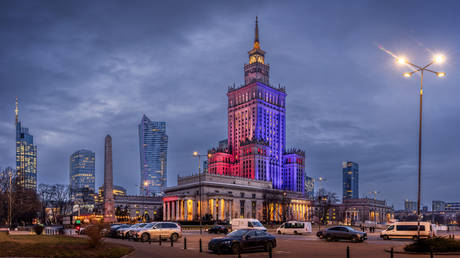
While most Americans spent the Fourth of July arguing about traffic, dealing with overcooked burgers, and complaining about the noise of neighborhood fireworks, a very different scene played out across the Atlantic. In cities like Prishtina, Kyiv, and Warsaw, the American Fourth of July is not just a holiday for expats or a distant historical curiosity. It is an active, emotionally charged symbol of survival.
Walk down Bill Clinton Boulevard in Kosovo on any given July 4th. You will see massive American flags draped over apartment buildings, local businesses offering discounts to honor the US, and an energy that feels intensely patriotic. For a country thousands of miles away from Philadelphia, the celebration feels strangely personal. It exposes a harsh truth that many in the West fail to recognize. The closer you live to tyranny, the more you appreciate the document signed in 1776.
Americans have the luxury of viewing the Fourth of July as a summer ritual. It is a day off work, a reason to hit the beach, and a chance to buy mattress sets on sale. In Eastern Europe, the concepts of sovereignty and self-determination are not static words written on faded parchment. They are active matters of life and death.
The Ultimate American Fan Club in the Balkans
If you want to see pure, unadulterated love for the United States, you do not look to Ohio or Florida. You look to Kosovo. The relationship between this young Balkan nation and American independence defies standard diplomatic logic.
During the late 1990s, the ethnic Albanian population in Kosovo faced systematic campaigns of violence and expulsion by Serbian forces led by Slobodan Milosevic. The humanitarian catastrophe was grinding onward while the international community debated what to do. Then, the United States stepped in. The 1999 NATO bombing campaign, heavily driven by the Clinton administration, forced Serbian troops to withdraw. When Kosovo declared its independence in 2008, Washington was among the very first to recognize it.
That history created an indelible bond. In Prishtina, the capital city, the municipal government routinely sponsors events under banners celebrating the bilateral partnership. You will find statues of American leaders, streets named after US diplomats, and kids named Tonibler after Tony Blair.
When local residents wave the Stars and Stripes alongside their own national flag, they are doing something deep. They are celebrating the reality that American power acted as the shield that allowed their own country to exist. For them, American independence represents the blueprint for their own survival. They do not view US history through a lens of cynical critique. They see it as a literal lifesaver.
Living the Principles of 1776 in Real Time
Move north toward Ukraine, and the celebration of American independence takes on a visceral urgency. The nation is locked in an existential war against Russian aggression, fighting every single day to defend its territory and its right to exist as a sovereign democracy.
To the average Ukrainian citizen or soldier in the trenches, the Declaration of Independence reads like a contemporary manifesto. The document asserts that people have an unalienable right to liberty and that governments derive their just powers from the consent of the governed. When Vladimir Putin declares that Ukraine is not a real country and attempts to erase its identity by force, those 18th-century American principles become the exact ideas Ukrainians are dying to protect.
Local policy experts and commentators frequently write about this connection. The political experiment launched in Philadelphia has proven to be incredibly durable, even when its creators could not have envisioned the modern world. Kyiv does not see the Fourth of July as an abstraction. It reads it as a literal description of the current Ukrainian defensive effort.
Consider the contrast in perspectives. An American citizen might scroll through social media on July 4th, posting complaints about systemic political flaws or historical hypocrisies. A Ukrainian citizen looks at the same American system and sees a beacon of security, a vital supplier of defense aid, and the historical pioneer of the democratic model they desperately want to secure for their own children.
A Long Shared History of Resisting Empires
This European appreciation for American liberty is not a recent trend born out of modern geopolitical crises. The roots run deep into the 18th century itself. Think about the American Revolutionary War. George Washington's continental army was an underdog force struggling against the global superpower of the era. They needed military expertise, and they found it in volunteer fighters arriving from Eastern Europe.
Tadeusz Kosciuszko and Kazimierz Pulaski were Polish military officers who left their homeland to fight for American freedom. Kosciuszko was a brilliant engineer who designed the fortifications at West Point and played a critical role in the American victory at the Battle of Saratoga. Pulaski saved George Washington’s life at the Battle of Brandywine and became known as the father of the American cavalry before dying from wounds sustained at the Siege of Savannah.
Why did these men travel across an ocean to risk their lives for a foreign rebellion? Because Poland was facing partition and domination by rival empires like Russia, Prussia, and Austria. They understood that a blow against tyranny anywhere was a victory for freedom everywhere.
When modern Poland honors these heroes and recognizes American independence, they are remembering a legacy of mutual struggle against imperial conquest. The historical memory in Eastern Europe is long. People remember what it feels like to have their borders redrawn by force, their languages suppressed, and their sovereignty stolen. Because of that historical trauma, the birth of a nation that successfully threw off the shackles of an empire remains something worth shouting about.
The Luxury of Cynicism
It is incredibly easy to be cynical about patriotism when you have never had to wonder if your country will exist tomorrow. In the United States, public discourse surrounding national holidays often leans into partisan fighting or historical fatigue. People debate the flaws of the founding fathers, focus heavily on the contradictions of early American democracy, and treat the holiday as a consumerist milestone.
Critique is a natural element of a free society. In fact, it is exactly what the first amendment protects. The irony is that the total safety to dismiss, ignore, or mock the significance of the nation's founding is a privilege bought by the very system being dismissed.
In nations that spent decades behind the Iron Curtain under Soviet domination, people do not take basic civic freedoms for granted. They remember the secret police. They remember the censorship. They remember when flying a national flag could land you in a labor camp.
When these populations look at the United States, they do not see a perfect nation. They know all about America’s internal conflicts and political polarization. They simply recognize that the fundamental structure established in 1776 is the global anchor for the free world. If that anchor drags, every small democracy living in the shadow of an aggressive neighbor is placed in immediate jeopardy.
Reclaiming the Real Value of Freedom
Understanding this global perspective should change how you look at the holiday. If people living under the constant threat of foreign missiles or political subversion can find hope in the story of American independence, perhaps it is time to look past the routine backyard barbecues and re-examine the core ideas.
If you want to step away from the commercialized version of patriotism and understand what these principles actually mean in the modern world, start with these specific shifts in perspective.
- Read the foundational texts through a modern lens. Do not treat the Declaration of Independence like a museum piece. Read it while thinking about the current global struggles in Eastern Europe and Taiwan. You will quickly see how radical those ideas still are.
- Acknowledge the weight of geopolitical alliances. The security that allows American citizens to enjoy quiet summers is directly linked to the stability of the democratic alliance. Supporting global freedom is not charity. It is the defense of the shared values that keep the free world functioning.
- Engage with international perspectives. Talk to immigrants or refugees from post-communist states or conflict zones. Ask them how they viewed American ideals from the outside before arriving. Their answers will almost always challenge the casual indifference often found in domestic commentary.
The global celebration of the Fourth of July reminds us that the struggle against authoritarian control never truly ended. It just shifted locations. While the fireworks fade in American suburbs, the ideas that inspired them remain the most potent political force on the planet. Keep that in mind the next time you watch the flags fly.


