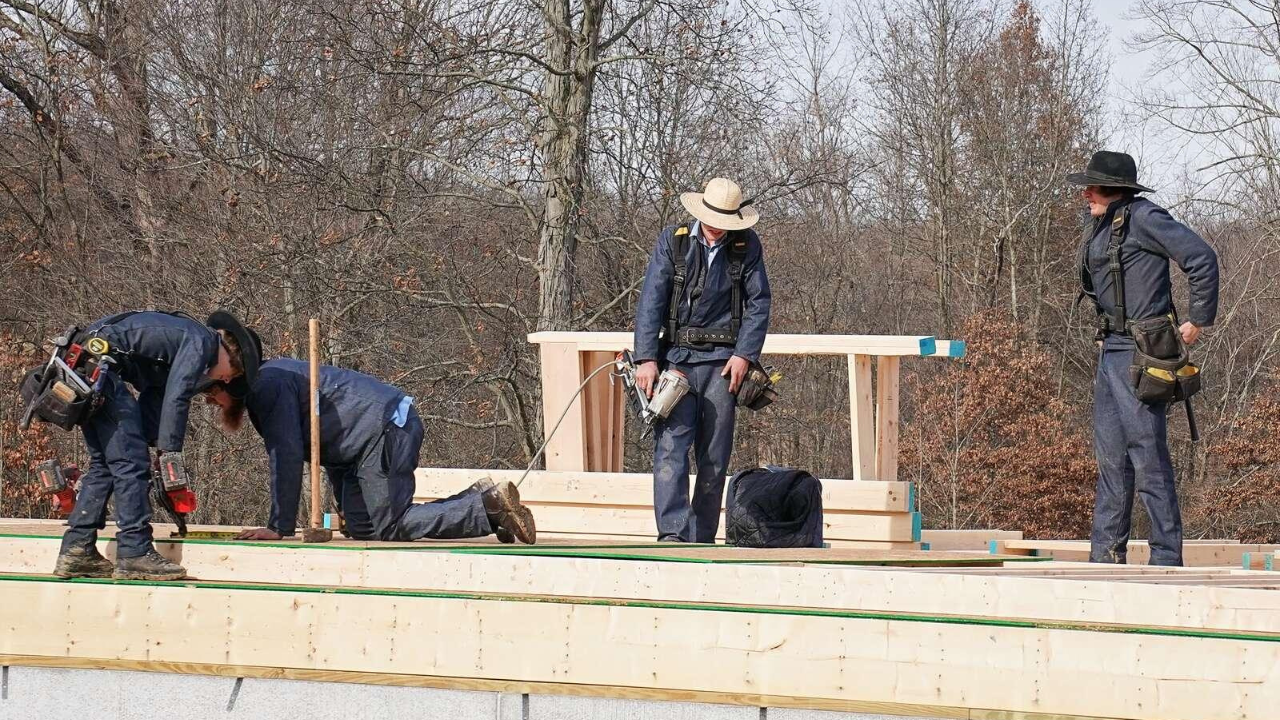
The Fetishization of the Horse and Buggy
Every time a natural disaster levels a mountain town, the media falls into a predictable, saccharine trap. They spot a beard, a straw hat, and a hand-sawn timber, and suddenly the narrative is written: "Amish Volunteers Save the Day."
The recent coverage of Hurricane Helene recovery in North Carolina is no exception. We are told stories of Amish crews rebuilding bridges and homes for free, operating with a speed and selflessness that puts "modern" society to shame. It makes for great clickbait. It feels good. It’s also a dangerous distraction from the actual mechanics of why our recovery systems are failing.
If we are relying on a subculture that rejects the power grid to fix the power grid’s mess, we aren't witnessing a heartwarming miracle. We are witnessing a systemic collapse of professional disaster management.
The Efficiency Myth of the Barn Raising
The "lazy consensus" suggests that the Amish are inherently more efficient because they lack bureaucracy. While it’s true that they don't wait for a FEMA inspector to blow a whistle, the idea that manual, non-permitted labor is a scalable solution for 21st-century infrastructure is a fantasy.
I have spent years analyzing supply chains and labor markets. When you look at the "free" labor provided by these communities, you aren't looking at a sustainable model. You are looking at a localized surge capacity that ignores the long-term liability of modern building codes.
The Amish build to their own standards. These standards are often high in terms of craftsmanship but frequently ignore the integration requirements of modern civil engineering. A bridge built by hand might look sturdy, but does it meet the hydraulic flow requirements for the next fifty-year flood? Does it have the seismic resilience required for the Appalachian fault lines?
When we celebrate the "free" bridge, we are often just deferring the cost of the professional bridge that will eventually have to replace it when the state realizes it doesn't meet safety regulations.
The Hidden Cost of Free Labor
Nothing is free. In economics, we call this the "opportunity cost." By centering the recovery narrative on volunteerism, we give a pass to the agencies that have massive budgets and even larger mandates.
- Labor Market Distortion: When a massive influx of unpaid labor enters a disaster zone, it can inadvertently suppress the local construction economy. Local contractors, who also lost their homes and need the work to stay solvent, cannot compete with "free."
- The Liability Vacuum: If a volunteer-built structure fails two years from now, who is responsible? There are no bonds, no insurance certificates, and no corporate entities to hold accountable.
- The "Hero" Excuse: Politicians love the Amish narrative because it shifts the burden of care from the state to the individual. Every photo op with a volunteer is a minute spent not answering for why the local bridge was vulnerable in the first place.
The Cult of the Low-Tech Solution
There is a weird, reactionary trend in modern commentary that suggests "going back to basics" is the answer to climate-driven disasters. It’t a romanticized lie.
The Amish aren't successful in these rebuilds because they use old tools. They are successful because they have a high-trust social architecture. That is the part we can't replicate by just buying a hammer.
The Amish can rebuild a house in days because every person on site has been trained in the same specific methodology since they were six years old. They don't need blueprints because the "blueprint" is baked into their culture. Modern American society is too fragmented, too specialized, and too diverse in its technical requirements to ever operate this way.
Stop trying to learn "simplicity" from the Amish. It’s a dead end. We need better technology, not less. We need modular, pre-fabricated infrastructure that can be dropped in by heavy-lift drones—not more guys with hand saws.
The Disaster Recovery Industrial Complex
If you want to understand why a group of volunteers can "outbuild" the government, look at the procurement process.
In a standard North Carolina recovery project, a contractor spends 30% of their time on paperwork, 20% on compliance, and 50% on actual construction. The Amish ignore the first two categories. This isn't a "superior" way of working; it's a legal loophole.
I’ve seen projects where the sheer weight of environmental impact studies prevented a bridge from being replaced for two years, even as residents were cut off from medical care. The Amish "solution" is a middle finger to that bureaucracy. But instead of just cheering for the rebellion, we should be demanding that the bureaucracy itself be dismantled for everyone else.
If it’s safe enough for the Amish to build it in a weekend, why isn't it legal for a local licensed contractor to do the same without six months of permitting?
The Resilience Paradox
We talk about the Amish being "resilient" because they can live without the internet. But true resilience in 2026 is the ability to maintain complex systems under stress.
A bridge that only carries a buggy is not a resilient bridge for a community that needs to move 40-ton fuel trucks and emergency vehicles. By focusing on these low-tech fixes, we are building a "Poverty Trap" infrastructure. We are settling for "good enough for now" and calling it a miracle.
The real tragedy of the Helene recovery isn't that the government was slow; it’s that we have reached a point where our expectations are so low that a 19th-century labor model looks like "cutting-edge" disaster relief.
Stop Thanking Volunteers and Start Demanding Engineers
The Amish are doing what their faith dictates: being good neighbors. That is commendable on a human level. But from a policy and business standpoint, it is a glaring red flag.
When you see a headline about "Unsung Heroes" rebuilding infrastructure, you should be asking:
- Where are the tax dollars meant for the North Carolina Department of Transportation?
- Why is the National Guard not deployed with rapid-response bridge kits?
- Why is our modern construction industry so strangled by litigation and regulation that it takes a religious sect to provide basic human needs?
We are treating a symptom and calling it the cure.
Volunteerism is a supplement, not a strategy. The moment we start relying on it to provide core infrastructure, we have admitted that the modern state is no longer functional.
Stop praising the beard and start questioning the ledger.
Build for the century we live in, or get out of the way of the people who actually know how to use a wrench.


