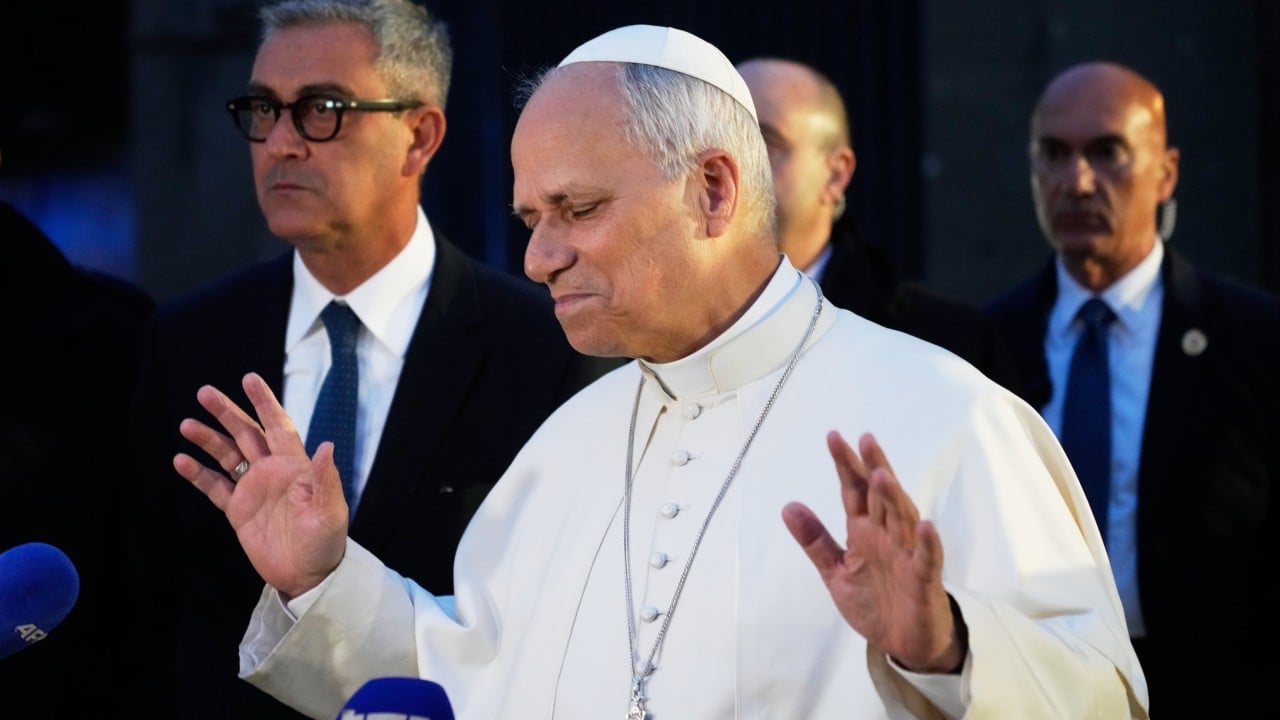
The escalation of public discord between President Donald Trump and Pope Leo XIV highlights a fundamental misalignment in the mechanics of global statecraft and spiritual morality. By characterizing the Holy See’s opposition to the U.S.-Israel war on Iran as an endorsement of Iranian nuclear capabilities, the Trump administration has inverted traditional diplomatic engagement into a public relations conflict. Secretary of State Marco Rubio’s visit to the Vatican serves as a tactical mechanism designed to de-escalate this friction without sacrificing the administration's strategic imperatives. This analysis breaks down the variables driving the dispute, the structural limitations of Rubio's mediation, and the broader implications for the U.S.-Vatican alliance.
The Structural Divergence of Statecraft and Doctrine
The tension between the White House and the Holy See operates on two distinct planes: pragmatic realpolitik and universal moral theology. These two systems of logic have entirely different objective functions.
The Objective Function of U.S. Foreign Policy Under Trump
The primary objective of the current administration's foreign policy is the containment and deterrence of adversarial regimes, particularly Iran. The operational cost function of this approach is measured in military deterrence, economic sanctions, and the preservation of U.S. and allied security architecture in the Middle East.
In this framework, any international actor or institution that criticizes military action or diplomatic isolation is perceived as a direct obstacle to U.S. strategic objectives. When the White House asserts that Pope Leo is endangering Catholics and citizens worldwide by opposing the conflict, it relies on a linear cause-and-effect argument:
- The U.S. uses military and economic pressure to prevent Iran from obtaining a nuclear weapon.
- Pope Leo publicly criticizes the use of force and calls for ceasefires.
- The White House interprets this opposition as a reduction in the deterrent credibility of the U.S.
The resulting claim that the Pope is indifferent to or supportive of Iranian nuclear ambitions is a rhetorical construct designed to align religious sentiment with the administration's defense strategy.
The Objective Function of the Holy See
Pope Leo, the first American pontiff, operates within a doctrine of universal human dignity, peace, and multilateral diplomacy. The Church’s mission, as reiterated by the Pope in response to these criticisms, is to preach peace and the Gospel. The Church evaluates the crisis through a normative framework:
- The cost of war is paid in civilian lives, humanitarian crises, and regional instability.
- The use of nuclear threats and the destruction of civilization are incompatible with Catholic social teaching.
- Dialogue and international law are the primary mechanisms for dispute resolution.
This conflict of operating models means that when the Trump administration pushes for unilateral or aggressive strategies in Iran, the Vatican's moral objection is immediate and structural. The Pope’s condemnation of the U.S. threats of mass civilian destruction is an outcome of this internal theological logic rather than an alignment with the Iranian regime.
Historical Precedents and the Iran Crisis
The current diplomatic impasse must be understood within the broader context of the U.S.-Vatican relationship. During the previous decades, various administrations have clashed with the Holy See over the use of force in the Middle East. The 2003 Iraq War, for instance, saw Pope John Paul II actively opposing the U.S. invasion. However, the current dynamic differs in several ways:
- The rhetorical intensity of the current White House has moved away from traditional deference toward a combative posture, directly calling the pontiff "weak on crime" and "terrible for foreign policy."
- As the first American pontiff, Pope Leo understands the domestic political environment of the United States better than his predecessors, making him more willing to speak out on issues affecting U.S. policies without fearing that he will be perceived as an outside, uninformed observer.
The Iran conflict presents a particularly difficult challenge. The administration’s policy of maximum pressure and targeted strikes has created a severe humanitarian crisis. The Vatican’s stance on the issue is shaped by its concern for the protection of Christian minorities in the region, who are often caught in the crossfire of such conflicts. The Pope’s opposition to the conflict is not based on an endorsement of the Iranian regime's nuclear ambitions, but on a desire to avoid an escalation that would devastate the region's Christian population.
The Rubio Diplomatic Mission: Objectives and Constraints
Secretary of State Marco Rubio's visit to the Vatican represents an effort to establish a channel of communication to manage this rift. Rubio, a practicing Catholic, brings a specific set of tools and limitations to the negotiation table.
The Objectives of the Mission
The primary goal of the Department of State's visit is to decouple the specific dispute over the Iran conflict from the broader bilateral relationship. Rubio must achieve three specific outcomes during his meetings at the Apostolic Palace:
- Reframe the narrative to shift the public conversation away from the conflict and toward mutual interests in the Western Hemisphere and the defense of persecuted Christians globally.
- Align on peripheral issues by identifying common areas of agreement on issues like religious freedom and human rights to demonstrate continuity in U.S.-Vatican relations.
- Prevent further escalation by signaling to the Vatican that the administration’s rhetoric is driven by domestic political calculations rather than a systemic rupture with the Catholic Church.
The Constraints of the State Department
Rubio operates under significant constraints. His ability to alter Trump’s public rhetoric is limited. The president's statements are directed primarily at his domestic base and are designed to frame the administration as strong on national security while positioning the papal opposition as part of the "radical left."
Furthermore, Rubio must navigate the domestic political implications within the United States. The Catholic voting bloc is highly contested ahead of the midterm congressional elections. The administration's attacks on Pope Leo are intended to appeal to certain conservative evangelical and Catholic voters who prioritize a strong foreign policy over the Pope's internationalist approach.
The Geopolitical Spillover
The friction between Washington and the Vatican has not been contained to the bilateral relationship. It has introduced instability into the relationship between the United States and its European allies, most notably Italy.
The Italian Government's Position
Italian Prime Minister Giorgia Meloni has historically aligned with the Trump administration on numerous geopolitical issues. However, the attacks on the first American Pope have forced a divergence. Prime Minister Meloni and Italian Foreign Minister Antonio Tajani have publicly defended Pope Leo.
The Italian government views the Holy See not only as a spiritual authority but as a crucial diplomatic actor in the Mediterranean and North Africa. The administration’s threats to withdraw U.S. troops from Italy in response to its lack of support for the Iran war have created a bottleneck in the security partnership.
- The cause stems from the Trump administration demanding full European alignment on its Middle East policy.
- The effect is that the Vatican and the Italian government reject the escalation of the conflict.
- The consequence is that the U.S. threatens to re-evaluate its troop presence in Europe.
This dynamic creates a multilateral coordination problem. Rubio's trip to Rome includes meetings with Meloni and Tajani to mend these ties, but doing so without yielding on the Iran strategy requires careful diplomatic balancing.
The Theological and Ideological Divide Within Conservatism
The spat has also exposed deep divisions among American conservative Catholics. Vice President JD Vance’s public remarks provide insight into this ideological fracture.
Vance has argued that the Vatican should "stick to matters of morality" and leave public policy to the administration. This perspective separates the moral foundations of state action from the practical execution of state power.
The Separation Thesis
The Vance doctrine rests on the assumption that religious and moral principles can be compartmentalized away from the realities of military strategy. This approach creates the following political mechanisms:
- The Vatican's teachings on peace and the sanctity of human life are viewed as theoretical ideals that cannot be applied to the realities of a nuclear-armed Iran.
- The elected head of state is the sole legitimate arbiter of the national interest, and the pontiff’s role is confined to spiritual administration.
The Integrationist Counter-Argument
Many Catholic intellectuals and diplomats within the administration argue against this separation. They contend that a foreign policy detached from moral considerations loses its legitimacy. The friction between Trump and Pope Leo XIV therefore reflects an internal struggle for the soul of the American conservative movement, with traditional religious principles clashing with an increasingly assertive, nationalist foreign policy.
The Domestic Political Calculus
The ongoing dispute holds substantial weight for the upcoming U.S. midterm congressional elections. The administration's focus on Pope Leo’s perceived stance on Iran is not merely an expression of foreign policy frustration; it is an electoral strategy. By positioning the Pope as an adversary of American security interests, the administration aims to consolidate the support of voters who prioritize a strong national defense.
However, this strategy carries significant risks. The Catholic electorate in the United States is not a monolith. While a segment of conservative Catholics supports the administration's foreign policy, a large proportion values the Pope's moral authority on issues like immigration, poverty, and peace. Attacking the pontiff could alienate moderate and Hispanic Catholic voters in key battleground states, particularly in the Midwest and the Sun Belt.
The Strategic Trade-Off
The administration faces a classic trade-off between mobilization and alienation:
- Mobilization energizes the base by creating a clear binary choice between American strength and perceived foreign moralism.
- Alienation separates key demographic groups, particularly Hispanic Catholics who are deeply connected to the teachings of the first American-born Pope.
Rubio’s mission to Rome is an attempt to manage this trade-off by softening the tone of the administration's message while maintaining its substance.
The Diplomatic Balancing Act in Rome
As Secretary of State Rubio prepares to meet with Pope Leo XIV at the Apostolic Palace, he must tread carefully to avoid further alienating the Holy See. The Vatican's diplomatic corps, led by Cardinal Secretary of State Pietro Parolin, has shown little inclination to back down from its stance on the Iran conflict.
Rubio will likely seek to pivot the conversation toward areas where the administration and the Holy See share common ground, such as the defense of religious minorities in China and the promotion of stability in the Western Hemisphere. The Secretary of State may also try to secure a commitment from the Vatican to engage in a quiet dialogue on the Middle East, rather than continuing the public exchange of criticisms.
However, the success of this approach is far from certain. The Pope has made it clear that he will not back down from his message of peace, stating that he has "no fear" of the administration. This presents a challenge for Rubio, who must find a way to present the administration's actions in a way that respects the Pope's moral authority while not yielding on the core strategic goals.
Strategic Action
Instruct Secretary of State Marco Rubio to avoid a public retraction regarding Pope Leo XIV, and instead anchor discussions at the Apostolic Palace on collaborative humanitarian efforts and the protection of religious minorities in China. This compartmentalizes the Iran dispute while mitigating the erosion of support among moderate Catholic voters.