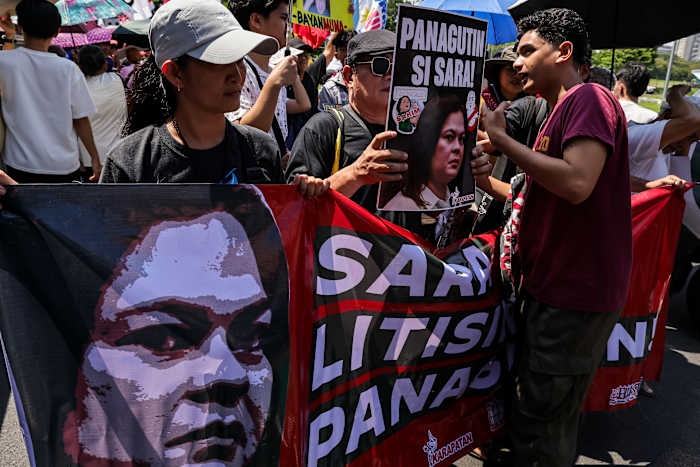
The opening of the Senate impeachment trial of Vice President Sara Duterte on July 6, 2026, marks the transition of the Philippine elite fracture from a low-intensity political conflict into a formal constitutional battleground. This proceeding is not merely a legal assessment of the structural allegations against the Vice President; it is an optimization problem for two warring political dynasties—the Marcos and Duterte factions—vying for executive dominance ahead of the 2028 presidential transition.
To evaluate the trial's trajectory, analysts must discard standard rhetoric regarding democratic values and focus strictly on the structural math of the Philippine legislature, the operational mechanics of the trial rules, and the systemic pressure points currently applied to the voting block of senator-judges.
The Arithmetic of Conviction: The 16-Vote Bottleneck
The fundamental constraint governing the trial is Section 3(6), Article XI of the 1987 Philippine Constitution, which dictates that no person shall be convicted without the concurrence of two-thirds of all the members of the Senate. In a fully populated chamber of 24 senators, this requires a minimum threshold of 16 affirmative votes.
However, the operational reality of the Senate has been destabilized by structural attrition, altering the denominator of this legislative equation:
- The Suspended Seat: Senator Jinggoy Estrada’s suspension by the Anti-Graft Court (Sandiganbayan) removes an active participant from the daily voting mechanism.
- The Attrition Factor: The arrest of Senator Rodante Marcoleta on plunder charges and the fugitive status of Senator Ronald "Bogo" Dela Rosa (sought by the International Criminal Court) severely compromise the pro-Duterte defense block's ability to mobilize institutional resistance on the Senate floor.
This operational contraction creates a severe systemic bottleneck. If the Senate counts its constitutional threshold based on active, sitting members rather than the total statutory roster, the absolute number required for conviction fluctuates. Even with these absences, the prosecution panel from the House of Representatives must execute a highly specific strategy to peel away independent or unaligned centrist senators to secure the 16 votes necessary to permanently disqualify Duterte from holding public office.
The Three Pillars of the Prosecution's Evidence Matrix
The Articles of Impeachment transmitted by the House of Representatives rely on three specific legal mechanisms designed to systematically target the Vice President's institutional and personal conduct.
1. The Fiscal Malversation Framework
The core technical component of the prosecution relies on the alleged misuse of confidential and intelligence funds (CIF) allocated to the Office of the Vice President (OVP) and the Department of Education (DepEd) during her tenure as Secretary. The financial audit mechanism hinges on proving that these funds were liquidated outside statutory guidelines, constituting a betrayal of public trust and graft under Republic Act No. 3019.
2. The National Security and Incitement Matrix
Unlike standard corruption trials, this proceeding incorporates a high-stakes national security variable. The prosecution has weaponized Duterte's public, broadcasted admissions regarding a conditional assassination plot targeting President Ferdinand Marcos Jr., the First Lady, and the Speaker of the House. By framing these statements as an explicit manifestation of inciting sedition and a culpable violation of the Constitution, the prosecution aims to lower the evidentiary bar from financial forensics to overt, recorded intent.
3. The Unexplained Wealth Vulnerability
The final component leverages discrepancies within Duterte’s Statements of Assets, Liabilities, and Net Worth (SALN). The legal mechanism here mimics the strategy utilized in the successful 2012 impeachment of Chief Justice Renato Corona. By matching cross-referenced property registries and banking transactions against her formal filings, the prosecution attempts to trigger an automatic statutory presumption of illegal enrichment under Section 17, Article XI of the Constitution.
Operational Bottlenecks in the Senate Impeachment Rules
The initial proceedings on July 6 immediately highlighted the primary procedural battleground: Senate Resolution 48, which governs the rules of the impeachment court. The 12–8 vote to elect Senator Francis "Chiz" Escudero as the presiding officer reveals a deeply fractured chamber and underscores several systemic operational limitations that will slow down the 92-day trial timeline.
The first limitation is the tension between legislative continuity and judicial duties. The Senate cannot completely freeze its legislative calendar. Senate President Sherwin Gatchalian has noted that the chamber must simultaneously process the national budget amidst a broader economic slowdown. This dual mandate creates a structural bottleneck, compressing the time available for evidentiary presentation and cross-examination.
The second limitation is the highly politicized nature of procedural objections. Because senator-judges act simultaneously as jurors and lawmakers, decisions regarding the admissibility of wiretaps, bank documents, or witness testimonies are decided by a majority vote of the senators present rather than a traditional, non-partisan judicial authority. This means that a well-organized minority block can frequently derail the prosecution's momentum by forcing lengthy caucuses and procedural roll-call votes on minor technicalities.
Strategic Forecast and Judicial Playbook
The defense strategy, orchestrated by lead counsel Sheila Sison, relies entirely on asymmetric delay tactics and jurisdictional challenges. By highlighting the aggressive speed with which the House of Representatives secured the impeachment votes, the defense will attempt to frame the trial as a partisan weaponization of constitutional processes. This playbook mirrors the previous 2025 legal maneuver where the Supreme Court temporarily nullified an earlier impeachment attempt on technical grounds.
The prosecution, led by Representative Gerville Luistro, has a highly linear path to execution. They must frontload the trial with the most concrete, mathematically verifiable evidence—specifically the confidential fund liquidation reports—before attempting to argue the more subjective, politically charged charges of sedition and assassination plots.
The definitive trend line of this trial will be determined over the next 45 days. If the prosecution fails to crack the core alignment of the independent centrist senators during the initial financial presentation, the momentum will shift toward an acquittal. Conversely, if the defense cannot block the introduction of audited financial discrepancies into the official record, the risk of a permanent disqualification from the 2028 presidential cycle will force the Duterte faction to abandon the legislative arena entirely, pivoting toward destabilizing public protests and street-level mobilization to preserve their political viability.