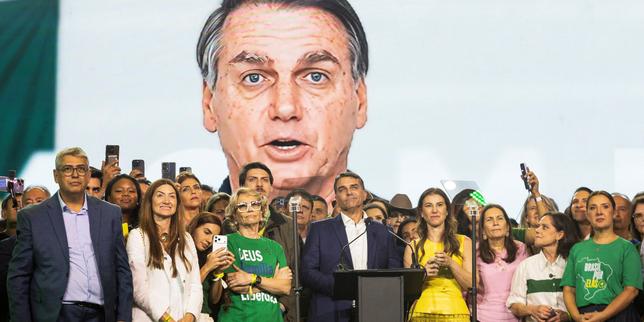
The deployment of an artificial intelligence generated avatar of former Brazilian president Jair Bolsonaro during a political convention establishes a critical threshold in digital-era campaign compliance. Barred from direct public communication due to judicial restrictions, Bolsonaro surfaced via synthetic video projection to endorse his son's presidential campaign. This operational workaround bypasses traditional administrative constraints, triggering an immediate confrontation with the Superior Electoral Court and its strict regulatory framework governing synthetic media. Analyzing this event requires breaking down the core vectors at play: the jurisdictional friction between legal bans and technological circumvention, the mechanics of proxy political surrogacy, and the structural enforcement failures inherent in decentralized media distribution.
The Jurisdictional Friction of Synthetic Surrogates
Electoral regulators face a severe enforcement gap when physical prohibitions are met with digital substitutes. Brazilian electoral rules, anchored by recent regulatory updates from the Superior Electoral Court, establish strict bans on synthetic content designed to replicate real individuals for the purpose of influencing voter intent. However, the institutional architecture of these rules assumes a direct liability model where a candidate or known agent publishes unauthorized media.
When a campaign deploys an avatar under the defense that the restricted individual neither recorded nor authorized the specific media file, the legal mechanism stalls. The primary variables defining this friction include:
- Attribution Ambiguity: Proving direct authorization versus decentralized campaign initiative.
- The Proxy Loophole: Utilizing synthetic likenesses to maintain name recognition and emotional resonance without violating literal physical detention or communication orders.
- Enforcement Latency: The temporal lag between the broadcast of synthetic media at a live event and the judicial review by electoral tribunals.
This creates an environment where legal frameworks designed to suppress disinformation are instead tested on their capacity to handle political surrogacy. The core challenge is not merely whether the video contains false information, but whether the synthetic replication of a disenfranchised political figure effectively nullifies judicial sanctions.
The Mechanics of Structural Evasion
The deployment strategy observed during the convention relies on exploiting the grey zones of institutional oversight. Campaigns operating under heavy judicial scrutiny face a high cost function for direct communication violations. By substituting the physical actor with an AI-generated twin, the campaign shifts the regulatory burden onto the judiciary to prove malice or direct orchestration.
The structural components of this evasion tactic operate across three distinct layers:
- Plausible Deniability at the Leadership Level: The restricted individual remains technically isolated, insulating them from direct contempt charges while reaping the tactical rewards of visibility.
- Audience Integration: The content is screened during internal party conventions or controlled rallies rather than official broadcast slots, complicating the classification of the media as formal campaign advertising.
- Regulatory Fragmentation: Legal opinions diverge sharply between strict interpretation advocates—who view any unauthorized deepfake of a political figure as an automatic violation of procedural bans—and institutional pragmatists who argue that the restriction requires proof of electoral harm or deception.
This division paralyzes swift administrative penalties. When regulatory authorities disagree on whether a synthetic surrogate constitutes illegal propaganda or protected political expression within an internal party meeting, enforcement efficiency drops to zero.
The Cost Function of Regulatory Enforcement
Regulating artificial intelligence in high-stakes political environments involves an inherent economic and administrative trade-off. Absolute bans on deepfakes encounter the reality of infinite digital distribution points. Even when courts issue injunctions or establish punitive guidelines, the velocity of social media replication outpaces the judicial response cycle.
The cost function is defined by two competing pressures:
- Type I Errors (Over-censorship): Suppressing legitimate political speech, satire, or transparently labeled commentary out of an abundance of caution.
- Type II Errors (Under-enforcement): Allowing sophisticated synthetic surrogates to erode the integrity of electoral restrictions by treating novel technological workarounds as unregulated loopholes.
In Brazil, the Superior Electoral Court's attempts to balance these risks through targeted resolutions run against the reality that political actors treat legal boundaries as parameters to be optimized around. If the penalty for deploying an unapproved avatar is delayed until after the electoral impact has already been absorbed by the voting public, the deterrent effect of the law approaches zero.
Strategic Outlook
The precedent set by the integration of a synthetic political surrogate signals a permanent shift in how judicial bans will be contested. Future campaigns will increasingly rely on algorithmic stand-ins to preserve the momentum of disqualified or restricted leaders. To counter this, electoral authorities must transition from static content bans to real-time behavioral monitoring that targets the systemic intent of digital impersonation, regardless of whether the source material is classified as formal advertising or internal convention media.


