Paleogenomic analysis has systematically dismantled the Eurocentric historical assumption that horses were a unilateral import to the Americas via Spanish conquistadors. While the genus Equus originated in North America millions of years ago and crossed into Eurasia via the Bering Land Bridge approximately 2.6 million years ago, the mechanism of subsequent genetic continuity remains heavily misunderstood. Popular historical narratives treat continental populations as isolated monoliths until human-mediated domestication. High-throughput sequencing of ancient DNA (aDNA) exposes a far more complex reality: a highly dynamic, bidirectional genetic exchange where specific, regional sub-populations acted as critical biological routers.
The primary vector for this genetic transmission during the Late Pleistocene was the Dalian horse (Equus dalianensis), an extinct equid native to northeastern China. Far from being a localized evolutionary dead-end, the Dalian horse served as the precise geographic and genetic intermediary that integrated Eastern Beringian (American) ancestry into the Eurasian caballine lineages. These lineages ultimately laid the foundation for modern European domestic horse populations.
The Three Pillars of Pleistocene Equine Connectivity
The architectural framework of this ancient intercontinental gene flow relies on three distinct operational variables: structural geological corridors, multi-generational genetic admixture, and regional population over-lapping.
1. Permeability of the Beringian Filter
The Bering Land Bridge was not a static highway; it functioned as an ecological filter. During glacial maxima, sea levels dropped sufficiently to expose the vast grassland tundra known as Beringia, stretching from the Lena River in modern Russia to the MacKenzie River in Canada. The permeability of this filter fluctuated according to climatic cycles, opening windows for large herbivore migration while simultaneously restricting specific species based on habitat distributions.
2. Bidirectional Admixture Mechanics
Genomic tracking demonstrates that after the initial divergence of Eurasian and North American horse populations roughly 1.0 to 0.8 million years ago, isolation was interrupted by multiple long-range dispersal events. The nuclear and mitochondrial genome records reveal at least two primary waves of intercontinental mixing occurring between 875,000–625,000 years ago and 200,000–50,000 years ago. Genetic material did not merely move along a linear trajectory; it accumulated within intermediate reservoirs, creating regional populations with highly complex ancestral profiles.
3. The Northeastern Asian Vector
Prior to recent paleogenomic sequencing, the spatial range of Equus dalianensis was assumed to be strictly confined to northeastern China, based on initial holotypes recovered from the Gulongshan site in Dalian. New genomic data from late Pleistocene specimens excavated in Qinggang County (Heilongjiang Province) and Harbin completely redefines this geographic distribution. Mitochondrial diversity mapping confirms the presence of the Dalian horse lineage deep within southern Siberia and the Yakutia region of the Russian Far East. This vast territorial footprint placed the Dalian horse in direct spatiotemporal contact with both Siberian caballine populations and incoming migrants from North America.
Quantifying the Genetic Bridge
The designation of the Dalian horse as a genetic router is supported by comparative genomic statistics. Ancestry component analyses performed on twenty complete mitochondrial genomes and two nuclear genomes isolated from late Pleistocene specimens reveal a unique genomic signature.
The Dalian horse population possessed a distinct and significant proportion of Eastern Beringian (E-EBer) ancestry. This specific American genetic signature is entirely absent from other coeval Northeast Asian equids. The data indicates that between 50,000 and 32,000 years ago, the E-EBer ancestry component within the Dalian horse lineage fluctuated dynamically. This fluctuation confirms ongoing, iterative genetic contact rather than a single, isolated migration event.
The transmission to European populations required an evolutionary sequence of step-down dilution:
- Primary Reservoir: North American horses carry 100% of the Eastern Beringian genomic signature.
- The Intermediate Router: The Dalian horse directly interfaces with E-EBer populations, integrating a highly dense concentration of this signature into its own distinct genetic clade.
- The Siberian Admixture Point: The expanded geographic range of the Dalian horse forces long-term contact with Late Pleistocene Northeast Siberian (NEsib) horses.
- The Dilution Effect: Because of this spatiotemporal overlap, the Dalian horse transmitted its acquired American ancestry into the NEsib population via localized gene flow. This explains why Late Pleistocene Siberian horses exhibit a very low (<0.7%) and highly uneven distribution of E-EBer ancestry.
The NEsib population subsequently served as the direct western pipeline, carrying these trace American genetic markers across the Ural Mountains and deep into the European continent. This network ultimately shaped the genomic landscape of Equus ferus caballus, the domestic horse line later reintroduced to the Americas by European maritime expansion.
The Cost Function of Ecological Specialization
Despite its critical function as an intercontinental genetic conduit, the Dalian horse faced an abrupt evolutionary collapse. The extinction trajectory of Equus dalianensis provides a clear lesson in the dangers of narrow ecological adaptation. While its genetic diversity remained robust up until its disappearance, its biological plasticity was structurally flawed.
Stable isotope data derived from fossilized tooth enamel reveals that the Dalian horse occupied an exceptionally narrow, specialized dietary niche. It was an obligate specialist grazer, entirely dependent on specific high-quality forage found across dry, cold grassland ecosystems.
The onset of rapid climatic shifts during the late Pleistocene—specifically around 40,000 years ago—disrupted this environment. The climate became increasingly humid, triggering an ecological regime shift. Dry grasslands were systematically replaced by acidic peatlands and saturated wetlands.
The structural vulnerabilities that doomed the Dalian horse can be modeled through two primary bottlenecks:
- The Metabolic Scaling Tax: The Dalian horse possessed an exceptionally large body size relative to other Pleistocene caballines. Large-bodied herbivores require a high absolute volume of digestible biomass to sustain basal metabolic functions.
- Nutritional Deprivation: As wet tundra and unpalatable wetland vegetation replaced dry grasses, the caloric density per square kilometer plummeted. The Dalian horse's limited ecological plasticity prevented it from shifting its diet toward woody vegetation or wetland plants.
The intersection of a massive metabolic requirement with a rapidly shrinking forage base created an immediate nutritional deficit. Lacking the adaptive flexibility to exploit the newly altered landscape, the Dalian horse suffered a swift population collapse. This ecological pattern mirrors the contemporaneous extinctions of other large megafaunal herbivores, such as the North American caballines and the giant camel (Camelops).
Evolutionary Risk Modeling
The survival, migration, and eventual extinction of ancient equine lineages offer a clear framework for modern conservation biology. The Dalian horse data proves that genetic diversity alone cannot guarantee long-term species survival when environmental conditions shift away from an animal's specialized adaptations.
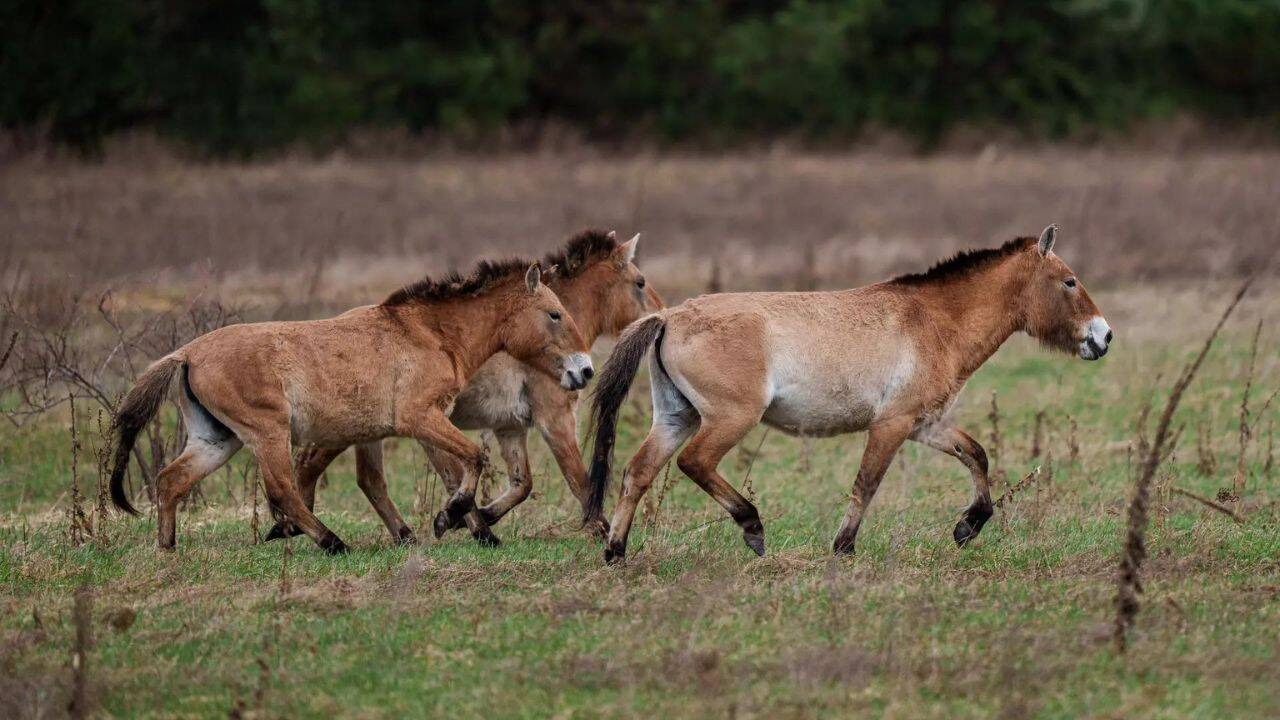
The primary threat to imperiled modern equids—such as the critically endangered Przewalski's horse (Equus ferus ssp. przewalskii)—is the loss of open, contiguous migration corridors. Przewalski's horse, which split from the domestic horse lineage between 160,000 and 38,000 years ago, currently suffers from extreme genetic bottlenecks due to human encroachment and a severe historical captive breeding squeeze.
Applying the lessons of the Dalian bridge requires conservation frameworks to shift away from merely maintaining captive population numbers. Management strategies must prioritize the establishment of expansive, topographically diverse wildlife corridors. These corridors must span multiple microclimates to buffer against modern, rapid environmental shifts. Without spatial elasticity and access to varied ecological niches, specialized herbivores remain highly vulnerable to localized ecosystem collapses, regardless of their historical evolutionary success.

:max_bytes(150000):strip_icc()/abby-marcus-wedding-couple-reception-outfits-241-1018-2000-78693942f5be4de9b83f8755450767bb.jpg)
