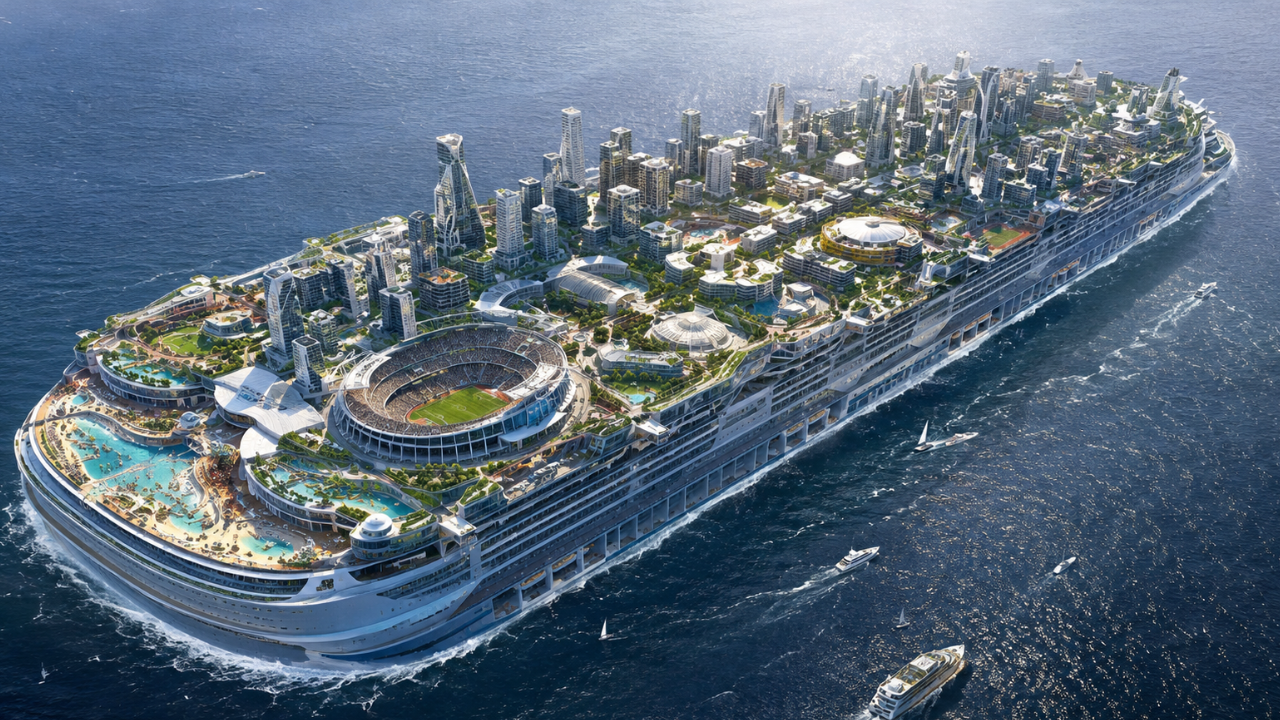
The engineering blueprints of the Freedom Ship concept challenge the physical limits of modern naval architecture, presenting a structural paradox: a vessel engineered to be eight times the gross tonnage of the largest contemporary cruise liners, designed to operate entirely outside territorial jurisdictions. The underlying thesis relies on achieving an unprecedented economy of scale at sea, condensing a 1.1-mile-long hull, 30 decks, and a 15,000-seat stadium into a single 2.3-million-gross-ton superstructure.
Analyzing the viability of this $16 billion ocean metropolis requires stripping away speculative real-estate marketing and auditing the core variables: structural mechanics, propulsion energetics, supply-chain logistics, and the jurisdictional frameworks governing a micro-state of 80,000 people.
The Structural Mechanics of a Mile Long Hull
To evaluate a vessel measuring 5,900 feet in length and 800 feet in width, traditional mono-hull cruise ship design metrics must be discarded. A standard steel mono-hull of this length would instantly break under hydrostatic bending moments when subjected to ocean swells. The wavelength of standard open-ocean wave systems would leave portions of the hull unsupported, inducing destructive hogging and sagging stresses.
The structural framework proposed for the Freedom Ship relies on a modular barge array rather than a contiguous keel. Multiple heavy-duty steel or pre-stressed concrete barge cells are designed to be coupled rigidly or semi-flexible to form a stable floating platform. This distributes the massive structural loads across a vast surface area, mitigating localized shear stresses.
- Displacement Volume: The 2.3-million-gross-ton estimate demands a volumetric displacement that prevents excessive draft. By widening the beam to 800 feet, the vessel distributes its weight horizontally. This yields a relatively shallow draft for its scale, though it permanently restricts the vessel from entering shallow coastal shelves.
- Torsional Rigidity: The primary engineering vulnerability lies in oblique wave angles. When waves strike the structure diagonally, the bow and stern experience opposing twisting forces. Managing this torsional stress requires an internal structural matrix of longitudinal and transverse bulkheads that function as a continuous box girder across all 30 decks.
The Propulsion Function and Energy Equilibrium
Sustaining a mobile city requires an uninterrupted baseload energy supply capable of powering both the propulsion systems and the municipal grid of an 80,000-person population. Standard marine diesel configurations are mathematically unviable due to the volume of fuel required; the deadweight capacity of the ship would be entirely consumed by its own fuel storage, choking out residential and commercial real estate.
The operational design specifies a nuclear propulsion architecture. A multi-reactor configuration utilizing small modular reactors (SMRs) provides the necessary energy density.
$$P_{\text{total}} = P_{\text{propulsion}} + P_{\text{municipal}}$$
The propulsion power required to move a 2.3-million-ton structure at a transit speed of 7 knots is massive, but the municipal load ($P_{\text{municipal}}$) required to heat, cool, and power a 30-deck urban footprint with a 15,000-seat stadium, schools, and hospitals actually represents the larger share of the energy equilibrium.
Nuclear power eliminates the need for refueling stops, allowing the vessel to execute its continuous two-to-three-year global circumnavigation cycle. The thermal energy generated by the reactors can be co-generated for desalination plants, converting seawater into the millions of gallons of potable water required daily by the residents.
The primary limitation of this energy strategy is not technological, but regulatory. Nuclear-powered civilian vessels face stringent maritime exclusion zones. Entering territorial waters within 12 nautical miles of many sovereign states requires specific bilateral treaties, meaning the vessel is structurally and legally bound to remain in international waters.
Logistics of an Isolated Supply Chain
Operating a permanently offshore municipality creates a continuous supply-chain bottleneck. Because the ship’s 800-foot beam and massive scale prevent it from entering any commercial port or passing through maritime chokepoints like the Panama or Suez Canals, all inbound and outbound logistics must be handled via secondary transport interfaces.
The logistics model relies on two primary vectors:
- The Aerial Vector: The uppermost deck functions as a continuous flight deck equipped with eight helipads and short-takeoff-and-landing (STOL) capabilities for small commercial aircraft. This handles high-value cargo, medical evacuations, and premium passenger transit.
- The Maritime Vector: A continuous internal marina, cut into the lower decks of the superstructure, allows commercial ferries and container barges to dock inside the hull. This is the primary channel for bulk food supplies, waste removal, and mass transit of the 10,000 daily tourists and 20,000 crew members.
The operational vulnerability of this system is sea-state dependency. During high-velocity wind events or severe ocean swells, landing aircraft on the top deck or mooring supply barges within the internal marina becomes mathematically unsafe. The ship must maintain an on-board reserve capacity of food, medical supplies, and critical spare parts capable of sustaining the 80,000-person population for a minimum of 30 days of complete isolation.
Jurisdictional Dynamics and Capital Realities
The economic premise of the project—capitalized at an estimated $16 billion—is built on the concept of international water residency. The corporate entity behind the project intends to market the vessel's 50,000 residential units as sovereign tax havens, free from the municipal, property, or income taxes levied by traditional nation-states.
This model introduces severe regulatory friction. Flagging a 2.3-million-ton civilian nuclear vessel requires approval from an open-registry maritime state (such as Panama, Liberia, or the Marshall Islands). These flag states are bound by international maritime conventions, including the International Convention for the Safety of Life at Sea (SOLAS). Compliance with SOLAS for a population of 80,000 requires life-safety systems, evacuation protocols, and structural fire protection systems that have never been tested at this scale.
The second limitation is the underwriting of risk. Securing hull and machinery insurance, alongside protection and indemnity (P&I) coverage for an asset of this scale operating continuously in international waters, represents an unprecedented risk concentration for global insurance syndicates. A single catastrophic structural failure or localized viral outbreak would exceed the capitalization of standard maritime insurance pools.
Capital Deployment and Construction Sequence
The capital allocation strategy requires constructing entirely new infrastructure before the vessel itself can even begin assembly. No existing shipyard possesses a drydock or construction slipway capable of accommodating an 800-foot-wide, mile-long hull.
The strategy outlined by the development team involves establishing a dedicated fabrication site, with current focus directed toward coastal infrastructure in Indonesia. The construction timeline is projected at four years, executing a modular assembly sequence:
[Phase 1: Yard Infrastructure & Drydock Excavation]
                       │
                       ▼
[Phase 2: Modular Barge Cell Fabrication & Hull Splicing]
                       │
                       ▼
[Phase 3: Reactor Integration & Internal Grid Allocation]
                       │
                       ▼
[Phase 4: Superstructure Decks & Topside Flight Deck Erection]
The financial viability hinges on a rolling capitalization model where early buyers purchase real estate and move into completed lower sections of the barge matrix while the upper 30 decks are still undergoing structural completion. This creates an extreme risk profile, exposing early residents to active industrial hazards and fluctuating capital markets over the multi-year assembly phase.
The final strategic play for developers attempting a project of this magnitude is not the optimization of the onboard amenities or the scaling of the 15,000-seat stadium; it is the absolute standardization of the modular hull cells to drive down fabrication costs. If the capital expenditure cannot be compressed through ultra-efficient modular construction, the project will remain bound to the conceptual phase, uninsurable and unbuildable under current global financial architectures.