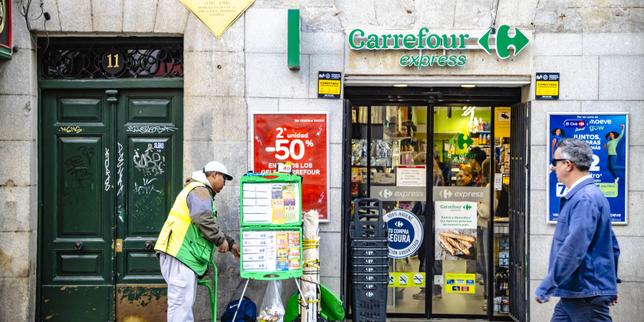
The structural evolution of Spain’s grocery distribution market demonstrates the clear limits of traditional hypermarket scale when confronted by highly optimized proximity ecosystems. While global retailers frequently rely on localized procurement and generic mass-volume strategies to capture market share, the Spanish grocery sector obeys a rigid geography-driven consumer framework.
Mercadona controls 29.5% of the Spanish grocery market, maintaining its leadership through a dense network of compact urban supermarkets and a private label infrastructure designed around systemic cost predictability. Carrefour holds the second position at 7.2% market share. The performance divergence between these two systems highlights a fundamental miscalculation in how international retail models assess Spanish consumer utility metrics. Carrefour’s historical reliance on the hypermarket format introduces structural vulnerabilities when consumer habits shift toward high-frequency, smaller-basket shopping trips located within walking distance of urban residential zones.
The Structural Mechanics of the Spanish Grocery Market
To evaluate the competitive friction between Carrefour and Mercadona, the market must be segmented by asset architecture, distribution velocity, and logistics frameworks. The Spanish market differs from Northern European or North American models because urban populations are highly dense and concentrated in multi-family apartment complexes rather than sprawling suburban developments. This spatial distribution dictates specific logistics requirements and consumer behavior patterns.
The Real Estate Density Disconnect
The operational efficacy of a grocery store is a direct function of its catchment area’s spatial layout. The hypermarket format requires large, low-cost suburban plots paired with extensive customer parking facilities. This real estate strategy assumes that consumers will batch their purchases into weekly or bi-weekly auto-reliant shopping trips.
The Spanish consumer ecosystem relies on a high-frequency, low-capacity acquisition cycle. Shoppers routinely distribute their wallet share across multiple chains to optimize for specific product categories—frequently purchasing fresh meat, fish, and produce at proximity banners or regional specialist chains while relying on larger distributors for shelf-stable goods. The underlying cost function of the hypermarket breaks down when real estate assets are physically isolated from the primary urban centers where these high-frequency purchasing decisions are made.
The Catchment Radius Bottleneck
Carrefour’s real estate network in Spain remains structurally tethered to its legacy hypermarket portfolio. While the French multi-national has aggressively expanded its smaller footprint banners—specifically Carrefour Express and Carrefour City—the revenue foundation of the business is still heavily weighted toward large suburban stores. These locations carry significant fixed overhead, utility costs, and labor requirements that require high basket values to maintain profitable operating margins.
Mercadona’s store fleet operates on a completely different model. The chain positions uniform 1,300 to 1,500 square meter layouts directly within urban neighborhoods. This footprint sits at the intersection of walking accessibility and sufficient shelf capacity to carry a concentrated assortment of high-velocity goods. By embedding stores within residential zones, the retailer captures spontaneous, low-volume foot traffic without incurring the high customer acquisition costs associated with promotional marketing.
Assortment Economics: Private Label Efficiency vs. Promotional Complexity
The operational divergence between these two competitors is clearly reflected in their inventory strategies and pricing mechanisms. The fundamental choice comes down to running an Everyday Low Price (EDLP) system with tight private label control, or a High-Low pricing architecture that depends on promotional volume to drive foot traffic.
Assortment Complexity & Pricing Architectures

[Mercadona: EDLP / Assortment Rationalization]
Urban Footprint (1,500m²) ──> ~8,000 SKUs ──> High Co-Innovation (Hacendado) ──> Max SKU Velocity

[Carrefour: High-Low / Assortment Proliferation]
Suburban Hypermarket ───────> ~40,000 SKUs ──> Complex Promotional Overhead ──> Higher Inventory Holding Cost
SKU Rationalization and Velocity Mechanics
Mercadona utilizes a strict operational strategy built around a highly rationalized inventory system. The retailer maintains a constrained product assortment of approximately 8,000 Stock Keeping Units (SKUs), heavily favoring its own private label brands like Hacendado, Deliplus, and Bosque Verde. This deliberate product limitation drives efficiency through specific economic levers:
- Monopsonistic Purchasing Levers: By focusing consumer demand onto a single private-label SKU rather than splitting volume across five national brands, the retailer consolidates its purchasing power to negotiate lower unit costs from suppliers.
- Logistical Optimization: A streamlined SKU count minimizes sorting, handling, and staging complexity across distribution centers, which maximizes inventory turnover rates and reduces holding costs.
- Predictable Shelf Velocity: Standardized product dimensions and stable demand patterns allow for automated replenishment schedules, keeping store shelves consistently filled with minimal manual labor.
Carrefour’s hypermarket model relies on assortment proliferation. A typical Carrefour hypermarket stocks between 30,000 and 50,000 SKUs, balancing international national brands, local brands, entry-level white labels, and its mid-tier private label lines. While this broad selection appeals to consumer choice in theory, it introduces clear operational drag. Managing a wide assortment increases inventory holding costs, dilutes bulk purchasing leverage, and creates shelf-space fragmentation that slows down the restocking process.
The Financial Strain of Promotional Overhead
Carrefour relies on a High-Low pricing model, using temporary price reductions, loyalty program vouchers, and multi-buy offers like "3x2" to stimulate consumer demand. This pricing architecture introduces distinct operational friction points into the supply chain:
The first liability is the Bullwhip Effect. Temporary price promotions create artificial demand spikes that distort real-time consumption data. Warehouse and logistics networks must maintain excess transportation capacity and safety stock to handle these promotional surges, which increases the total cost to serve.
The second limitation is Margin Dilution. Price promotions alter consumer purchasing behavior by training shoppers to only buy goods when they are discounted. This structural shift compresses gross margins on national brands without securing long-term customer retention once the promotional period ends.
Mercadona operates an uninterrupted Siempre Precios Bajos (SPB) or Everyday Low Price model. The retailer eliminates temporary promotional discounts, marketing circulars, and media advertising campaigns. This strategic choice stabilizes demand patterns, enabling highly accurate production scheduling for agricultural and manufacturing partners. The saved marketing capital is reinvested directly into the baseline price of the product portfolio, creating a self-reinforcing price perception that does not rely on promotional cycles.
Supply Chain Architecture and the Fresh Food Challenge
In the Spanish grocery sector, fresh categories like fruit, vegetables, meat, and fresh fish account for a significant portion of consumer wallet share. Managing these perishable supply chains efficiently serves as a major differentiator for operational profitability.
Vertical Integration and Co-Innovation Loops
Mercadona manages its fresh supply chain through a highly integrated, localized sourcing model. The retailer relies on long-term, exclusive supply agreements with dedicated manufacturing partners, historically referred to as interproveedores. These suppliers integrate their production lines directly with the retailer’s inventory systems, providing end-to-end visibility that minimizes cold-chain transit times.
This supplier ecosystem is supported by specialized co-innovation centers. Mercadona uses these facilities to study consumer behavior firsthand, gathering real-world insights to refine product formulations, packaging designs, and portion sizes. When a product update is approved, the integrated supplier network can scale manufacturing immediately, reducing the time-to-market for new private label products.
Multi-Format Distribution Disruption
Carrefour’s supply chain in Spain has to support an asymmetrical, multi-format retail network:
Carrefour Supply Chain Overhead
                                            ┌──> Hypermarkets (Bulk Pallet Delivery)
Central Distribution Center ──> Cross-Dock ─┼──> Carrefour Market (Medium-Scale Replenishment)
                                            └──> Carrefour Express (Frequent, Low-Volume Drop-offs)
This structural complexity requires distribution centers to simultaneously process bulk pallet deliveries for suburban hypermarkets and low-volume, high-frequency break-pack shipments for urban Express stores.
Cross-docking perishables across mixed retail formats creates distinct operational bottlenecks. The logistical requirements of an express store located in a historic city center—which faces vehicle size limits and restrictive delivery windows—are entirely different from the straightforward dock logistics of a suburban hypermarket. This variation adds manual sorting steps, increases transit times, and introduces extra touchpoints that elevate product damage rates and shrink metrics in fresh categories.
Digital Integration and Omnichannel Economics
The shift toward online grocery sales introduces a fundamental challenge to traditional retail margins. Delivering low-margin, high-weight food items to residential addresses presents a difficult logistics problem that requires significant capital investment to achieve profitability.
The Dark Store Hub-and-Spoke Model
Mercadona initially managed online fulfillment directly from standard supermarket shelves. This store-pick model created clear operational friction, clogging grocery aisles with e-commerce pickers and hurting the shopping experience for in-store customers. To fix this bottleneck, the company shifted to a specialized hub-and-spoke fulfillment model built around dedicated urban distribution centers, which they call Colmenas (Beehives).
These digital hubs handle online order fulfillment away from the public store network. Equipped with automated picking lines and zone-routing conveyers, they dramatically increase lines picked per labor hour compared to traditional store-based picking. Orders are bundled into optimized delivery routes using specialized home-delivery vehicles, allowing the company to run a profitable online operation while maintaining a minimum order threshold of €50 and a fixed delivery fee.
The Micro-Fulfillment Strategy
Carrefour uses a hybrid omnichannel model that pairs regional dark stores with automated in-store micro-fulfillment centers (MFCs) attached to its existing hypermarkets. This approach uses the large physical footprints of suburban hypermarkets as decentralized logistics hubs to service surrounding urban areas.
| Operational Metric | Mercadona (Colmena Hub) | Carrefour (Hybrid Hypermarket/MFC) |
|---|---|---|
| Fulfillment Infrastructure | Dedicated Urban Dark Store | Integrated Hypermarket Picking & MFC |
| Picking Efficiency | High (Automated Zone Routing) | Moderate (Mixed Manual & Automated) |
| Inventory Cannibalization | Zero (Independent Inventory) | Risk of In-Store Stock Depletion |
| Last-Mile Proximity | Optimized (Perimeter of Dense Cities) | Sub-optimal (Suburban Inbound Transit) |
While Carrefour's strategy reduces upfront real estate costs by leveraging existing space, it introduces ongoing operational compromises. Picking orders directly from standard hypermarket shelves creates inventory accuracy issues when online pickers and walk-in customers compete for the same physical stock. Furthermore, dispatching last-mile delivery vans from suburban hypermarkets into dense urban cores adds transit time and fuel overhead, which increases the total cost per delivery.
Strategic Playbook for Market Repositioning
To stabilize its market share in Spain and protect its margins from Mercadona's ongoing expansion, Carrefour must move away from generic hypermarket promotions and systematically restructure its asset utilization and supply chain mechanics.
Phase 1: Real Estate Rationalization and Hypermarket Downsizing
Carrefour needs to reduce the physical sales floor of its underperforming hypermarkets by 30% to 40%. The reclaimed square footage should be converted into dedicated dark store fulfillment spaces and temperature-controlled storage cells. This conversion turns low-yield retail space into high-density logistics hubs that support the fast-growing urban Express network.
Phase 2: Assortment Simplification and Net Pricing
The retailer should reduce its national brand SKU count by 25% in secondary and tertiary product tiers, using that shelf space to expand its mid-tier private label lines. Carrefour must replace its complex multi-buy promotional mechanics with an Everyday Low Price framework on 1,000 essential high-volume SKUs. This pricing change will help smooth out demand spikes, reduce logistics costs, and build a clearer, more consistent value perception among price-conscious shoppers.
Phase 3: Regional Sourcing Alignment
Carrefour must decentralize its fresh product procurement by setting up dedicated regional supply networks across autonomous communities like Andalusia, Catalonia, and Madrid. Buying directly from regional agricultural groups allows the company to match Mercadona's local sourcing advantages, reduce transport distances, and build an assortment that directly satisfies regional consumer preferences for fresh food.