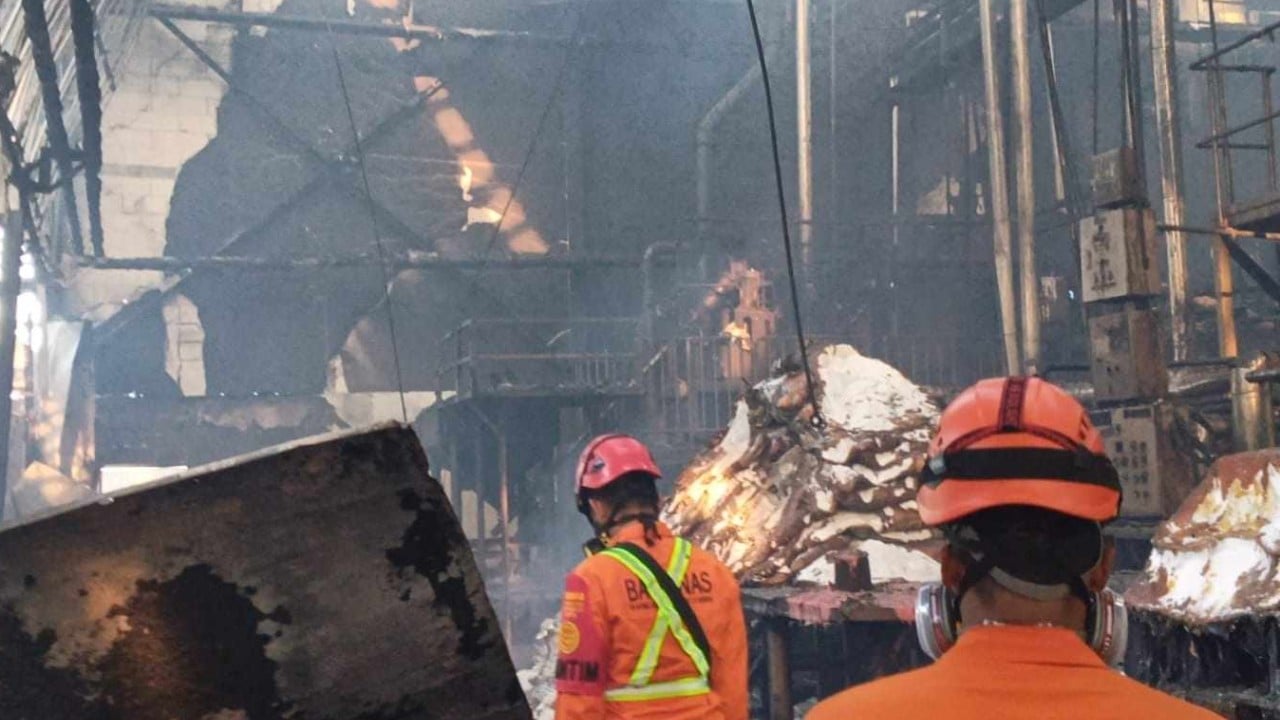
An industrial fire at an Indonesian confectionery plant that leaves at least three workers dead and dozens unaccounted for is never a freak accident; it is the predictable thermodynamic conclusion of compounding operational, structural, and regulatory failures. Breaking news reports treat these mass-casualty events as isolated tragedies, focusing on immediate emergency response while ignoring the engineering physics and supply chain economics that turned a production floor into an inescapable trap. Understanding why high-casualty fires persist in Southeast Asian light manufacturing requires dissecting the specific combustion mechanics of sugar and oil processing, the architectural bottlenecks of rapid egress, and the capital-allocation incentives that prioritize unit throughput over facility integrity.
The Thermodynamics of Confectionery Combustion
Confectionery manufacturing looks benign to the outside observer, yet its raw inputs constitute a volatile chemical environment. The primary hazard is not merely open flame from cooking vats, but the aerosolization of fine organic particulates. In other developments, we also covered: The Problem With Prison Confessions in the Madeleine McCann Investigation.
Dust Deflagration Mechanics
Granulated sugar, cornstarch, cocoa powder, and flour are non-hazardous in bulk piles. When mechanical grinding, pneumatic conveying, or high-speed packaging suspends these particles in the air at specific concentrations, they form an explosive dust cloud. Under the Combustion Pentagon framework, five elements must coincide for a dust explosion: fuel (suspended sugar/starch dust), an oxidizer (oxygen), an ignition source (an overheated bearing, electrical arc, or static discharge), dispersion, and confinement.
A primary deflagration inside a closed mixer or dust collector rarely causes facility-wide devastation on its own. The catastrophic lethality stems from the secondary explosion. The pressure wave from the initial blast dislodges accumulated fugitive dust resting on overhead beams, ductwork, and machinery housings. This newly suspended cloud ignites almost instantaneously, propagating a flame front through the entire building envelope at speeds that outrun human reaction time. Reuters has also covered this fascinating topic in great detail.
Thermal Runaway in Lipid and Sugar Processing
Beyond airborne particulates, confectionery lines rely on massive thermal loads. Boiling sugar syrups reach temperatures between 150°C and 170°C, while tempering vegetable fats and oils introduces high-flashpoint liquids into continuous-flow systems.
When a seal fails or a thermal oil heat-exchanger ruptures, superheated fats atomize into a fine mist. Unlike solid fuels that char and build heat slowly, atomized cooking oils ignite below their standard bulk flashpoints. Once ignited, burning lipids generate intense radiant heat flux that rapidly compromises standard structural steel, causing roof trusses to lose load-bearing capacity within minutes rather than hours.
The Architecture of Mass-Casualty Entrapment
High fatality counts and dozens of missing workers point directly to a catastrophic failure in Available Safe Egress Time (ASET) versus Required Safe Egress Time (RSET). In an industrial fire, survival depends entirely on whether ASET exceeds RSET. When ASET collapses due to toxic smoke and radiant heat, RSET balloons because of structural bottlenecks.
Egress Bottlenecks and Security-First Design
Light manufacturing facilities in developing industrial zones frequently exhibit a fundamental design conflict between loss prevention (theft) and life safety (evacuation). To prevent inventory shrinkage of high-value finished goods or raw commodities, facility managers routinely lock secondary fire exits, weld security bars over ground-floor windows, and funnel all shift personnel through a single biometric or security-checked turnstile.
During a flash fire or dust explosion, this single-point egress creates a deadly compression zone. As smoke reduces visibility to zero—often within 90 seconds of a synthetic packaging fire—workers disorient and converge on the single familiar entrance. Crowd crush dynamics take over long before flames reach the perimeter.
The Smoke Toxicity Timeline
The phrase "dozens missing" in early casualty reports reflects two grim realities: extreme thermal destruction of remains and rapid incapacitation from asphyxiants. Confectionery plants store vast quantities of polyethylene, polypropylene, and cardboard packaging materials alongside finished product.
When these polymers burn in a ventilation-limited environment, incomplete combustion generates high concentrations of carbon monoxide (CO) and hydrogen cyanide (HCN). Two breaths of air containing high HCN levels cause immediate neuromuscular collapse. Workers do not fail to escape because they cannot outrun fire; they collapse in place because the atmosphere becomes neurotoxic within two minutes of ignition.
The Operational Accounting of Missing Personnel
In modern Western manufacturing, an automated badge-in system coupled with muster-point RFID scanners provides an exact headcount within ten minutes of an evacuation alarm. The inability to confirm the exact number of trapped workers—resulting in vague reports of "dozens missing"—exposes a deeper administrative breakdown in labor tracking.
- Subcontracted and Daily-Wage Labor: Indonesian light manufacturing frequently relies on tiered labor outsourcing to manage seasonal demand spikes, particularly ahead of major religious holidays when confectionery demand surges. Third-party agency workers often enter facilities via paper sign-in sheets kept at the front security desk—the very office frequently destroyed in the initial fire or abandoned during evacuation.
- Shift Overlap Ambiguity: Confectionery production often runs on continuous 24-hour cycles to avoid the energy penalty of cooling and reheating massive sugar-boiling vessels. Fires occurring during shift handovers catch two overlapping cohorts inside the building simultaneously, doubling the human density in packaging and staging zones while doubling administrative confusion over who had already exited.
- Informal Space Conversion: As production scales, companies frequently convert open warehouse bays into high-density manual packaging floors without updating occupancy permits or adding proportional fire-suppression capacity. Emergency responders arrive expecting a low-occupancy storage warehouse and instead encounter a crowded assembly floor.
The Economics of Deferred Maintenance and Regulatory Arbitrage
To explain why these engineering failures persist across Indonesia's manufacturing hubs—from Tangerang and Bekasi to East Java—one must examine the unit economics of low-margin food production.
The Cost Function of Compliance
Confectionery manufacturing is a volume-driven, thin-margin business. Capital expenditure (CapEx) on high-speed wrapping machines directly increases revenue per square meter. CapEx on explosion-proof electrical fittings (ATEX/IECEx rated), centralized HEPA dust-collection systems, and automated deluge sprinklers adds zero units to daily output while increasing fixed depreciation costs.
In an environment where enforcement of Indonesia's Keselamatan dan Kesehatan Kerja (K3) occupational safety standards is fragmented across local and national jurisdictions, rational actors operating without strict insurer oversight treat safety compliance as an optional variable cost. The financial penalty for a failed municipal safety inspection is orders of magnitude lower than the cost of retrofitting a legacy factory with explosion venting and fire-rated compartmentation.
The Supply Chain Blind Spot
Global and regional fast-moving consumer goods (FMCG) conglomerates routinely audit Tier-1 contract manufacturers for food safety (HACCP, ISO 22000) because contaminated candy triggers immediate, expensive brand recalls. Structural fire safety and combustible dust mitigation rarely receive equivalent audit weight. A factory can pass a hygiene audit with spotless stainless-steel surfaces while harboring lethal layers of explosive sugar dust inside its ceiling voids and ungrounded electrical panels.
Distinguishing Known Realities from Investigative Hypotheses
When analyzing an active industrial disaster in its immediate aftermath, strict separation between verified physical facts and analytical deduction prevents false conclusions.
- Verified Operational Facts: The facility processed confectionery goods, suffered a major fire resulting in confirmed fatalities, left a large, unverified cohort of workers unaccounted for, and experienced structural collapse or extreme heat damage severe enough to delay immediate search-and-rescue entry.
- High-Probability Engineering Hypotheses: Given the casualty ratio and the presence of missing personnel, the event almost certainly involved rapid fire spread fueled by either combustible dust deflagration or high-volume packaging/lipid combustion, compounded by compromised egress routes.
- Unverified Variables: The exact primary ignition source (electrical short, mechanical friction, or thermal oil leak) and the precise status of the facility's active fire suppression systems (whether sprinklers were absent, turned off for maintenance, or overwhelmed by an explosion) require forensic metallurgical and electrical examination of the cooled debris.
The Strategic Mandate for Industrial Risk Mitigation
Relying on municipal fire inspections or post-disaster government task forces will not prevent the next mass-casualty factory fire in Southeast Asia. Municipal enforcement lacks the technical capacity to audit process-safety hazards like dust deflagration indices ($K_{st}$ values) or thermal oil degradation.
The burden of enforcement must shift immediately to commercial property insurers and Tier-1 brand procurement teams. Before renewing coverage or issuing production contracts for food and confectionery facilities, risk underwriters and corporate buyers must enforce three non-negotiable operational gates:
- Mandatory Dust Hazard Analyses (DHA): Require third-party engineering verification of fugitive dust control, explosion venting on all enclosed milling/mixing equipment, and intrinsically safe electrical wiring in dry-ingredient zones.
- Physical Egress Audits: Conduct unannounced physical inspections verifying that panic-bar fire exits are unlocked from the inside during active shifts, completely decoupling inventory theft prevention from perimeter doors through internal cage-and-camera controls.
- Off-Site Digital Muster Logs: Eliminate paper gate logs by mandating cloud-synced digital entry tracking for all direct and subcontracted personnel, ensuring rescue commanders have an immutable manifest of lives inside the structure the second an alarm triggers.