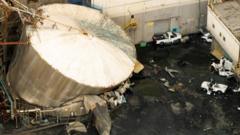
Industrial disasters involving large-scale chemical containment vessels are rarely the result of a single isolated variable. Instead, they represent a critical convergence of mechanical vulnerability, chemical thermodynamics, and structural engineering limitations. The catastrophic failure of a 900,000-gallon capacity tank holding "white liquor" at the Nippon Dynawave Packaging facility in Longview, Washington, serves as a stark case study in industrial mechanics. The incident resulted in at least one confirmed fatality, nine personnel remaining unaccounted for, and ten distinct injuries, illustrating the extreme physical forces unleashed when large-scale storage systems experience rapid pressure differentials.
To evaluate the operational and structural mechanics of this event, analysts must look past generic media reporting of an "explosion" and examine the specific physics of a large-scale tank implosion. By understanding the interaction between caustic chemical processes and structural integrity, asset managers and safety engineers can identify the precursor vulnerabilities that lead to systemic containment failure. Don't miss our earlier coverage on this related article.
Mechanical and Chemical Drivers of the Vacuum Collapse
Standard atmospheric storage tanks are engineered to withstand substantial internal positive pressure, but they are uniquely vulnerable to negative pressure differentials. An implosion occurs when the external atmospheric pressure exceeds the internal pressure of the vessel to a degree that surpasses the structural yield strength of the tank walls. This creates an immediate, catastrophic inward collapse.
In the context of the pulp and paper manufacturing process, the stored substance—white liquor—is a highly corrosive, strongly alkaline solution consisting primarily of sodium hydroxide ($NaOH$) and sodium sulfide ($Na_2S$). This chemical mixture is utilized at elevated temperatures within the Kraft process to dissolve lignin and separate wood fibers. The physical properties of the fluid and its operational environment dictate two primary potential mechanisms for vacuum generation. To read more about the background of this, The Washington Post offers an in-depth summary.
The Thermal Shrinkage Mechanism
White liquor is handled at elevated processing temperatures. If a closed or improperly vented vessel experiences a rapid drop in internal temperature—either due to an interruption in upstream thermal feeds, the sudden introduction of cooler fluids, or external ambient shifts—the internal vapor space undergoes rapid thermal contraction. Because the gas volume shrinks faster than external air can displace it in an unvented system, an internal vacuum develops instantaneously.
The Volumetric Displacement Rate Disconnect
A mechanical vacuum is frequently generated during high-rate fluid extraction. If pumps draw liquid out of a vessel at a volumetric rate higher than the volumetric inflow rate of replacement air or compensating inert gas, the internal pressure drops according to the ideal gas law:
$$P V = n R T$$
When the air venting system fails to match the displacement rate of the liquid being pumped out, the tank becomes an accidental vacuum chamber. For a tank containing roughly 540,000 gallons of liquid (representing the reported 60% fill level of its 900,000-gallon maximum capacity), the massive upper vapor headspace means that even a minor percentage-based drop in internal pressure translates into an immense total force exerted across the broad surface area of the upper tank walls and roof.
The Structural Yield Function of Atmospheric Tanks
The structural integrity of large industrial storage tanks relies on geometric symmetry and circumferential tension, often referred to as hoop stress. Under normal operation, the weight of the liquid exerts outward radial force, which steel plates are exceptionally well-suited to handle via tensile strength. However, when subjected to an external compressive force via an internal vacuum, the structural calculation changes entirely.
The critical buckling pressure ($P_{cr}$) of a thin-walled cylindrical shell can be modeled using variations of classical structural stability equations, which demonstrate that resistance to buckling is highly sensitive to the thickness-to-radius ratio:
$$P_{cr} \propto \left(\frac{t}{r}\right)^3$$
Where:
- $t$ represents the wall thickness of the tank shell.
- $r$ represents the radius of the cylinder.
Because industrial storage tanks maximize volume by utilizing relatively thin steel plates relative to their massive radii, their inherent resistance to external buckling pressure is remarkably low. A vacuum of less than 1 pound per square inch (psi) below atmospheric pressure is frequently sufficient to cause the structural collapse of a massive, unreinforced tank shell.
Once a localized area of the tank wall buckles or loses its cylindrical geometry, the uniform distribution of structural loads is destroyed. The failure propagates across the entire structure within milliseconds, leading to a complete mechanical collapse where the roof and upper walls fold inward, severely compromising the lower sections and causing a massive release of the stored liquid.
Secondary Hazards and Operational Recovery Bottlenecks
The consequences of a tank implosion extend far beyond the immediate structural collapse. The mechanical energy released during a 540,000-gallon structural failure creates an immediate multi-hazard environment that severely limits tactical rescue and recovery operations.
- Corrosive Liquid Inundation: The rapid release of white liquor creates a severe chemical hazard zone. Sodium hydroxide and sodium sulfide cause immediate chemical burns upon contact with epithelial tissue and present a severe inhalation hazard if aerosolized or converted into mist. The liquid spilled into local drainage infrastructure, necessitating immediate environmental containment protocols by state regulatory bodies to prevent regional water table contamination.
- Structural Instability Zones: A partially collapsed tank holding residual fluid remains a highly volatile kinetic hazard. The remaining steel framework is subject to unpredictable shifts as internal shifting loads alter the center of gravity. Emergency responders cannot safely navigate the immediate perimeter until mechanical stabilization—such as external shoring or structural reinforcement—is completed. This physical limitation explains the operational shift from an active rescue phase to a stabilized recovery phase.
- Industrial Mass Casualty Logistics: The intersection of thermal, chemical, and mechanical trauma requires specialized field decontamination before patients can be safely transported to regional medical centers. Responding units must establish immediate containment zones to wash down affected personnel, a process that inherently lengthens the timeline of medical intervention for victims with inhalation or deep-tissue chemical injuries.
Predictive Risk Factors and Compliance Deficiencies
Evaluating the systemic vulnerabilities that precede major containment failures requires tracking a facility’s operational compliance and maintenance history. Regulatory tracking reveals that the Nippon Dynawave facility, which dates back to 1953, has operated under heightened scrutiny, with open safety complaints filed with the Occupational Safety and Health Administration (OSHA) in early 2026.
While older industrial infrastructure can be maintained safely through rigorous capital expenditure, it possesses inherent risks that modern facilities mitigate through structural redundancy. Legacy systems often feature older metallurgical standards and are more susceptible to fatigue, micro-cracking, and wall thinning from decades of handling highly alkaline compounds like white liquor.
Furthermore, standard risk assessments indicate that open regulatory complaints regarding workplace safety are often leading indicators of systemic operational drift—a phenomenon where small deviations from optimal safety protocols become normalized over time, ultimately manifesting in a major system failure.
Engineering Protocols for Prevention
To eliminate the risk of vacuum-induced structural failure in chemical storage infrastructure, asset integrity programs must deploy a multi-layered engineering defense. Relying solely on manual inspection is insufficient; facilities must integrate active mechanical protections and advanced diagnostic monitoring into their core operational framework.
Dual-Element Pressure and Vacuum Relief Systems
Every low-pressure storage vessel must be equipped with sized weight-loaded or spring-loaded pressure-vacuum (PV) valves. These valves must be calculated to handle the maximum possible volumetric displacement rate during both rapid pump-out scenarios and extreme thermal contraction events. Redundant emergency venting hatches, which lift entirely if standard PV valves fail to equalize pressure rapidly enough, provide a secondary mechanical fail-safe.
Emergency Gas Blanketing Systems
Implementing automated inert gas blanketing (typically utilizing nitrogen) maintains a positive internal pressure within the tank's vapor space. If the internal pressure drops below a critical setpoint, high-capacity regulatory valves instantly inject nitrogen gas to equalize the differential, preventing the formation of an internal vacuum regardless of liquid extraction rates or temperature drops.
Continuous Acoustic Emission and Thickness Monitoring
Advanced asset integrity management requires the deployment of non-destructive testing protocols. Continuous ultrasonic thickness testing (UT) maps localized wall thinning caused by internal caustic corrosion. Concurrently, acoustic emission monitoring can detect micro-fissures and localized structural shifting long before a visible buckle occurs, allowing operators to isolate and drain a vulnerable vessel before a catastrophic structural failure can materialize.