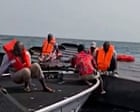
Marine transit disasters in inland African waters are rarely isolated anomalies of sudden misfortune; rather, they represent the predictable culmination of structural over-capacity, regulatory latency, and unmanaged hydrodynamic risk. The capsizing of the Rural Infrastructure Development Agency vessel Mbuya Nehanda on Lake Kariba, which resulted in at least 15 fatalities and 27 missing persons, exposes the operational vulnerabilities inherent in rural African inland water transport. Understanding this event requires stripping away narrative descriptions of rough weather and examining the mechanical, economic, and administrative failure points that transformed a routine five-hour transit into a mass casualty incident.
The Load Vector and Mass Discrepancy
Maritime safety hinges on a rigid constraint: total displacement must not exceed the certified buoyant design parameters of the hull. In the Lake Kariba disaster, this foundational margin of safety was breached long before departure.
The baseline parameters highlight a severe operational imbalance:
- Stated passenger carrying capacity: 90 individuals.
- Officially audited ticket sales (adults): 114 individuals.
- Registered crew members: 5 individuals.
- Unaccounted demographic variable: An unknown volume of infants and children below the ticketing threshold.
- Witness and crew estimates of actual load: Up to 153 individuals.
This reveals a baseline capacity excess of roughly 30% utilizing only verified adult ticket data, scaling past 70% under realistic manifest estimates. When a hull designed for a 90-person maximum load profile absorbs upwards of 140 to 150 human bodies plus cargo, the center of gravity shifts upward. This reduction in freeboard height severely diminishes the vessel's righting moment when lateral forces are applied.
The Hydrodynamic Failure Loop
Lake Kariba is the world's largest man-made reservoir by volume, stretching over 200 kilometers with an expanse that generates genuine marine weather patterns, including rapid wave steepening under high wind shear.
The sequence of failure follows a strict physical progression:
- Static Overload: Excess weight depresses the hull deeper into the water column, reducing the distance between the waterline and the gunwale.
- Dynamic Instability: As the vessel encountered strong wind-driven waves near Long Island, the reduced freeboard allowed water to breach the deck prematurely.
- Free Surface Effect and Sloshing: Ingress water on the deck or within the hold introduced a free surface effect, shifting weight dynamically to the lee side as the ship rolled.
- Catastrophic Inversion: With the center of gravity permanently displaced past the metacenter, the righting arms failed, causing the vessel to invert rather than recover.
Eyewitness footage from shore prior to departure captured local concerns regarding the ability of the ageing vessel—reportedly operational for decades—to manage active wave action. These warnings highlight a systemic failure in localized risk assessment: passengers recognized the environmental hazard, yet institutional dispatch protocols lacked the authority or mechanism to override the commercial and transit demands of rural communities.
Administrative and Governance Bottlenecks
The post-incident response and regulatory audit reveal systemic blind spots in tracking inland water passenger volume. Passenger manifest integrity broke down due to systemic record-keeping omissions regarding minors, creating an invisible demographic variable that complicates search and rescue operations. When emergency services cannot establish an exact baseline count of the missing, resource allocation for sub-aqua recovery units and rapid response deployment remains reactive rather than targeted.
The institutional reliance on an ageing fleet operated by developmental funds points to a chronic infrastructure deficit. Remote communities dependent on the route from Kariba town to Chalala fishing camps face a binary choice: utilize dilapidated, overloaded state-linked transport or accept economic isolation. Because alternative road infrastructure around the massive reservoir perimeter is often prohibitive, demand inelasticity forces passengers onto vessels regardless of visible safety compromises.
Strategic Operational Corrections
Preventing future structural failures on large inland bodies of water requires an immediate pivot from punitive post-disaster declarations to real-time asset controls.
- Mandatory Electronic Manifests: Transitioning away from manual paper ticket registries to digital turnstile counts that capture all demographics, including non-paying children, ensures exact real-time payload accounting before unmooring.
- Dynamic Weather-Threshold Dispatching: Establishing hard legal cutoffs where marine operations automatically suspend based on meteorological wind-shear and wave-height data rather than captain or dispatcher discretion.
- Fleet Modernization and Load Sensors: Retrofitting legacy hulls with physical weight sensors or draft-line electronic indicators that trigger visual alarms when passenger intake crosses the maximum deadweight tonnage threshold.