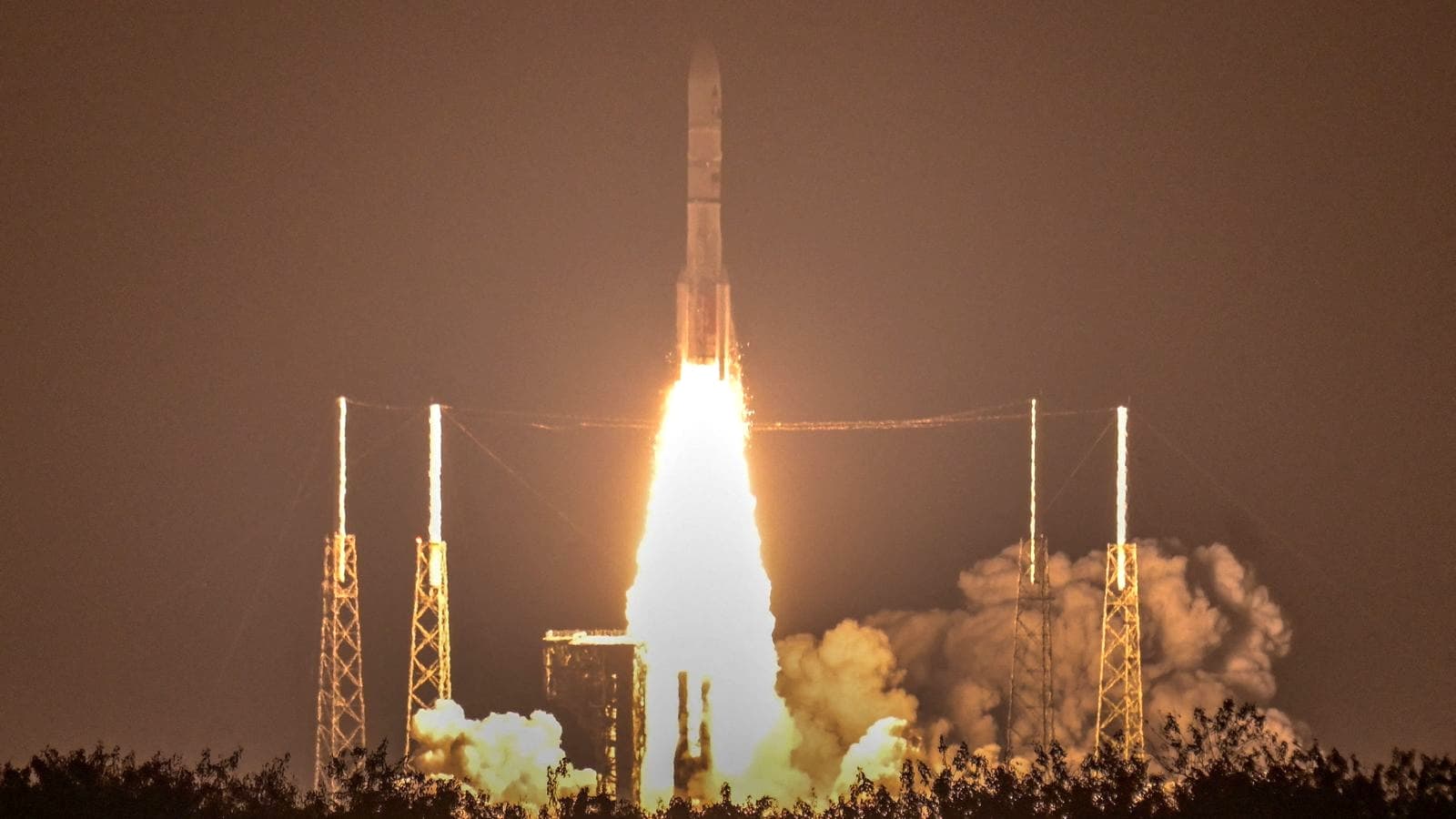
A mid-flight rocket failure destroys more than hardware; it compresses deployment schedules, triggers regulatory stand-downs, and exposes the fragility of single-string launch dependencies in capital-intensive satellite constellations. When a joint Boeing-Lockheed Martin launch vehicle—operated by United Launch Alliance (ULA)—suffers a catastrophic anomaly carrying 40 Amazon internet satellites, the immediate loss of payload represents only the first-order financial impact. The second-order consequences govern regulatory licensing, insurance underwriting, spectrum milestones, and competitive market share in low Earth orbit (LEO).
To evaluate the true operational damage of a mid-flight anomaly involving a ULA vehicle and Amazon’s Project Kuiper hardware, analysts must separate sensationalized headlines from aerospace engineering mechanics and telecommunications economics. Standard media coverage focuses on the explosion itself. Rigorous analysis examines the three systemic vectors affected by the loss: failure mode mechanics, regulatory timeline compression, and constellation unit economics.
Deconstructing the Launch Vehicle Architecture and Failure Vectors
Understanding what happens when a Boeing-Lockheed rocket fails mid-flight requires examining the structural division of responsibility within United Launch Alliance. ULA operates as a 50-50 joint venture between Boeing and Lockheed Martin, combining legacy engineering teams, propulsion suppliers, and avionics architectures. Whether the mission utilizes the retiring Atlas V or the next-generation Vulcan Centaur, a mid-flight breakup stems from a distinct chain of physical events rather than a single isolated component.
In aerospace systems engineering, mid-flight anomalies generally cluster into three operational categories:
- Propulsion and Fluid Dynamics Failures: During maximum dynamic pressure (Max Q) or stage separation, turbopump cavitation, combustion instability, or propellant feedline ruptures cause rapid pressure spikes. If the thrust vector control system cannot compensate for asymmetric thrust, aerodynamic loads exceed the structural limits of the airframe within milliseconds.
- Guidance, Navigation, and Control (GNC) Divergence: Software faults, inertial measurement unit drift, or actuator failures push the vehicle outside its programmed flight corridor. When trajectory deviation threatens populated areas, the Autonomous Flight Safety System (AFSS) initiates range safety destruct charges, intentionally terminating the vehicle mid-flight.
- Stage Separation and Fairing Malfunctions: Pyrotechnic bolts or pneumatic separation mechanisms must execute within strict millisecond tolerances. A partial separation or premature payload fairing deployment exposes delicate satellite buses to hypersonic atmospheric drag, shredding the payload before orbital insertion.
Without official telemetry data from the Federal Aviation Administration (FAA) and the vehicle manufacturer, attributing the exact root cause remains an educated hypothesis rather than a confirmed fact. However, the operational consequence of any mid-flight termination is identical: a mandatory mishap investigation overseen by the FAA Office of Commercial Space Transportation.
The Regulatory Bottleneck and Stand-Down Mechanics
A rocket explosion immediately freezes the launch manifest. Under federal aviation regulations, the launch provider cannot resume flight operations until it identifies the root cause, implements corrective hardware or software modifications, and receives formal FAA sign-off on its mishap report.
This regulatory freeze creates a compounding schedule penalty for the payload customer. Amazon’s Project Kuiper operates under strict Federal Communications Commission (FCC) licensing mandates. Under standard FCC rules for non-geostationary orbit (NGSO) constellations, licensees must deploy 50 percent of their authorized satellites within six years of authorization and 100 percent within nine years. Failure to meet these deployment milestones risks forfeiture of valuable Ka-band spectrum rights.
When 40 satellites are lost in a single ascent, the customer absorbs a double penalty:
- Direct Hardware Replacement Lag: Satellite manufacturing lines operate on batch production schedules. Replacing 40 flight-ready units requires diverting components—such as phased-array antennas, hall-effect thrusters, and optical inter-satellite links—from future production blocks, slowing overall fleet expansion.
- Manifest Re-Sequencing: Because ULA’s launch pad turnaround times and booster production rates are fixed by physical infrastructure, delayed flights cannot simply be doubled up. Every month spent grounded pushes subsequent launches further right on the calendar, shrinking the margin for error against FCC deployment deadlines.
Constellation Economics and the Cost Function of Lost Payloads
Evaluating the financial impact of losing 40 broadband satellites requires modeling the cost function of LEO deployment rather than looking at isolated price tags. While exact internal manufacturing costs for Project Kuiper hardware and ULA launch contracts are proprietary, the economic variables governing the loss are well established in satellite telecommunications.
The total financial loss ($L_{total}$) of a failed rideshare or dedicated constellation launch follows a specific structural formula:
$$L_{total} = C_{launch} + (N \times C_{sat}) + C_{insurance} + C_{opportunity}$$
Where $C_{launch}$ represents the amortized cost of the launch service, $N$ equals the number of destroyed satellites (40 units), $C_{sat}$ denotes the marginal manufacturing cost per spacecraft, $C_{insurance}$ accounts for policy deductibles and subsequent premium hikes, and $C_{opportunity}$ captures delayed subscriber revenue.
Capital Expenditure vs. Launch Amortization
For mega-constellations, satellite manufacturing relies on economies of scale. By moving from bespoke, multi-year spacecraft builds to assembly-line production, operators drive $C_{sat}$ down into the low millions per unit. Consequently, the loss of 40 satellites represents a contained, replaceable capital expenditure rather than an existential balance-sheet crisis for a parent company with Amazon’s cash flow. The hardware is designed to be expendable at the batch level.
The Underwriting Ripple Effect
Space insurance markets operate on narrow capital pools. A single multi-satellite loss alters actuarial risk models across the entire sector. Even if Amazon self-insures its satellite hardware—a common practice among tech giants building high-volume constellations to avoid high brokerage fees—commercial insurers underwriting ULA’s third-party liability and future commercial manifests will recalibrate premiums. Higher launch insurance rates increase the baseline cost of access to orbit for all commercial payloads utilizing that vehicle family.
Opportunity Cost and Market Entrenchment
The most severe variable in the cost function is $C_{opportunity}$. Every month a constellation lacks critical mass in orbit, incumbent providers—most notably SpaceX’s Starlink—capture enterprise contracts, aviation partnerships, maritime accounts, and rural residential subscribers. Once a commercial customer installs competitor user terminals and integrates network routing hardware, customer acquisition costs for late entrants rise sharply. A launch failure delays the exact moment a constellation achieves continuous regional coverage, handing competitors uncontested quarters to lock in long-term revenue.
Single-String Dependency vs. Multi-Provider Resilience
Amazon’s procurement strategy highlights a core tension in modern aerospace logistics: securing heavy-lift capacity across an industry plagued by development delays. To guarantee enough fairing volume and mass-to-orbit capability for over 3,200 satellites, Amazon executed the largest commercial launch procurement in history, splitting contracts across ULA, Arianespace, and Blue Origin, alongside supplemental launches from SpaceX.
This multi-provider strategy was explicitly designed to insulate the constellation from single-point failures. Yet in practice, reliance on new or transitioning launch vehicles creates correlated schedule risk:
- Vehicle Transition Bottlenecks: ULA’s shift from the retired Russian-engined Atlas V to the domestic Vulcan Centaur created a narrow window where flight heritage was still accumulating. Early operational flights of any new rocket architecture carry statistically higher anomaly probabilities than mature systems with dozens of consecutive successes.
- Cross-Platform Delays: Because competing heavy-lift vehicles like Blue Origin’s New Glenn and Arianespace’s Ariane 6 faced their own developmental timelines, a stand-down on ULA’s side cannot be immediately absorbed by shifting payloads to another booster. Payload adapters, dispenser rings, and acoustic vibration profiles are custom-engineered for specific launch vehicles, preventing rapid plug-and-play swaps between different rockets.
Operational Limitations of Constellation Recovery Strategies
When a major launch anomaly occurs, executive leadership typically evaluates three recovery levers: accelerating factory output, purchasing stopgap launches on proven boosters, or petitioning regulators for milestone waivers. Each lever carries hard operational constraints.
Accelerating satellite production runs into supply chain physics. Specialized components—such as radiation-hardened semiconductors, reaction wheels, and krypton or xenon propellant tanks—have fixed supplier lead times. Injecting additional capital into assembly lines cannot compress chemical processing or component testing cycles beyond physical limits.
Purchasing stopgap launch capacity on mature, high-cadence rockets requires negotiating with direct competitors or waiting in multi-year manifest queues. Even when launch slots are secured, integrating a 40-satellite dispenser stack onto a different fairing envelope requires months of coupled loads analysis to verify that launch vibrations will not damage the spacecraft structures.
Petitioning the FCC for deployment deadline extensions offers administrative relief, but regulatory bodies scrutinize force majeure claims strictly. Competitors routinely file formal oppositions to waiver requests, arguing that spectrum warehousing harms public interest and stifles market competition. Relying on regulatory leniency introduces legal uncertainty into capital allocation plans.
Strategic Execution for Constellation Operators
To neutralize the downstream damage of a mid-flight launch failure, satellite operators and aerospace procurement teams must shift from reactive crisis management to structural supply chain decoupling:
- Standardize Payload Interfaces Across Launch Vehicles: Engineering teams must design satellite dispenser rings and electrical umbilical interfaces around universal mechanical standards rather than vehicle-specific adapters. Reducing structural customization cuts cross-vehicle re-manifesting timelines from nine months to under ninety days.
- Maintain a Rolling Buffer of Flight-Ready Hardware: Rather than operating on a strict just-in-time delivery model tied to specific launch dates, manufacturing lines should maintain a rolling reserve equal to two full launch batches. When a booster stands down, the reserve inventory immediately fills the next available slot on an alternate provider without starving downstream launch campaigns.
- Decouple Constellation Deployment from Unproven Launch Architectures: Core regulatory milestone launches—those required to hit mandatory 50 percent orbital thresholds—must be booked exclusively on flight-proven vehicles with established reliability records, relegating developmental rockets to secondary replenishment phases until they achieve at least ten consecutive successful orbital insertions.