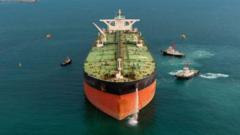
Global energy transit through the Persian Gulf operates on a fragile mathematical assumption that the Strait of Hormuz will remain perpetually open. Recent military hostilities involving the United States, Israel, and Iran have completely invalidated that baseline. Commercial tanker transit through the corridor has experienced near-total collapse, driven by direct kinetic threats, marine insurance cancellations, and electronic interference.
Understanding the mechanics of this disruption requires moving past superficial news headlines and evaluating the structural stress points governing modern crude oil logistics.
The Three Pillars of Maritime Disruption
The security deficit across Middle Eastern shipping lanes is sustained by three distinct operational vectors: asymmetric kinetic threats, insurance market pricing failures, and navigational degradation.
Asymmetric Kinetic Vectors
Traditional naval strategy assumes that protecting a chokepoint requires countering equivalent state-actor navies. The modern conflict model subverts this by substituting multi-million-dollar warships with low-cost, asymmetrical vectors managed by the Islamic Revolutionary Guard Corps.
Shore-to-ship ballistic missiles, one-way attack drones, and semi-submersible explosive craft present an interception math problem for defending navies. A single successful hit from an inexpensive drone can immobilize a very large crude carrier, creating asymmetric financial leverage for Tehran. Even when naval escorts intercept the majority of incoming threats, the margin for error is zero. Insurance underwriters and commercial operators cannot absorb a single catastrophic failure event, rendering naval protection insufficient to coax standard commercial fleets back into the corridor.
The Insurance Cost Function
Maritime transport operates on underwriting viability. When underwriters cannot price tail risk, they withdraw coverage entirely.
War risk premiums for Gulf transits escalated past insurable thresholds shortly after hostilities commenced. Underwriters faced an immediate liquidity mismatch: the premium collected from a single voyage could not cover the total loss liability of a $150 million tanker carrying two million barrels of crude. Consequently, insurance cancellations acted as an automatic circuit breaker, freezing commercial movements far more effectively than physical blockades alone.
Navigational Degradation
Physical attacks are compounded by systemic electronic warfare. More than one thousand commercial vessels in the region have experienced severe Global Positioning System and Automatic Identification System interference.
This degradation forces crews to navigate congested, narrow shipping lanes with compromised positional data. The combination of spoofed signals, radar interference, and the constant threat of floating or anchored naval mines creates an operational environment where human error carries catastrophic downside risk.
The Dual-Track Flow Dynamic
The breakdown of standard tanker transit has not resulted in an absolute cessation of petroleum extraction. Instead, it has fractured the market into two distinct operational tracks: compliant commercial freezes and shadow fleet leakages.
The Compliant Fleet Shutdown
Major independent shipowners, multinational energy conglomerates, and publicly traded tanker pools have instituted total transit bans for the Strait of Hormuz and adjacent high-risk zones. For these entities, corporate liability, crew safety mandates, and regulatory compliance under Western sanctions outweigh spot-market incentives. This compliant segment accounts for the massive drop in official export volumes from primary Gulf producers such as Saudi Arabia, Kuwait, and the United Arab Emirates.
The Shadow Fleet Mechanism
Conversely, a secondary tier of maritime trade persists through opaque ownership structures. Operating outside Western oversight, these vessels engage in dark transits—turning off transponders, utilizing ship-to-ship transfers in sheltered anchorages like Fujairah, and catering primarily to non-aligned buyers.
Iran itself has successfully maintained a baseline of petroleum exports through this shadow apparatus, primarily directing cargoes toward buyers in countries like China. This bifurcation proves that supply restrictions in modern conflicts are rarely absolute; rather, they introduce a massive cost-imposition tax that alters trade routes and pricing structures globally.
Geographic Contagion and Alternative Logistics
Maritime risk does not respect localized boundaries. When the primary artery of the Strait of Hormuz constricted, the stress propagated immediately to secondary choke points, most notably the Bab el-Mandeb strait and the approaches to the Suez Canal. Recent kinetic incidents near Egyptian port infrastructure demonstrate that regional proxies can project force far beyond the Persian Gulf theater.
This systemic vulnerability forces a permanent recalculation of enterprise logistics. The primary alternative—rerouting tankers around the Cape of Good Hope—imposes a severe time penalty, adding thousands of nautical miles and weeks of transit duration to voyages between the Middle East and European or North American markets. The resulting reduction in effective global fleet capacity drives up freight rates, which subsequently flows downstream into refined product prices, industrial input costs, and macroeconomic inflation indicators.
Deploy prepositioned multi-tier electronic counter-countermeasures across commercial fleets, establish private-public risk-sharing pools independent of traditional underwriting delays, and lock in long-term non-Gulf supply contracts to insulate operations from permanent chokepoint volatility.