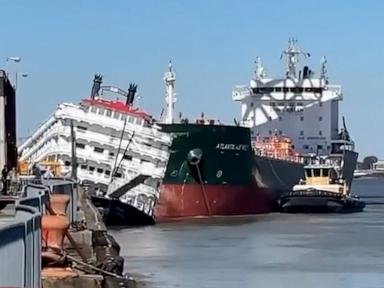
Survival in a commercial vessel capsizing on the Lower Mississippi River rarely depends on luck; it is the deterministic output of hydrodynamic geometry, response latency, and multi-agency maritime coordination. Standard media coverage frames the complete rescue of passengers and crew from a capsized New Orleans riverboat following a tanker collision as a "miracle." That framing obscures the mechanics of the event. When a high-displacement ocean-going tanker strikes a shallow-draft passenger vessel in a confined, fast-moving channel, the survival rate is governed by four measurable variables: kinetic energy transfer, buoyancy reserve, thermal exposure limits, and the spatial density of nearby commercial tug and Coast Guard assets.
The Physics of Asymmetric Maritime Collisions
The Lower Mississippi River near New Orleans presents one of the most complex navigational environments in North America. Deep-draft ocean-going tankers, often displacing upwards of 50,000 to 100,000 deadweight tons, share a narrow, winding, and heavily silted channel with shallow-draft excursion riverboats, ferries, and articulated tug-barge units.
Mass Differential and Momentum Transfer
In any collision between an ocean-going tanker and a coastal or inland riverboat, the mass ratio is severely skewed. Kinetic energy scales linearly with mass and quadratically with velocity ($KE = \frac{1}{2}mv^2$). Even when a deep-draft tanker operates at a reduced harbor speed of 8 to 10 knots, its sheer momentum means that a glancing blow imparts immense lateral force onto a lighter, flat-bottomed riverboat. Unlike ocean-going vessels engineered with deep V-hulls and heavy transverse framing to absorb lateral wave and contact loads, traditional riverboats utilize wide-beam, shallow-draft hulls designed for stability in calm water and minimal vertical clearance.Hydrodynamic Rollover Mechanics
When a tanker strikes or washes a shallow-draft vessel amidships, two forces act simultaneously to induce a capsize. First, direct mechanical impact pushes the upper superstructure laterally while water resistance holds the lower hull in place, creating a violent rotational moment (torque). Second, the Bernoulli effect—caused by a massive hull moving rapidly through a restricted channel—creates a zone of low pressure alongside the tanker. This hydrodynamic suction pulls the smaller vessel toward the tanker's hull before the bow wave or stern wake violently pushes it outward. Once the riverboat's center of gravity shifts beyond its maximum righting arm (the horizontal distance between the center of buoyancy and the center of gravity), the vessel passes its angle of vanishing stability and inverts.The Air-Pocket Phenomenon
Capsizing does not equate to immediate sinking. Because riverboats feature expansive, compartmentalized interior decks and broad, flat superstructures, rapid inversion frequently traps significant volumes of air within the hull and main deck cabins. This trapped air provides temporary positive buoyancy, preventing the vessel from plunging immediately to the riverbed—which, in the New Orleans harbor reach, routinely exceeds 100 feet in depth. The stability of this inverted state depends entirely on hull integrity. If the collision breaches the hull plating below the waterline (now facing upward), air escapes rapidly, accelerating the sink rate. If the hull remains largely intact, the vessel floats inverted, creating a critical, time-bounded window for surface and subsurface extraction.
Channel Constraints and Navigational Risk Factors
To understand how a collision occurs in a heavily regulated port like New Orleans, one must examine the operational constraints of the Mississippi River between Mile 90 and Mile 105 Above Head of Passes (AHP).
- River Stage and Current Velocity: The Mississippi River is not a static body of water. Depending on seasonal runoff from the Ohio and Missouri river basins, current velocities in the New Orleans bend (specifically around Algiers Point) fluctuate between 2 knots at low water and over 6 knots during high-water stages. A 6-knot following current severely degrades a deep-draft vessel's rudder authority. To maintain steerageway—the minimum speed required for water flowing over the rudder to turn the ship—a vessel moving downstream must travel faster than the current itself, often exceeding 10 to 12 knots over ground. Stopping distances under these conditions stretch to over a mile.
- The Algiers Point Bottleneck: The sharp, 110-degree bend at Algiers Point creates a severe blind spot for radar and visual watchkeeping, compounded by high-water eddies and crosscurrents. The U.S. Coast Guard enforces strict Vessel Traffic Service (VTS) protocols here, including one-way traffic lights during high-water stages. However, ferries and tour boats crossing the channel perpendicular to the main shipping lane must constantly thread the gap between ascending and descending deep-draft traffic.
- Communication and Bridge Resource Management: Commercial vessels in this sector operate under the guidance of state-commissioned river pilots (such as the Crescent River Port Pilots) who board ocean-going ships to navigate the river. Collisions in VTS-monitored zones typically trace back to one of three failures: an unannounced course alteration by a smaller vessel, a mechanical steering or propulsion loss (a "blackout") on the deep-draft vessel, or a breakdown in bridge-to-bridge VHF radio coordination where passing arrangements (port-to-port versus starboard-to-starboard) are misunderstood.
The Extraction Matrix: Why Survival Reached 100 Percent
When a passenger vessel capsizes in a major industrial port, the outcome is dictated by the "Golden Window"—the interval between hull inversion and either complete submersion or the onset of cold-water incapacitation. In the New Orleans incident, achieving a zero-fatality outcome required the simultaneous alignment of four operational factors.
1. High Asset Density and Zero Transit Latency
Unlike offshore maritime disasters, where Coast Guard cutters and helicopters require 30 to 90 minutes to reach the datum point, the Port of New Orleans maintains an exceptionally high density of commercial maritime assets. Harbor tugs, crew boats, pilot boats, and Port of New Orleans fireboats operate continuously within the harbor limits.
Commercial harbor tugs are uniquely suited for immediate maritime rescue. They possess high horsepower, exceptional maneuverability via azimuth thrusters, low freeboard at the stern for pulling survivors from the water, and crews trained in line handling and emergency towing. In a harbor collision, nearby tugs typically arrive on scene within 180 to 300 seconds—well before official federal search-and-rescue (SAR) assets can even launch from nearby stations like Sector New Orleans.
2. Dynamic Drift Containment
A capsized vessel in a moving river is a moving target. If a floating, inverted hull drifts into moored barges, bridge pilings (such as the Crescent City Connection piers), or anchored ships, secondary impacts will crush the superstructure and collapse internal air pockets. Immediate intervention by commercial tugs allows responders to pin the inverted hull against a riverbank, a stationary dock, or between two tugs. Stabilizing the wreck stops downstream drift, protects survivors clinging to the hull from being swept under stationary barges, and creates a fixed platform for rescue divers.
3. Thermal and Riverine Survival Windows
Water temperature dictates physiological survival times. In the Lower Mississippi, water temperatures range from roughly 45°F (7°C) in mid-winter to over 85°F (29°C) in late summer.
- Cold Shock Response: In water below 60°F, sudden immersion triggers an involuntary gasp reflex and hyperventilation, dramatically increasing the risk of immediate drowning before a victim can even swim to a flotation device.
- Swimming Failure: Cold water rapidly cools peripheral muscles and nerves in the arms and legs, causing swim failure within 10 to 30 minutes, long before core hypothermia sets in.
- Turbidity and Current: The Mississippi River carries a massive sediment load, reducing underwater visibility to near zero. Survivors swept away from the hull cannot see rescue boats, and rescue crews cannot see submerged victims. Consequently, a 100 percent rescue rate indicates that passengers either evacuated onto the exterior hull/life rafts prior to full inversion, or remained trapped within accessible air pockets close to the surface while the hull was stabilized.
4. Subsurface Extrication Protocols
If passengers are trapped inside an inverted superstructure, standard surface rescue fails. Coast Guard Maritime Safety and Security Teams (MSST) and local municipal dive units must execute rapid hull penetration or interior search operations. Because cutting into an inverted hull with exothermic torches risks releasing the trapped air bubble—causing the vessel to sink instantly with divers and victims inside—rescuers must rely on underwater entry through existing doors, broken windows, or emergency escape hatches, using umbilical air lines to pass emergency breathing apparatuses to trapped survivors before guiding them out through zero-visibility water.
Systemic Vulnerabilities in Inland Passenger Operations
Labeling a successful rescue a "miracle" invites complacency by treating a systemic near-miss as an act of providence rather than a failure of risk controls. A rigorous post-incident evaluation reveals three structural vulnerabilities inherent to mixing passenger tourism with heavy industrial shipping.
Structural Vulnerability 1: Asymmetric Damage Stability Standards
Under U.S. Coast Guard regulations (46 CFR Subchapter K and Subchapter T), small passenger vessels are built to specific intact and damage stability criteria. However, these criteria are calculated based on standard flooding scenarios—such as the breach of a single watertight compartment—rather than the catastrophic lateral energy transfer of a collision with a 70,000-ton bulk carrier or tanker. A riverboat can be 100 percent compliant with federal safety regulations and still suffer instantaneous capsize when struck by an ocean-going vessel.
Structural Vulnerability 2: Life-Saving Appliance Deployment Latency
In a rapid capsize, traditional life-saving appliances often become inaccessible. Life jackets stored in overhead racks or beneath seats cannot be retrieved when a vessel rolls 90 degrees in under ten seconds. Similarly, hydrostatic release units (HRUs) on inflatable life rafts are designed to deploy when submerged to a depth of 4 to 13 feet. If a vessel capsizes and floats inverted at the surface without sinking deeply enough to trigger the HRUs, or if the rafts deploy underneath the inverted hull and become pinned against the deck, passengers are left in the water without primary flotation.
Structural Vulnerability 3: Reactive vs. Predictive Traffic Management
Current VTS frameworks rely heavily on radio communication, Automatic Identification System (AIS) transponders, and radar tracking. While effective at preventing collisions between two deep-draft vessels, the system still permits high-density passenger vessels to operate in the immediate proximity of deep-draft shipping lanes without physical separation barriers or mandatory tug escorts. When a mechanical failure occurs on a tanker in a high-current bend, the kinetic momentum cannot be arrested before it sweeps across the entire navigable width of the river.
Tactical Risk Mitigation for Port Authorities and Operators
Preventing the next catastrophic river collision requires shifting from reactive rescue reliance to engineered operational controls. Port authorities, vessel operators, and maritime regulators must implement three specific structural changes.
First, enforce temporal and spatial segregation in high-risk river bends. Passenger vessels carrying more than 50 people should be prohibited from transiting designated high-risk choke points (such as Algiers Point) simultaneously with deep-draft vessels exceeding 500 feet in length during high-water river stages. VTS controllers must hold passenger vessels in safe holding zones outside the main channel until deep-draft traffic clears the bend.
Second, mandate continuous-wear personal flotation devices (PFDs) or rapid-access deck stowage during high-traffic transits. Relying on cabin-stowed life jackets fails in rapid-capsize scenarios. Operators must transition to low-profile, inflatable belt-pack PFDs for passengers during transit through active industrial harbor zones, or redesign exterior deck seating to incorporate buoyant, break-away cushions that release automatically upon inversion.
Third, formalize commercial tug rescue integration into port emergency response plans. Because commercial harbor tugs consistently arrive on scene before government vessels, port authorities should establish standardized funding, liability protections, and annual joint-training exercises specifically focused on hull pinning, inverted vessel stabilization, and mass water recovery for commercial tug crews. Relying on the proximity of private industry without formalizing their tactical role leaves future survival rates entirely to chance.