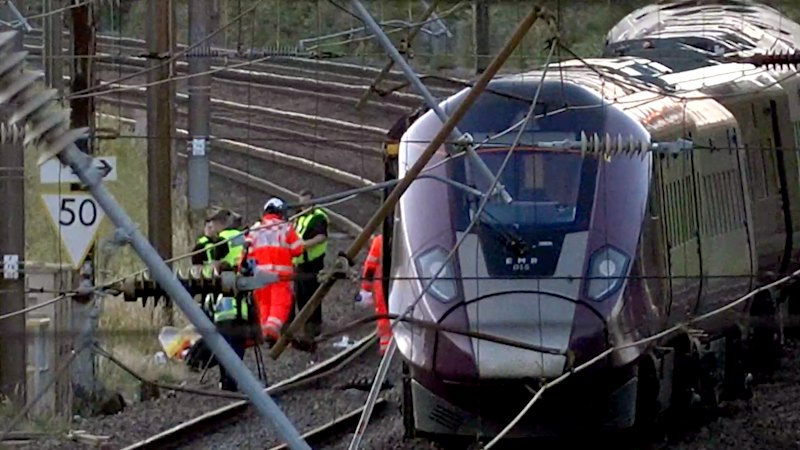
Modern rail networks are designed to be zero-fail systems, where overlapping layers of automation, mechanical interlocks, and human oversight theoretically reduce the probability of a multi-train collision to near zero. When two trains collide on a major artery north of London—resulting in at least one fatality and dozens of injuries—the incident cannot be understood as a mere accident. It represents a sequential breach of the system’s defensive vectors. Resolving why these assets occupied the same spatial coordinates at the same time requires isolating the systemic mechanisms behind infrastructure safety.
The Three Vectors of Rail Interlocking Systems
To understand how a collision occurs, one must map the three core pillars of rail traffic separation. These vectors function as an engineered "Swiss Cheese" model of accident prevention, where a failure occurs only when the holes in every layer align.
- Fixed Block Signaling (The Spatial Vector): Rail networks divide tracks into fixed geographic segments called blocks. Under normal operations, track circuits or axle counters detect the presence of a train within a block, turning the preceding signal red to prevent a second train from entering.
- Automatic Train Protection (The Technical Vector): When a human operator fails to obey a restrictive signal, sub-surface magnets or digital beacons feed telemetry directly to the train’s onboard computer. This triggers an emergency brake application independently of driver input.
- Operational Control Protocol (The Human Vector): Under degraded conditions—such as signal failures or extreme weather—human controllers dictate movements via explicit verbal or digital mandates, bypassing automated interlocks under strict speed limits.
The occurrence of a collision confirms that a systemic breakdown penetrated all three vectors. Either a primary positioning system failed to register the first train, an automatic braking mechanism failed to arrest the second train, or an operational directive mistakenly authorized manual entry into an occupied sector.
Kinetic Energy Transfer and the Mechanics of Impact
The severity of injuries and infrastructure damage in a rail collision is governed by Newtonian mechanics. The total destructive potential is a direct function of kinetic energy ($E_k$), expressed through the classical equation:
$$E_k = \frac{1}{2}mv^2$$
Where $m$ is the total mass of the consist (the linked sequence of rail cars) and $v$ is the velocity at impact. Because velocity is squared, a doubling of speed quadruples the destructive energy transmitted through the train hulls.
When an active train strikes a stationary or slower-moving train, this energy must be dissipated instantly. This occurs through three distinct structural phases:
- Crumple Zone Absorption: Modern rolling stock features dedicated energy-absorbing structures at the chassis ends. These zones deform intentionally to absorb initial megajoules of energy, protecting the passenger cabin.
- Overriding and Jackknifing: Once structural absorption thresholds are exceeded, the kinetic forces seek paths of least resistance. If the couplers fail or buckle, the heavy locomotive or leading carriage can override—climbing on top of the adjacent train—or telescope, where one carriage slices through another.
- Lateral Derailment: Unspent kinetic energy forces the wheels off the rails, causing vehicles to tip or slide sideways into adjacent lines or trackside structures, multiplying secondary impacts for passengers inside.
The Root-Cause Matrix: Isolating the Failure Chain
Independent safety bodies, such as the Rail Accident Investigation Branch (RAIB), focus on a structured root-cause matrix to establish accountability and prevent recurrence. Investigators isolate variables across three specific operational dimensions.
Infrastructure Degradation vs. Signal Malfunction
Tracks and signaling networks face constant mechanical and electrical stress. A primary point of vulnerability is the track circuit. This system relies on the steel wheels and axle of a train short-circuiting a low-voltage electrical current running through the rails, signaling the system that the block is occupied.
If leaf residue, rust, or environmental debris coats the rail head, it can insulate the wheels from the track. This creates a "phantom block" condition where an occupied track appears clear to the signaling center, leaving the system blind to a stationary asset.
Human Error Under Cognitive Load
While automation reduces routine operational tasks, it changes the nature of human error. In high-density corridors north of London, drivers manage tight timetables under variable visibility.
If a driver encounters a yellow "caution" signal but fails to decelerate adequately before the subsequent red "danger" signal, the margin for error drops to zero. Human error analysis looks at whether low-visibility conditions, fatigue, or confusing signal placement created a cognitive bottleneck that delayed driver reaction times.
Systemic Latency in Automatic Braking
European Train Control System (ETCS) and older variants like the Train Protection & Warning System (TPWS) are built to intercept human error. If a train passes a red signal, the system must calculate the required braking curve to stop the vehicle before it reaches the conflict point.
A failure here implies either an onboard hardware fault, a trackside beacon malfunction, or environmental factors—such as wet or greasy rails—that compromised the friction coefficient between the steel wheels and the rail, extending the stopping distance beyond the designated safety overlap.
Immediate Operational Interventions
To stabilize a rail corridor following a major collision and minimize systemic shock, network operators must execute an established sequence of industrial safety protocols.
The immediate imperative is the execution of a regional emergency stop broadcast. This digital command drops all surrounding signals to red and alerts all active cabs within the geographic cell to halt, isolating the incident zone and preventing secondary collisions from oncoming traffic. Simultaneously, traction current to the overhead lines or third rail must be isolated and grounded. This removes the risk of electrocution to passengers evacuating the carriages and allows emergency services to safely access the track layout.
Once the site is electrically and mechanically isolated, the phase shifts to forensic data preservation. Investigators must immediately secure the On-Train Data Recorders (OTDR)—the equivalent of aviation black boxes—from both units. These units log millisecond-by-millisecond inputs of throttle position, braking pressure, signal aspects passed, and GPS positioning. This data is cross-referenced against the solid-state logs of the regional signaling interlocking tower to reconstruct the exact timeline of the failure chain.
The final operational layer requires a complete audit of the rail infrastructure’s defensive technologies. Network operators must accelerate the deployment of Level 2 ETCS, which replaces physical trackside signals with continuous, wireless cab-signaling. This technology removes human visibility limits from the safety equation by constantly enforcing dynamic speed profiles directly inside the driver's console, completely neutralizing the risk of isolated signal misinterpretation.