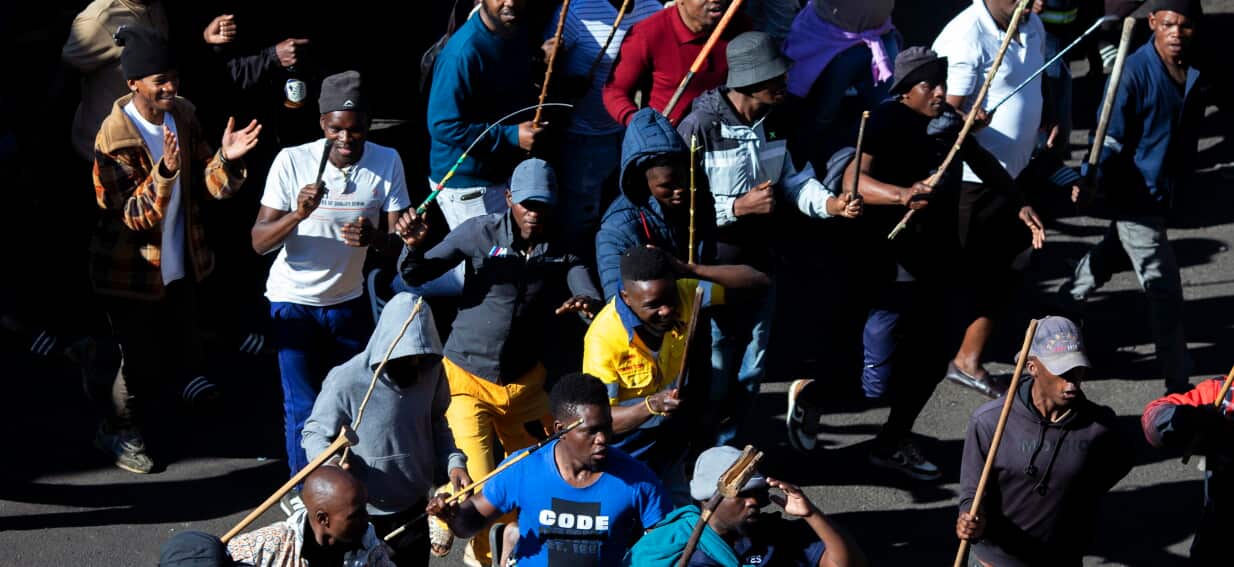
The standard narrative framing South Africa’s recurring waves of anti-immigrant violence treats the phenomenon as a sudden eruption of irrational prejudice or localized lawlessness. This diagnosis is fundamentally flawed. The escalation of coordinated movements—exemplified by targeted community actions and extra-legal ultimatums demanding mass expulsions—is the logical outcome of a highly predictable socio-economic equation. When extreme structural unemployment intersects with a systemic collapse of municipal infrastructure, the state loses its monopoly on order, and marginalized populations naturally default to zero-sum resource competition.
To understand why foreign nationals become the primary target of public anger, one must bypass political rhetoric and examine the underlying structural machinery driving the crisis.
The Tripartite Engine of Scarcity
The mobilization of anti-immigrant sentiment relies on three reinforcing economic realities that squeeze the working-class population.
1. The Realities of Joblessness and Informality
South Africa sustains one of the highest unemployment rates globally, with broad unemployment exceeding 40%. This structural deficit creates an environment where formal labor absorption is mathematically impossible for millions of citizens. Because the formal economy cannot absorb the labor supply, competition shifts entirely to the informal sector—micro-enterprises, retail tuck shops (spaza shops), and casual labor.
Data from administrative tax records indicates that foreign nationals occupy a minimal footprint in the formal economy, holding less than 4% of formal jobs, a metric unchanged for over a decade. The conflict is therefore not a struggle for corporate or industrial employment. Instead, it is concentrated at the survivalist level of the informal economy, where low entry barriers put local and migrant entrepreneurs in direct, unmediated competition for daily subsistence.
2. Municipal Infrastructure Degradation
The flashpoints of anti-immigrant mobilization correlate precisely with geographic areas experiencing localized governance failures. Prolonged electrical grid instability, erratic water distribution, overcrowded public health facilities, and failing municipal sewage systems create an environment of chronic deprivation.
When public services collapse, the domestic population views the presence of non-citizens not merely as a demographic shift, but as an unsustainable addition to a fixed and deteriorating infrastructure load. The struggle for public goods transforms into a zero-sum calculation: every non-citizen utilizing a clinic or occupying space in a school is perceived as directly depriving a citizen of a constitutional right.
3. High-Velocity Cost Inflation
The household economy for the bottom two income quintiles has experienced severe pressure due to the rising costs of food, fuel, and basic utilities. As real purchasing power contracts, the margins for economic survival vanish. This acute financial strain acts as a behavioral accelerant, turning latent frustration with state performance into active, outward hostility toward visible, unprotected migrant populations within the community.
The Political Economy of Scarcity Scapegoating
The conversion of systemic economic anxiety into organized violence requires a mechanism of redirection. In highly unequal societies, political actors and extra-legal formations perform a structural function: they redirect public anger downward rather than upward.
[Systemic Governance Failure] + [Fiscal Austerity]
                       │
                       ▼
         [Severe Resource Scarcity]
                       │
                       ▼
   [Political Redirection & Vigilantism]
                       │
                       ▼
   [Horizontal Conflict / Target: Migrants]
This model explains the displacement of accountability. If marginalized populations correctly identify state corruption, fiscal austerity, and macroeconomic policy failure as the sources of their deprivation, the political elite faces an existential legitimacy crisis. By framing the crisis as an issue of unauthorized cross-border migration, political opportunists offer a simplistic, highly visible explanation. The narrative suggests that if the external population is removed, structural constraints will instantly dissolve—jobs will materialize, housing backlogs will disappear, and public safety will be restored.
This structural misdirection exploits the relative powerlessness of migrant communities. Lacking formal political representation, voting leverage, or consistent institutional protection, foreign nationals function as an accessible surrogate target for grievances that are actually rooted in state incapacity.
Market Distortions and the Counter-Productivity of Vigilantism
The core irony of anti-immigrant economic blockades and forced business closures is that they actively worsen the local economic conditions they claim to solve. This friction introduces distinct economic distortions into township economies:
- Supply Chain Disruption: Independent migrant networks often operate highly optimized, high-volume wholesale sourcing models. Forcibly closing foreign-owned retail operations removes low-cost consumer options, raising prices for local consumers who are already financially vulnerable.
- Destruction of Micro-Capital: Informal commerce relies on velocity and micro-credit networks. When shops are looted or shuttered, local capital is destroyed, reducing overall economic activity within the community.
- Negative Job Multiplier Effects: Empirical assessments demonstrate a positive labor market correlation: micro-enterprises operated by foreign nationals frequently employ local citizens for logistics, security, and retail assistance. Forcing these businesses to close increases local unemployment.
Macroeconomic Guardrails and Policy Constraints
Resolving this destabilizing dynamic requires acknowledging the structural limitations facing South Africa. The state is trapped between a shrinking fiscal trajectory and a massive demand for social spending. Relying solely on immigration enforcement or border militarization will not stabilize the social landscape, because policing cannot fix an underlying structural deficit.
The stabilizing path requires a shift from political scapegoating to targeted structural reforms:
- Formalizing Informal Markets: Municipalities must transition from punitive policing of informal markets to developing micro-infrastructure, such as secure public trading zones and accessible wholesale storage hubs, reducing friction between competing traders.
- Decentralized Infrastructure Investment: Ring-fencing infrastructure budgets for the most vulnerable municipalities is essential to decoupling basic service delivery from local population changes.
- Rigorous Labor Standards Enforcement: Enforcing minimum-wage laws in labor-intensive sectors like hospitality, agriculture, and construction eliminates the incentive for employers to exploit undocumented workers to undercut local labor markets.
Without these systemic interventions, the cycle of horizontal conflict will repeat. As long as economic structural failures remain unaddressed, the domestic population will continue to experience severe resource scarcity, and vulnerable migrant populations will remain the default target for systemic frustration.
For an objective look at the economic impacts of migration and the real drivers of employment within South Africa's borders, watch Can anti-immigration protests solve South Africa's unemployment, which features expert analysis detailing how systemic labor dynamics operate apart from populist narratives.