History does not always arrive with the crash of breaking glass or the roar of marching boots. Sometimes, it enters quietly, wearing a tailored suit, carrying the weight of an impossible transition in a leather briefcase.
Picture a humid July evening in Hong Kong in 1997. The neon signs of Victoria Harbour reflect off a choppy sea, slicing through the dark water in ribbons of electric pink and toxic green. For more than a century, the Union Jack had fluttered over Government House, a symbol of distant empire. Now, that flag was folding for the last time. Beneath a torrential downpour that soaked the collars of dignitaries and journalists alike, sovereignty transferred. A city of millions held its breath, suspended between an illustrious, chaotic past and an opaque, uncharted tomorrow.
Into that breathless vacuum stepped Tung Chee-hwa.
Before he became the first Chief Executive of the Hong Kong Special Administrative Region, Tung was a shipping magnate. He understood the language of steel hulls, deep-water ports, and volatile trade winds. He knew how to keep a massive vessel stable when the ocean turned violent. But nothing in the boardrooms of the Orient Overseas Container Line could have prepared him for the storm he was about to pilot.
He did not seek the job. Beijing wanted stability; London wanted a graceful exit; local business elites wanted reassurance that their fortunes would remain safe. Tung was chosen because he was seen as a safe pair of hands. A businessman with a quiet demeanor, a respected family name, and a deep reverence for familial and civic duty.
Yet, the territory he inherited was a psychological pressure cooker. People were packing their lives into cardboard boxes, heading for Toronto, Sydney, or London, fleeing a phantom they could neither fully name nor escape. Trust was scarce. Walls were going up—between the nervous public and the incoming administration, between local identities and mainland expectations, between fear and possibility.
Tung recognized a fundamental truth that many technocrats miss: economic prosperity means nothing if the people do not feel safe in their own homes.
He set out to build bridges. Not literal spans of concrete and steel across the harbor—though infrastructure projects did multiply under his watch—but fragile, invisible bridges of reassurance. He wanted to stitch together a fractured society.
Consider the magnitude of the task. He had to implement the principle of one country, two systems, a constitutional experiment with zero historical precedent. How do you merge a hyper-capitalist, fiercely independent, free-wheeling society steeped in common law with a rising, centralized socialist superpower?
The answer was never going to be found in a neat political textbook. It required navigating minefields of suspicion on a daily basis.
When the Asian Financial Crisis struck mere months after the handover, speculative forces attacked the Hong Kong dollar, threatening to pull the rug out from under the entire economy. Property values plummeted. Negative equity turned the dream of homeownership into a generational nightmare for thousands of families. Protests erupted. The collective anxiety boiled over into anger.
Critics painted Tung as out of touch, a captain who did not hear the crew screaming from the lower decks. And certainly, some of his policy initiatives—such as the ambitious target to build eighty-five thousand flats a year to solve the housing crisis—collided disastrously with the sudden market crash, derailing his domestic agenda and triggering fierce backlash.
Yet, watch closely what happened beneath the political turbulence. Tung never abandoned his post. He absorbed the blows with a stoic endurance characteristic of his generation. When SARS swept through the city in 2003, turning crowded apartment blocks into silent quarantine zones and bringing tourism to a dead halt, the city faced its darkest hour since the Second World War.
In moments like that, leadership stops being about grand political philosophy and becomes entirely human. It is about nurses in suffocating protective gear sweating through double shifts. It is about neighbors leaving groceries outside apartment doors. And it is about a leader who, despite sinking popularity ratings and intense political pressure, worked behind the scenes to secure mainland support, medical supplies, and economic lifelines to pull the territory back from the brink.
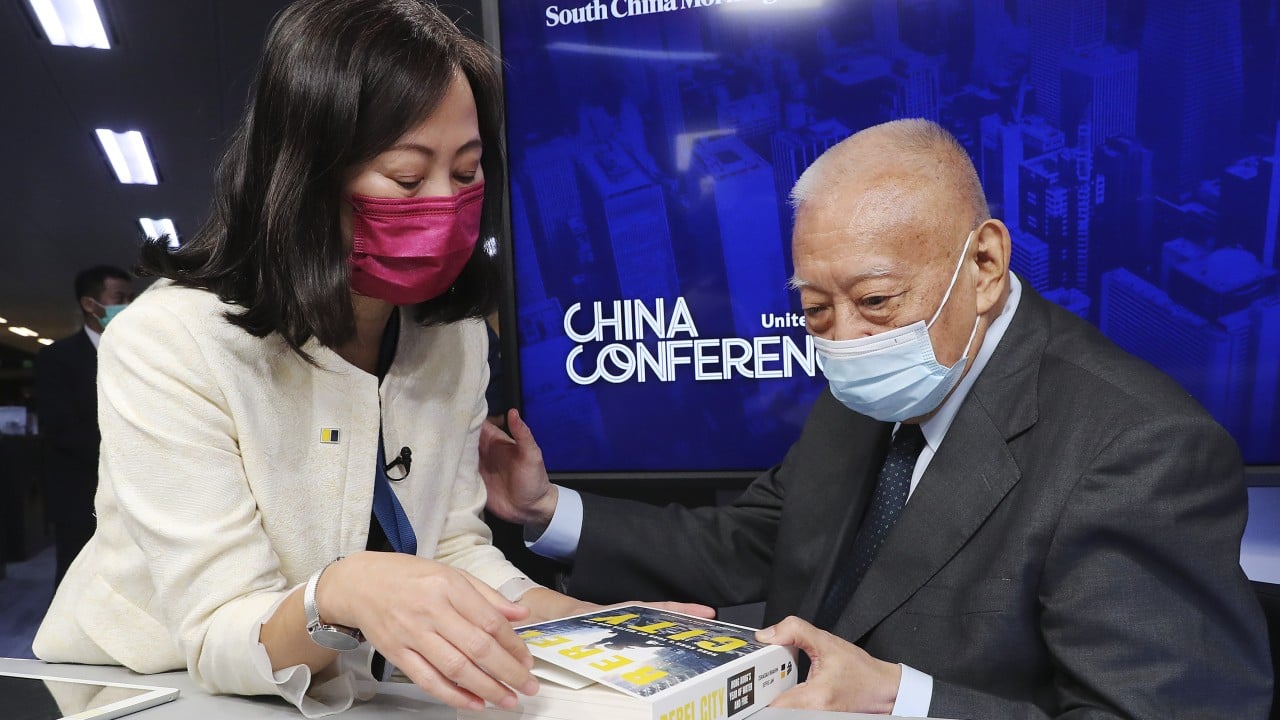
Tammy Tam, looking back years later from her vantage point as editor-in-chief of the South China Morning Post, captured a nuanced reality that simplistic historical narratives often miss. She remembered a man caught in the cruelsome crosscurrents of history, navigating a terrain where every single choice carried massive, unintended consequences. She recalled a leader whose intentions were anchored in a genuine devotion to his home, even when the storms proved too fierce for any single helmsman to completely control.
Tung eventually stepped down in 2005, citing health reasons, leaving behind an office battered by crisis but intact.
History is rarely kind to transition figures. They are the shock absorbers of political evolution, taking the brunt of the impact so that those who follow can roll more smoothly down the road. They bear the scars of a society in pain, absorbing the raw friction of change.
Walk along the Central waterfront today. The skyline is taller, denser, humming with an unyielding, electric energy. Ferries still churn the jade-green waters of the harbor, slicing back and forth between Hong Kong Island and Kowloon. The bridges span the water, carrying millions of lives across physical and economic divides every single day.
The walls that Tung tried to bridge have mutated, shifting into new shapes for a new era. But the fundamental challenge remains identical to the one that hung heavy in the rainy air of July 1997. How do human beings find common ground when history pushes them apart?
The answer does not rest in grand constitutional declarations or sleek corporate mission statements. It rests in the quiet, stubborn persistence of ordinary people refusing to let the bridges burn behind them, choosing instead to walk across, one hesitant step at a time, into the noise and the light of whatever comes next.

.png)

