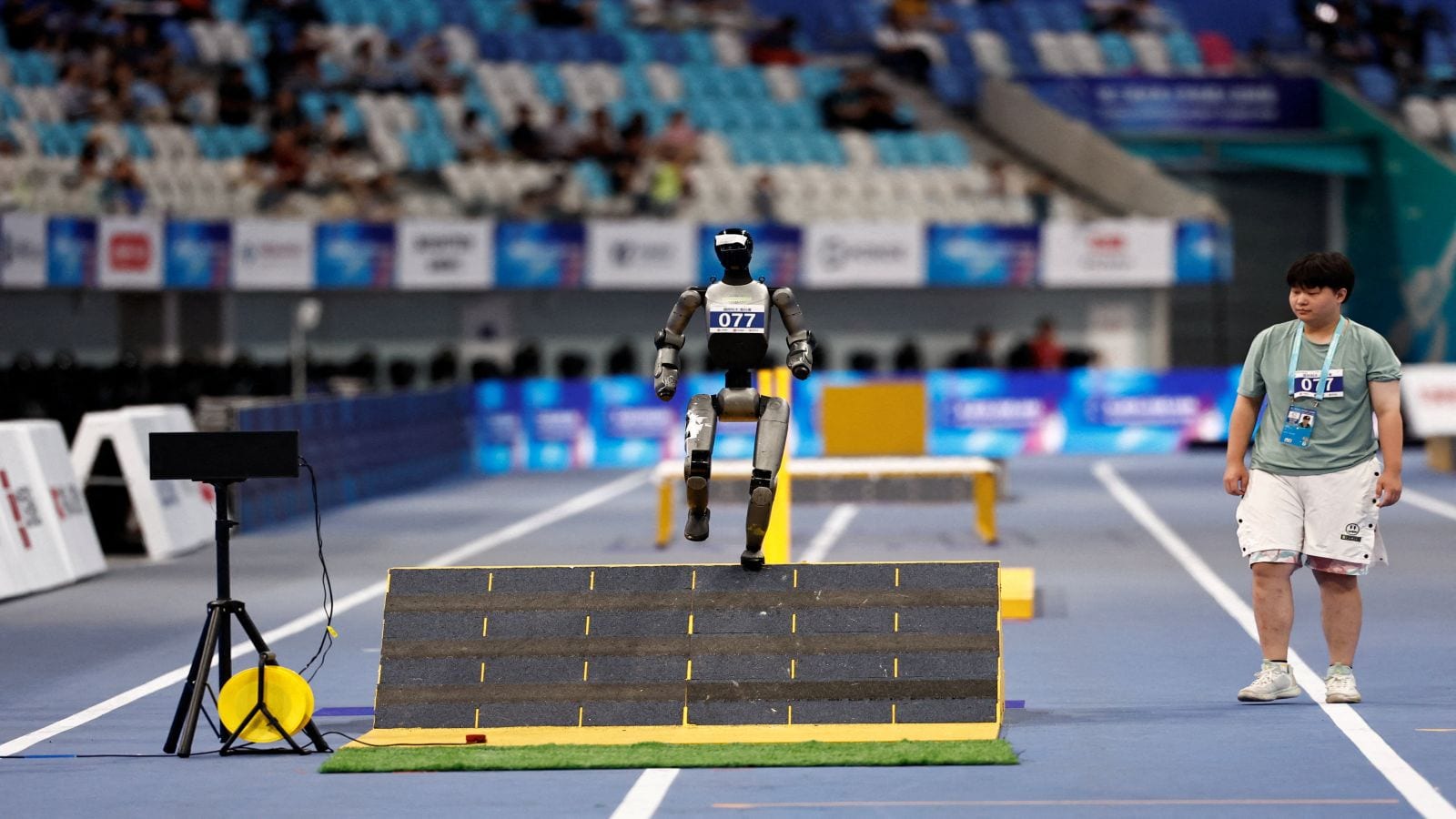
The convergence of high-frequency actuation and distributed neural control has moved past theoretical benchmarking. At the National Speed Skating Oval in Beijing, the second iteration of the World Humanoid Robot Games exposed both the mechanical acceleration and the systemic vulnerabilities of contemporary bipedal platforms. With 2,056 registered units across 666 teams competing in 51 discrete categories, the event served as an empirical stress test for hardware durability, power density, and closed-loop algorithmic autonomy.
Media coverage frequently defaults to anthropomorphic spectacle—highlighting sprint times that outperform biological records. However, a rigorous engineering analysis requires stripping away the headlines to examine the underlying mechanical trade-offs, thermal management failures, and control-loop latencies that dictate why certain platforms succeed while others experience catastrophic structural failure on the track.
The Mechanics of Speed versus Thermal Dissipation
The primary technical narrative of the competition centered on high-velocity linear locomotion, specifically the sub-ten-second 100-meter sprints achieved by platforms such as Tiangong Ultra and Lightning. To deconstruct these achievements, one must examine the cost function of electric actuation under extreme transient loads.
Biological sprinters like Usain Bolt rely on variable compliance, elastic tendon storage, and neuromuscular feedback loops that optimize energy return across asymmetrical terrain. Conversely, high-performance humanoid platforms substitute biological muscle with brushless direct-current motors, harmonic drives, and rigid skeletal frames made of carbon fiber or aerospace-grade aluminum alloys.
Achieving a peak velocity exceeding 14 meters per second requires instantaneous torque spikes that push motor windings and inverter circuits to their thermal thresholds. The structural failures observed during the trials—such as thermal runaway, actuator burnout, and violent deceleration crashes resulting in structural fires—highlight a core engineering bottleneck. High power-to-weight ratios generate intense localized heat within the torso and hip assemblies. Without active liquid cooling systems or heavy heat sinks that would otherwise compromise the payload-to-weight ratio, these machines operate on a razor-thin thermal margin.
The mechanics of the sprint reveal a stark divergence between raw actuator capability and stabilization control:
- Actuator Output: Peak torque generation is sufficient to break linear speed benchmarks over short distances, driven by high-voltage battery discharges.
- Feedback Latency: Sensor fusion loops processing inertial measurement units and joint encoders often struggle to correct micro-oscillations at high speeds.
- Ground Reaction Forces: Rigid foot designs lacking biomimetic dampening transfer shock waves directly up the kinematic chain, destabilizing the onboard computation units.
The Autonomy Spectrum and Control Architecture
A critical evaluation of the 51 events requires separating remotely operated or pre-programmed trajectory execution from fully autonomous navigation. While the short sprints permitted telemetry assistance, events spanning longer durations and complex spatial interactions mandated autonomous perception-action loops.
The architectural challenge of a humanoid robot operating in unstructured scenarios lies in the sensor-processing pipeline. Unlike wheeled or quadrupedal robots with lower centers of mass and simplified kinematic trees, humanoids must continuously solve a high-dimensional balancing problem while processing dense point clouds from LiDAR and stereoscopic cameras.
The transition from individual linear races to multi-agent scenario events—such as automated emergency response, industrial assembly tasks, and robotic football—exposes the limitations of current decentralized reasoning. In football matches, machines exhibited improved dribbling and ball-tracking mechanics, yet passing sequences and spatial positioning remained constrained by inference latency in onboard vision-language-action models. The computational overhead required to interpret a dynamic playing field forces a compromise between inference frequency and physical reaction speed.
When robots engage in high-impact scenario events, such as freestyle fighting or heavy lifting, the control architecture must dynamically switch between position control and impedance control. Impedance control allows the robot's joints to act with calculated compliance, absorbing external forces rather than resisting them rigidly. Platforms that failed to modulate joint stiffness promptly upon impact experienced catastrophic gear stripping or structural fracture.
Capital Allocation and Supply Chain Concentration
Beyond the physical hardware, the competitive ecosystem reflects macroeconomic consolidation. Approximately ninety percent of the competing teams originated from domestic Chinese entities, supported by deep industrial supply chains for precision reducers, frameless motors, and localized sensor suites.
The valuation responses in public markets, exemplified by significant capital inflows into foundational robotics firms like Unitree, underscore a broader industrial pivot. Governments and private equity syndicates are treating humanoid robotics as a strategic manufacturing asset rather than a pure academic pursuit.
This capital concentration alters the engineering incentives. Instead of prioritizing general-purpose adaptability—such as zero-shot generalization to unseen household environments—teams frequently optimize for demonstration-heavy metrics: vertical jump heights, sprint velocities, and synchronized aesthetic displays. While these metrics provide immediate marketing value, they do not correlate linearly with commercial utility in unstructured logistics or eldercare environments.
Systemic Limitations in Dexterous Manipulation
While athletic spectacles dominate public discourse, the industrial and scenario-based subsets of the competition provided a more accurate gauge of technological maturity. Dexterous-hand categories, requiring fine-motor precision such as thread tightening, electronic component assembly, and bean sorting, revealed the persistent fragility of multi-fingered end-effectors.
Tactile feedback integration remains underdeveloped relative to visual perception. Human manipulation relies heavily on distributed mechanoreceptors across the glabrous skin, providing millions of parallel data streams regarding slip, texture, and normal force. Artificial hands relying on sparse tactile arrays or vision-based tactile sensing struggle to maintain stable grasps when subjected to oil, dust, or variable friction coefficients typical of real-world factories.
The primary constraints limiting the commercial deployment of these platforms are threefold:
- Mean Time Between Failures: Mechanical wear on cable-driven or gear-heavy fingers under continuous load reduces operational endurance.
- Energy Density Limitations: Operating an untethered, full-sized humanoid with high-dof manipulation capabilities for more than two hours under heavy load remains constrained by current lithium-ion chemistry limits.
- Software Generalization: Sim-to-real transfer gaps cause policies trained in physics engines to degrade when confronted with the physical anomalies of legacy manufacturing infrastructure.
Prioritize investment in thermal management architectures and sensor-fusion redundancy rather than actuator output optimization. The limiting factor of bipedal robotics is no longer peak mechanical force, but system-level reliability under sustained operational stress.