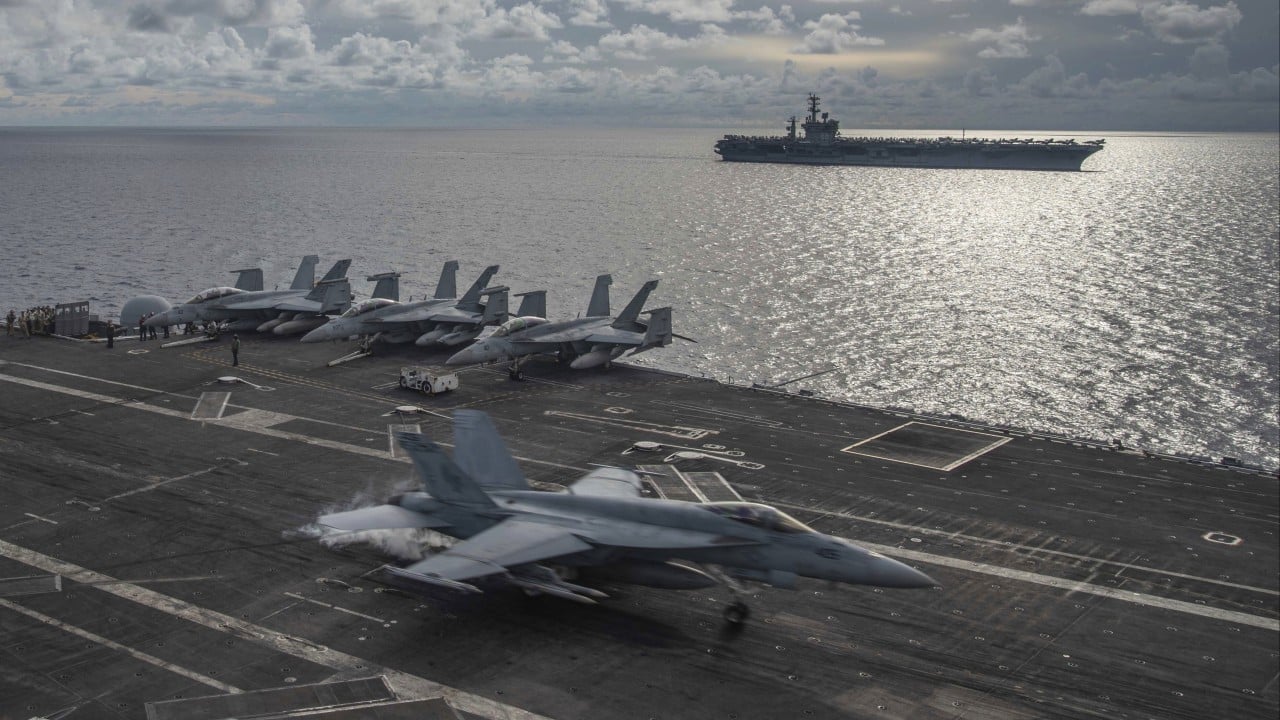
Synchronizing operational military talks in Shanghai with executive summitry in Shenzhen converts tactical maritime safety into a diplomatic shock absorber. When US and Chinese naval delegations convened for the second 2026 working group meeting and annual session of the Military Maritime Consultative Agreement (MMCA) from November 18 to November 20, the timing was deliberate. Parallel to President Donald Trump and President Xi Jinping meeting on the sidelines of the Asia-Pacific Economic Cooperation (APEC) summit in Shenzhen, mid-level commanders were locking in the 2027 maritime safety agenda. Standard geopolitical reporting treats these parallel tracks as routine diplomatic choreography. In practice, this dual-track alignment represents a calculated effort to decouple tactical collision risk from high-level political volatility.
The Structural Anatomy of the Dual-Track Mechanism
Modern great-power competition suffers from a persistent synchronization problem: political leaders negotiate macro-level frameworks while tactical operators execute micro-level maneuvers in contested zones. Without an institutional bridge, a single miscalculation by a destroyer captain or fighter pilot in the South China Sea or the Taiwan Strait can instantly derail head-of-state diplomacy.
To understand why the November 2026 Shanghai meetings matter, analysts must separate the diplomatic theater from the operational mechanics. The architecture relies on three distinct tiers of engagement:
- Executive Political Signaling (Shenzhen): At the APEC summit, Trump and Xi established the overarching political tolerance for bilateral friction. Executive meetings set the macro-incentives, signaling to both bureaucracies whether aggressive posturing will be rewarded or penalized.
- Institutionalized Operational Guardrails (Shanghai): Operating under the 1998 MMCA framework, US Indo-Pacific Command (INDOPACOM) and People’s Liberation Army (PLA) Navy and Air Force officers reviewed specific incidents of unsafe intercepts. Their mandate is strictly technical: establishing rules of behavior for unplanned encounters at sea and in the air.
- Forward-Looking Agenda Locking (The 2027 Schedule): By finalizing the 2027 working group calendar during the November session, both militaries created bureaucratic inertia. Scheduled meetings force internal staff reviews, requiring both defense establishments to audit their own operational compliance ahead of future sessions.
The causal link between these tiers is asymmetric. Executive summits do not solve tactical maritime disputes, nor do MMCA sessions resolve territorial sovereignty claims. Instead, the MMCA functions as a circuit breaker. When political tension spikes, the existence of an active, scheduled military-to-military channel prevents localized tactical friction from escalating into an unmanageable strategic crisis.
Deconstructing the Military Maritime Consultative Agreement
Standard media summaries characterize the MMCA as a confidence-building measure aimed at promoting regional peace. This framing obscures the actual mechanics of the agreement. The MMCA is not a treaty, an arbitration body, or a conflict-resolution mechanism. It is a technical risk-management protocol designed to reduce the probability of accidental kinetic escalation.
The Historical Fragility of Military Channels
The operational value of the MMCA is best measured by the consequences of its absence. In August 2022, following then-US House Speaker Nancy Pelosi’s visit to Taiwan, Beijing suspended MMCA dialogues alongside several other bilateral defense channels. During the subsequent twenty-month blackout, the rate of coercive and risky aerial and maritime intercepts in the Indo-Pacific surged. Without a formal venue to review telemetry, radar logs, and bridge-to-bridge communication failures, tactical commanders operated with higher ambiguity and lower accountability.
Following the November 2023 presidential summit in Woodside, California, the mechanism was reactivated, with working group meetings resuming in April 2024 on a biannual cadence. The November 2026 Shanghai session marks the continuation of this post-resumption rhythm—specifically the second working group meeting of the calendar year paired with the formal annual review.
Tactical Friction Variables
Inside the Shanghai working groups, discussions focus on concrete physical variables rather than abstract diplomatic principles. Practitioners evaluating maritime and aerial safety examine four primary failure points:
- Closure Rates and Minimum Safe Distances: High-speed intercepts involving maritime patrol aircraft or surface combatants leave seconds for human correction. Delegations review specific incidents where lateral or vertical separation fell below standard international norms, such as those outlined in the Convention on the International Regulations for Preventing Collisions at Sea (COLREGs) and the Code for Unplanned Encounters at Sea (CUES).
- Active Sensor and Illumination Protocols: The use of fire-control radar lock-ons, high-intensity lasers, or chaff deployment during routine reconnaissance flights creates immediate ambiguity. To a target platform, a fire-control lock is indistinguishable from the precursor to a weapons release. MMCA sessions attempt to standardize warning thresholds and discourage non-kinetic harassment.
- Bridge-to-Bridge and Air-to-Air Communications: Even when vessels operate within legal international waters, linguistic misunderstandings or unmonitored radio frequencies can turn a routine passing maneuver into a dangerous game of chicken. Establishing standardized phraseology on VHF Channel 16 and international guard frequencies reduces the cognitive load on junior watch officers.
- Unmanned Systems Integration: As both the US Navy and the PLA deploy autonomous surface vessels and long-endurance reconnaissance drones, traditional human-centric collision rules break down. Defining liability and intercept boundaries for unmanned platforms represents a growing operational requirement for the 2027 agenda.
The Economics of Escalation and Strategic Deterrence
To evaluate why both Washington and Beijing invest political capital in these parallel tracks, one must apply game theory and cost-benefit analysis to naval operations. Both states operate under a classic security dilemma in the Western Pacific, yet their immediate operational incentives diverge sharply.
The Asymmetric Cost Function of Incidents
For the United States, maintaining freedom of navigation and persistent intelligence, surveillance, and reconnaissance (ISR) coverage along the First Island Chain is a foundational requirement for alliance credibility. An accidental collision—similar to the April 2001 EP-3E surveillance plane incident near Hainan Island—imposes severe strategic costs on Washington. It disrupts regional diplomatic alignments, forces crisis-management bandwidth away from other global theaters, and risks the loss of sensitive military personnel and hardware.
For China, aggressive intercepts serve a dual purpose: they demonstrate resolve to domestic audiences and attempt to raise the operational cost of US forward presence. However, Beijing faces a distinct threshold constraint. China’s economic stability depends heavily on uninterrupted maritime trade flows through the South China Sea and the East China Sea. A lethal maritime collision that triggers naval blockades, spikes maritime insurance premiums, or disrupts global supply chains directly threatens Beijing’s domestic economic priorities.
The cost function for both powers reveals a narrow zone of mutual interest: neither side wants an unintended kinetic clash to dictate the timeline of a broader conflict. By holding the Shanghai talks simultaneously with the Xi-Trump bilateral in Shenzhen, both governments signal to global markets and regional allies that competition remains bounded by rational risk management.
Crisis Stability vs. Strategic Coercion
A critical distinction in military strategy separates crisis stability from deterrence. Deterrence relies on convincing an adversary that the costs of aggression outweigh the benefits. Crisis stability, conversely, depends on ensuring neither side feels pressured to strike first or escalate rapidly during a tense standoff due to fear of miscalculation.
The MMCA exclusively targets crisis stability. It does not alter the underlying balance of power, nor does it compel either navy to alter its strategic patrol routes. When US Pacific Command states that the Shanghai talks focused on "reducing the risk of unsafe and unprofessional encounters," it is describing an effort to preserve crisis stability while competitive patrols continue unabated.
Operational Blind Spots and Institutional Limitations
Treating the resumption and continuation of the MMCA as a guarantee of regional stability is an analytical error. Relying on procedural military dialogues to contain structural geopolitical rivalry introduces specific vulnerabilities that practitioners must account for.
The Leveraged Suspension Problem
The primary flaw of the MMCA is its status as a diplomatic deliverable rather than an inviolable safety baseline. Beijing historically treats military-to-military communication channels as political rewards that can be revoked to register displeasure over US arms sales to Taiwan, diplomatic visits, or trade restrictions. When safety mechanisms are weaponized as diplomatic leverage, they vanish precisely when geopolitical tension is highest and the risk of accidental collision is most acute. The 2022–2024 suspension proved that institutional inertia cannot survive a deliberate political decision to sever contact.
Structural Divergence in Legal Interpretations
Technical rules of the road cannot override fundamental disagreements over maritime jurisdiction. The United States conducts Freedom of Navigation Operations (FONOPs) and aerial reconnaissance within China’s Exclusive Economic Zone (EEZ) based on the United Nations Convention on the Law of the Sea (UNCLOS), which permits military activities beyond the 12-nautical-mile territorial sea. China interprets domestic legislation and international law as granting coastal states the right to regulate foreign military activities within their 200-nautical-mile EEZ.
Because the Shanghai working groups explicitly avoid resolving sovereignty and legal disputes, tactical commanders remain locked in conflicting operational mandates. A PLA pilot ordered to shadow and deter a US reconnaissance aircraft in what Beijing views as a restricted zone is executing state policy, regardless of how politely the subsequent MMCA working group reviews the flight telemetry.
The Principal-Agent Friction in Contested Zones
Even when senior leadership in Shenzhen and Shanghai agree on professional standards, execution depends on junior officers operating under high stress. In naval and aerial operations, the principal-agent problem manifests when local commanders interpret ambiguous rules of engagement aggressively to demonstrate competence or patriotism to their superiors. Without transparent disciplinary mechanisms—which neither military shares with the other—agreements reached in conference rooms degrade rapidly when two warships converge at 25 knots in low visibility.
Strategic Forecast for the 2027 Maritime Cycle
The alignment of the November 2026 Shanghai MMCA session with the Shenzhen leadership summit establishes a predictable operational baseline for the coming year. By locking in the 2027 working group schedule, both defense establishments have signaled an intent to maintain communication channels through the next fiscal and political cycle.
Quantitative Indicators to Monitor
Analysts tracking the durability of this framework over the next twelve months should disregard official diplomatic readouts praising "candid and constructive" exchanges. Instead, monitor three concrete operational metrics:
- Intercept Telemetry Releases: Track the frequency with which the US Department of Defense declassifies video and photographic evidence of unsafe PLA intercepts. A sustained drop in public releases indicates that operational behavior at sea is aligning with the Shanghai discussions. A sudden spike signals that political friction has overridden technical guardrails.
- Calendar Adherence Under Stress: Observe whether the first scheduled 2027 working group meeting occurs on time following inevitable political flashpoints, such as US transit operations through the Taiwan Strait or joint multilateral exercises in the Philippine Sea. Execution of the meeting during a period of diplomatic friction confirms that the MMCA has successfully decoupled from political leverage.
- Expansion of Technical Scope: Watch for the formal inclusion of unmanned aerial and surface vehicles in 2027 MMCA communiqués. Failure to establish protocols for autonomous platforms will leave a widening operational gap as both fleets scale up uncrewed deployments.
The Tactical Play for Maritime Operators and Risk Analysts
Organizations operating commercial vessels, subsea infrastructure, or defense supply chains in the Western Pacific must treat the Shanghai-Shenzhen alignment as a temporary reduction in tail-risk rather than a structural shift in regional security.
- Maintain Elevated Transit Buffers: Commercial shipping and energy logistics planners should not reduce war-risk insurance coverage or narrow routing buffers around the Taiwan Strait and the Spratly Islands based on diplomatic summitry. The underlying legal and territorial disputes remain entirely unresolved.
- decouple Political Headlines from Operational Readiness:* Defense and geopolitical risk teams must index their threat assessments to physical force posture—such as PLA naval deployment tempos and US carrier strike group movements—rather than diplomatic statements. The MMCA lowers the probability of an accidental spark, but it does nothing to remove the fuel accumulated across the First Island Chain.
- Prepare for Asymmetric Disruptions: Because direct kinetic clashes are actively managed through mechanisms like the MMCA, state competition will increasingly migrate toward gray-zone vectors. Expect heightened activity in non-lethal maritime militia swarm tactics, subsea cable interference, and cyber-electromagnetic spectrum contestation, all of which fall outside the narrow safety mandate of traditional naval consultative agreements.