Most retrospective profiles of Patrick Stewart rely on sentimental anecdotes and chronological trivia, failing to explain the actual operational mechanics behind a six-decade career that spans the Royal Shakespeare Company, network television syndication, and billion-dollar cinematic franchises. Stewart’s trajectory is not a product of luck or mere charisma; it is the result of deliberate, high-leverage positioning across three distinct entertainment economies. By examining his career through the frameworks of brand equity transfer, vocal acoustics, and cross-medium adaptation, we can isolate the exact variables that transformed a regional stage actor into an enduring global asset.
The Dual-Engine Brand Architecture
Actors typically face a binary market trap: remain in high-prestige, low-margin theatrical work, or pivot to high-margin, low-prestige commercial franchises that erode critical standing. Stewart bypassed this trade-off by constructing a dual-engine career architecture where classical legitimacy subsidized commercial credibility, and commercial capital funded theatrical risk.
When Paramount Pictures cast Stewart as Captain Jean-Luc Picard in Star Trek: The Next Generation in 1987, the studio was attempting to reboot a dormant intellectual property without the original cast. Standard television casting favors familiar faces with proven ratings history. Paramount’s decision to hire a 47-year-old British Shakespearean actor with virtually zero mainstream American television recognition appeared counterintuitive. Yet, this exact deficit created an asymmetric advantage. Because American audiences had no prior comedic or melodramatic associations with Stewart, they accepted his authoritative cadence as intrinsic to the character.
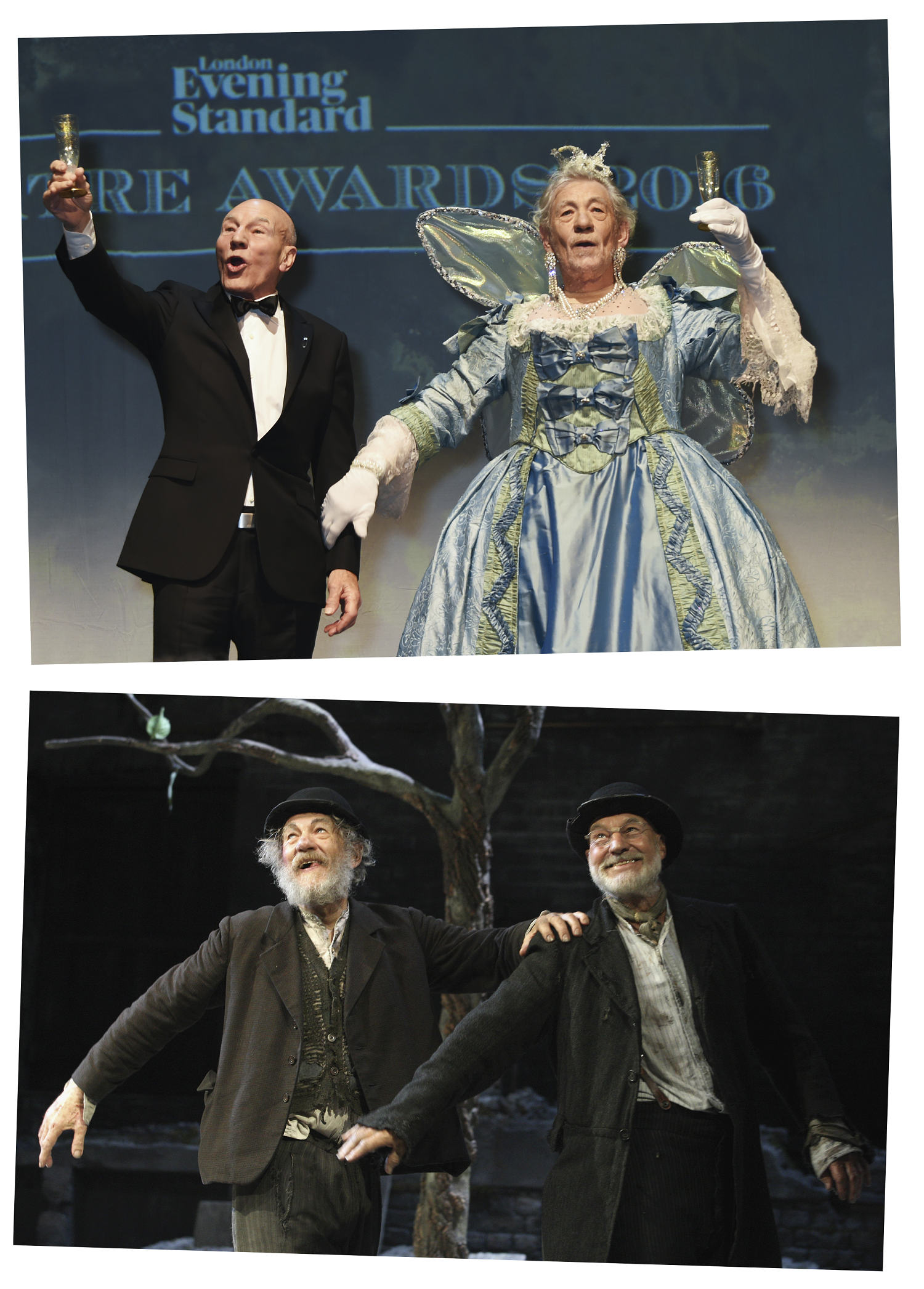
This dynamic illustrates signaling theory in media economics. Stewart’s twenty-year tenure with the Royal Shakespeare Company functioned as a high-cost signal of competence and gravitas. In turn, that gravitas stabilized the early, uneven scripts of The Next Generation, elevating a syndicated science-fiction program into a cultural institution. Once the series achieved syndication dominance—generating hundreds of millions in licensing revenue—Stewart converted that newfound commercial leverage back into stage capital, returning to Broadway and the West End in productions like The Tempest, Macbeth, and Waiting for Godot. Each medium reinforced the other, preventing the brand dilution that typically afflicts aging television stars.
Vocal Mechanics and Authority Signaling
To understand why Stewart commands attention in environments ranging from minimalist black-box theaters to CGI-heavy blockbusters, one must analyze his primary technical instrument: his voice. In audiovisual media, vocal delivery operates as an immediate proxy for cognitive authority and emotional stability.
Stewart’s vocal profile is defined by three measurable acoustic characteristics:
- Subglottal Resonance and Pitch Control: Trained in the pre-amplification traditions of British repertory theater, Stewart projects from the diaphragm rather than the throat. This produces a rich, low-frequency resonance that maintains clarity even at low volume. In audio mixing, baritone frequencies cut through dense orchestral scores and ambient sound effects without requiring artificial compression, allowing his dialogue to dominate a scene effortlessly.
- Consonant Articulation: Classical verse speaking requires precise plosive and fricative enunciation to carry meaning across large auditoriums. Applied to television and film, this precision eliminates vocal ambiguity. When Stewart delivers exposition-heavy sci-fi terminology or comic-book lore, the crispness of his diction lends pseudo-scientific plausibility to fictional concepts.
- Cadence Variation: Rather than relying on volume escalation to convey anger or urgency, Stewart utilizes tempo deceleration and strategic pauses. By slowing his delivery during high-stakes narrative moments, he forces the pacing of the entire scene to conform to his rhythm, establishing psychological dominance over scene partners.
This technical foundation explains why Stewart became an elite voice actor alongside his on-camera work. Whether narrating documentaries, voicing animated characters, or lending weight to video game protagonists, his vocal track alone carries sufficient structural integrity to anchor a production.
Franchise Risk Management and the Professor X Pivot
By the late 1990s, Stewart faced the primary existential threat of every iconic television lead: terminal typecasting. Following seven seasons and multiple feature films as Jean-Luc Picard, the market viewed him almost exclusively through the lens of a single archetype. A lesser strategist would have either retreated entirely into theater or accepted diminishing returns in direct-to-video thrillers. Instead, Stewart executed a calculated lateral move into a nascent, unproven genre.
In 2000, Stewart accepted the role of Professor Charles Xavier in Bryan Singer’s X-Men. At the time, the superhero film genre was commercially toxic following the critical and financial collapse of Batman & Robin in 1997. Signing onto a comic-book adaptation carried significant reputational risk for a classically trained actor. However, the structural alignment between Xavier and Picard minimized character friction while maximizing audience expansion.
Both characters operate as moral philosopher-kings leading idealistic ensembles through existential crises. By stepping into the Xavier role, Stewart retained his core brand attributes—empathy, intellectual rigor, and leadership—while porting them to a younger, demographically distinct audience. X-Men grossed nearly $300 million globally, reviving the superhero genre and launching a twenty-year cinematic franchise. Stewart’s participation was not incidental to that success; alongside Ian McKellen as Magneto, Stewart provided the dramatic ballast required to convince mainstream audiences to take a story about genetic mutants seriously.
Crucially, Stewart avoided the trap of franchise complacency. While continuing to appear in the X-Men series, he actively subverted his dignified public persona through recurring appearances on Seth MacFarlane’s animated series American Dad! as CIA Deputy Director Avery Bullock. By voicing an unhinged, morally bankrupt bureaucrat, Stewart demonstrated high self-awareness, insulating himself from parody by executing the parody himself. This deliberate tonal whiplash prevented his authoritative image from hardening into self-importance.
The Structural Limitations of the Legacy Revival
Evaluating Stewart’s later career requires confronting a critical strategic vulnerability: the diminishing returns of nostalgia-driven intellectual property. In 2020, Stewart returned to his most famous role in Star Trek: Picard, a streaming series designed to anchor Paramount+’s subscriber acquisition strategy. While the project leveraged immense built-in audience goodwill, it also exposed the inherent friction between an actor’s desire for artistic evolution and a corporation’s demand for brand consistency.
In the first two seasons of Picard, Stewart exercised significant creative influence, steering the narrative away from traditional Starfleet procedural adventures toward a slower, trauma-focused character study. From a purely artistic standpoint, the impulse to deconstruct an aging hero is logical. From a market standpoint, however, dismantling the core competency of a beloved archetype alienates the core demographic. Viewership data and critical consensus indicated sharp audience fatigue when the series sidelined the familiar tonal mechanics of The Next Generation in favor of bleak psychological deconstruction.
The corrective action taken in the third and final season of Picard proves the rule. When showrunner Terry Matalas restored the original ensemble cast, rebuilt the classic starship bridge, and returned to traditional narrative structures, critical reception and streaming metrics rebounded immediately. The lesson for entertainment executives and legacy talent is unambiguous: nostalgia assets possess rigid structural boundaries. You can age a character, and you can deepen their emotional stakes, but if you strip away the foundational traits that generated the original brand equity, the asset loses its market value.
Vulnerability as a Strategic Multiplier
A frequently overlooked component of Stewart’s public longevity is his management of personal narrative. For decades, Stewart projected an image of impenetrable British stoicism, a persona reinforced by his commanding roles. Yet, in the latter third of his career—culminating in his 2023 memoir Making It So—Stewart systematically dismantled that facade by公开 discussing his impoverished childhood in Yorkshire, the domestic abuse inflicted by his father, and his early struggles with emotional intimacy.
In reputation management, sudden vulnerability from an authority figure creates high-impact engagement. Because Stewart waited until his professional legacy was unassailable before disclosing personal trauma, the disclosures did not weaken his market standing; they humanized it. Audiences retroactively recontextualized his disciplined, composed performances as the hard-won armor of a survivor rather than the effortless entitlement of an aristocrat.
This shift also allowed Stewart to champion social causes—specifically domestic violence awareness and end-of-life autonomy—with authentic moral authority rather than generic celebrity endorsement. By aligning his personal history with concrete advocacy, he transformed his public platform from a promotional vehicle into a credible civic instrument.
Operational Takeaways for Long-Horizon Career Design
Stewart’s sixty-year trajectory offers a repeatable blueprint for professionals operating in high-volatility, winner-take-all markets. Sustaining relevance across multiple generational shifts requires abandoning passive career management in favor of disciplined portfolio allocation:
- Arbitrage Prestige Across Markets: Never allow success in a single vertical to define your total market value. Use the financial capital generated in commercial sectors to fund high-risk, high-prestige projects in niche sectors, and use the credibility earned in niche sectors to command premium pricing in commercial markets.
- Master the Foundational Medium: Trends in distribution—from regional theater to network syndication to algorithmic streaming—are transient. Technical mastery of core fundamentals, such as vocal control, physical presence, and textual analysis, remains platform-agnostic and immune to technological disruption.
- Subvert Your Own Archetype Before the Market Does: When a specific professional identity becomes overwhelmingly successful, proactively introduce controlled contradictions. Engaging in self-aware subversion neutralizes external parody and signals adaptability to decision-makers.
- Respect the Boundaries of Core Assets: Innovation within an established brand requires preserving the foundational value proposition. Deconstruction works only when the audience still recognizes the underlying architecture that attracted them initially.
The next phase of Stewart’s career will inevitably transition from active production to archival curation and institutional mentorship. As artificial intelligence and synthetic media begin to replicate vocal and visual likenesses, Stewart’s body of work stands as a benchmark for unreplicable human craft. Talent agencies and studio executives looking to build durable, multi-decade franchises must stop chasing transient social media metrics and return to the foundational mechanics Stewart proved over six decades: rigorous classical training, strategic cross-genre positioning, and an uncompromising commitment to structural craft.