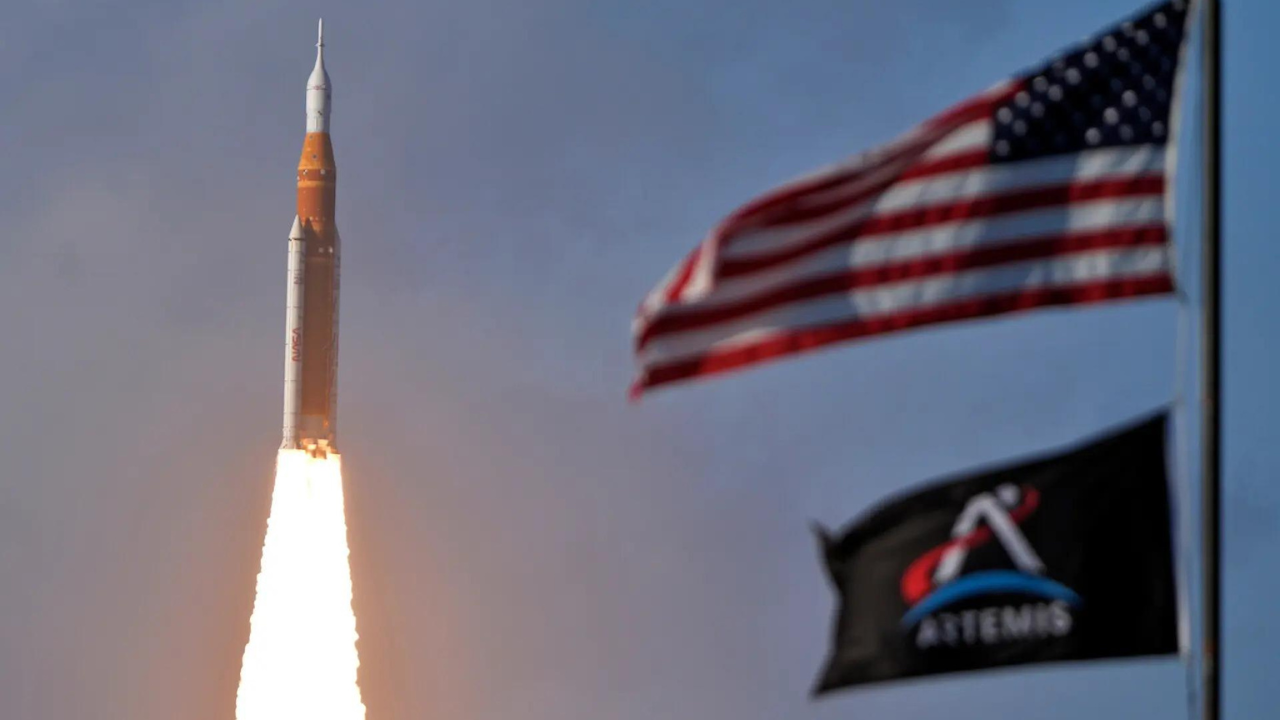
Stop calling it a lunar landing. Stop calling it a "giant leap." Artemis II is a ten-day high-altitude circle jerk designed to mask the fact that NASA is decades behind its own schedule and billions over its own budget.
The mainstream press is currently tripping over itself to publish "mission timelines" that read like travel brochures. They talk about the "Free Return Trajectory" as if it’s a stroke of navigational genius rather than a physics-mandated safety net for a craft we don't fully trust yet. They highlight the crew diversity to distract you from the technical stagnation.
If you want the truth, Artemis II isn't the beginning of a new era. It is a desperate, $4 billion rehearsal for a play that doesn't have a final act.
The SLS Is a Jobs Program Not a Rocket
The Space Launch System (SLS) is the backbone of Artemis. It’s also an archaic Frankenstein’s monster. NASA took the Space Shuttle’s Solid Rocket Boosters—technology that essentially dates back to the late 1970s—and strapped them to a core stage that uses RS-25 engines. Those engines are literally "reusable" Shuttle relics that we are now throwing into the ocean after a single use.
It is the height of fiscal insanity.
We are spending $2 billion per launch on a "disposable" rocket in an era where SpaceX and even Blue Origin have proven that reusability is the only way to scale. NASA isn't innovating; they are recycling. They’re using the Moon as a justification to keep legacy aerospace contractors like Boeing and Northrop Grumman on a permanent government IV drip.
Every time you see that orange tank lift off, remember: you’re watching $2 billion of non-recoverable hardware sink to the bottom of the Atlantic. That isn't progress. It's a museum piece with a fresh coat of paint.
The Orion Heat Shield Scandal
The "lazy consensus" says Artemis II is a safe next step because Artemis I was a "resounding success."
It wasn't.
During the uncrewed reentry of Artemis I, the Orion capsule’s heat shield didn't char the way it was designed to. It "ablated" unevenly. Small chunks of the protective material broke off in a way that engineers didn't predict. In the world of aerospace, "unpredicted" is a polite word for "we almost lost the vehicle."
NASA is currently hand-waving this away, claiming the margins are sufficient for a crewed flight. But let's be blunt: they are sending four human beings—Reid Wiseman, Victor Glover, Christina Koch, and Jeremy Hansen—into a high-velocity reentry at $25,000$ mph while still "studying" why the shield behaved unexpectedly.
If this were a private car manufacturer, there would be a massive recall. Because it’s NASA and the "National Interest" is at stake, it’s a "calculated risk." We are betting four lives on a "good enough" fix because the political optics of a delay would be terminal for the program’s funding.
The "Free Return" Trap
The media loves to talk about the "Free Return Trajectory" as a feature. It’s actually a limitation.
Artemis II will not orbit the Moon. It will fly past it. The spacecraft will use the Moon's gravity like a slingshot to whip the crew back toward Earth. This is 1960s navigation. It requires the least amount of fuel and the least amount of engine burning.
Why are we doing this? Because the Orion capsule is overweight and underpowered.
The European Service Module (ESM), which provides the thrust, doesn't have the delta-v (change in velocity) to get Orion into a low lunar orbit and back out again with a full crew and life support. We are "looping" the Moon because we can't actually stay there yet.
- Mainstream view: "A historic lap around the lunar far side!"
- The Reality: "A drive-by because we can't afford to park."
The Lunar Gateway is a Toll Booth in Space
You’ll hear a lot about the Gateway—a planned space station that will orbit the Moon. NASA claims it’s a "staging point." In reality, it’s a unnecessary pit stop that adds complexity, risk, and cost to every single mission.
If you want to go to the Moon, go to the Moon. Apollo didn't need a Gateway. Starship doesn't need a Gateway.
The Gateway exists solely to give the Orion capsule a reason to live. Since Orion can’t actually descend to the lunar surface (it’s too heavy and lacks a lander), NASA had to invent a destination for it. They created a "toll booth" in high lunar orbit so they can justify the existence of a capsule that can’t finish the job.
We are building a multi-billion dollar shack in the middle of nowhere just so we have a place to drop off the mail.
The Math of the 10-Day Mission
Let’s look at the actual $10$-day timeline.
- Days 1-2: High Earth Orbit (HEO) maneuvers. This is essentially "checking the brakes" in the parking lot.
- Days 3-5: Trans-Lunar Injection. A long, cold ride in a capsule roughly the size of a small SUV.
- Day 6: The Flyby. The crew will be $6,400$ miles above the lunar surface. For context, that is incredibly far away. They will see the Moon, but they won't feel it.
- Days 7-10: The long fall back to Earth.
Total cost? Roughly $4$ billion for the mission. Total time spent near the Moon? A few hours.
We are paying $400$ million per day for a glorified photo op. While we do this, the commercial sector is developing heavy-lift capabilities that will make the SLS look like a horse and buggy within five years.
The False Narrative of "Inspiration"
"But it inspires the next generation!"
Does it? The "Artemis Generation" is being raised on a diet of CGI renders and delayed launch dates. Since the end of the Shuttle program in 2011, NASA has launched exactly one (1) crew-capable moon rocket. In that same timeframe, private industry has revolutionized orbital mechanics, landed boosters on drone ships, and launched thousands of satellites.
Real inspiration comes from iteration and achievement, not from a decade-long PR campaign for a single flyby.
We are teaching the next generation that space is hard, expensive, and rare. It shouldn't be. Space should be routine. By treating Artemis II as a "historic milestone," we are accepting a pace of progress that would have been laughed at during the 1960s.
Apollo 8 went from a blank sheet of paper to a lunar orbit in seven years. We’ve been "working" on the SLS/Orion architecture for nearly twenty, and we’re still just doing a flyby.
The Hard Truth About Artemis III
The dirty secret in Houston is that Artemis III—the actual landing—is likely not happening in 2026. Or 2027.
To land on the Moon, NASA needs:
- A functional SLS (Only one exists at a time).
- A functional Orion.
- SpaceX’s Starship HLS (Human Landing System).
- A propellant transfer system (Starship needs to be refueled in orbit by ~10 other Starships).
- New Space Suits (Axiom Space is still developing these because NASA’s internal suit program failed).
Artemis II is the "consolation prize" mission. It’s the mission NASA is running because they know the lander isn't ready, the suits aren't ready, and the refueling tech doesn't exist yet. They are flying Artemis II to prove they are "doing something" while they wait for the private sector to actually build the hardware that lands.
Why We Should Stop Celebrating
We should be demanding more.
We should be angry that we are using $1970$s-derived hardware in $2026$. We should be questioning why we are spending billions on a disposable rocket when we could be investing in a permanent, reusable lunar infrastructure.
Instead, we get "mission timelines" and "crew profiles." We get human interest stories about what the astronauts are eating. We get the "spectacle" of the launch.
Artemis II is a symptom of a space program that has forgotten how to be bold. It is a mission designed by committee, funded by inertia, and sold via nostalgia.
The Moon is $238,000$ miles away. If we’re going to spend $4$ billion to go there, we should at least have the guts to land. Anything else is just an expensive lap of honor for a race we haven't even finished.