The asphalt didn't just crack. It heaved.
It was a quiet morning until hundreds of thousands of gallons of municipal water began tearing through the dark soil beneath Sunset Boulevard. Within minutes, one of the most iconic arteries of American car culture was rendered completely useless. Millions of commuters were rerouted, local businesses braced for impact, and municipal crews found themselves locked in a high-stakes race against gravity, pressure, and time. For a closer look into similar topics, we suggest: this related article.
To a casual observer clicking through a quick news update, a broken main is merely a minor urban inconvenience—a delayed commute, a skipped left turn, a brief headline destined to be forgotten by the weekend. But stand near the edge of a flooded trench on Sunset, smelling the damp silt and hearing the constant, thrumming roar of heavy machinery, and the reality shifts.
Civilization, it turns out, is remarkably brittle. For further details on this development, detailed reporting is available at NBC News.
The Invisible Monster Under the Pavement
Think of a major city as a giant living organism. We see the skin—the shimmering high-rises, the neon signs, the freshly painted crosswalks. We ignore the guts.
Buried just a few feet beneath the rush-hour traffic lies a labyrinth of iron, concrete, and pressurized fluid. Some of these pipes were laid down when men still wore bowler hats to work. Day after day, they bear the unyielding weight of delivery trucks, SUVs, and endless traffic cycles. They expand in the summer heat and contract in the cool night air. They rust. They fatigue.
Then, without warning, the metal gives up.
When a main breaks under a high-profile corridor like Sunset Boulevard, the initial catastrophe isn't the water itself—it's the sudden, violent displacement of earth. The rushing water hollows out the foundation, carving hidden caverns directly beneath the street. A road that looked solid three seconds ago becomes a fragile crust over an abyss.
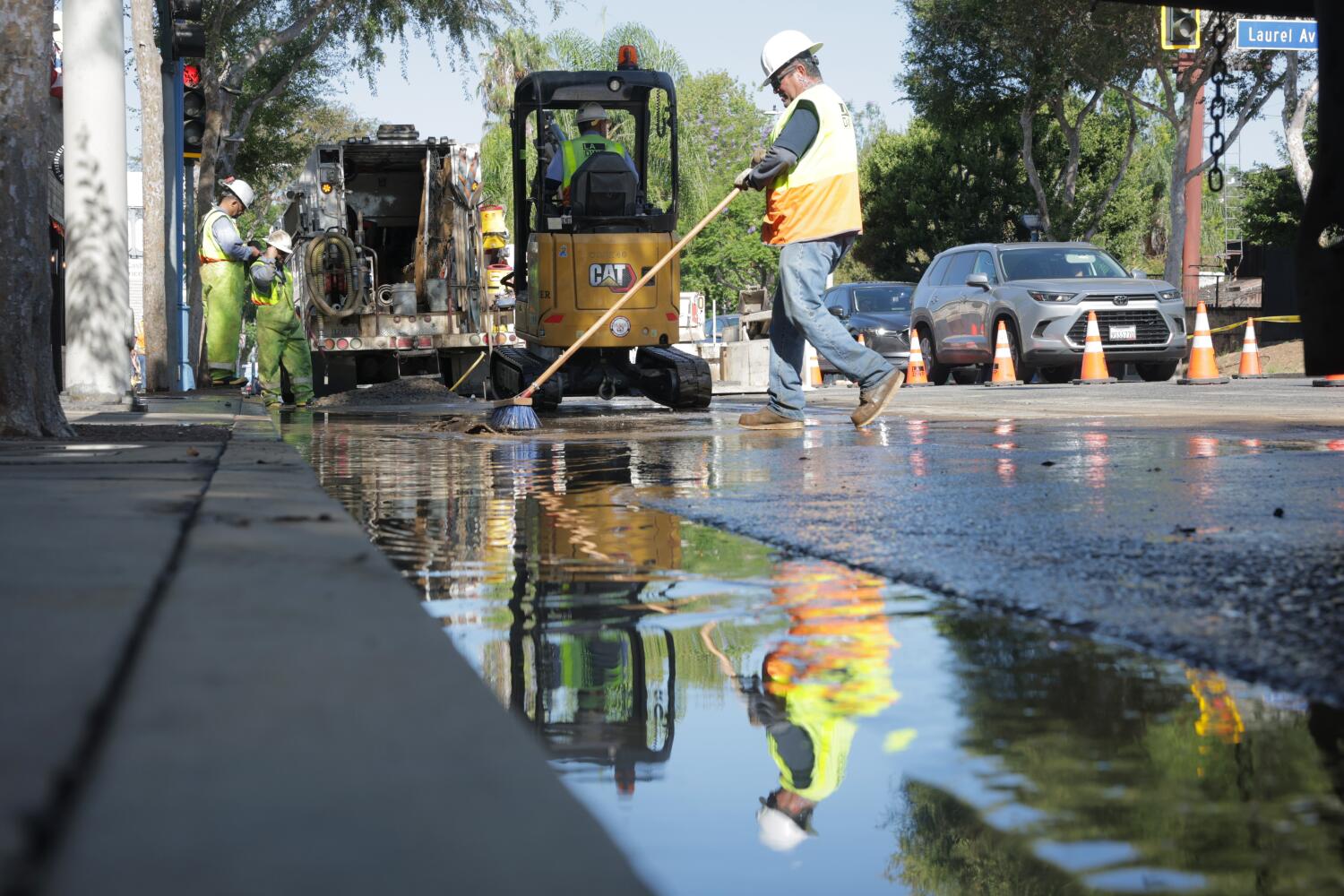
Crews don't just step up with shovels and fix a leak. They enter a high-hazard construction zone where a single wrong move can collapse the surrounding roadway. First comes the shutdown, a delicate dance of turning massive, rusted valves without sending water hammer shocks through adjacent lines that could trigger another burst down the block. Next comes the excavation, peeling back layers of ruined asphalt to expose the subterranean disaster.
The water stops flowing from the breach, but time starts ticking louder.
The Cost of a Stopped Clock
Consider a local coffee shop sitting three doors down from the detour tape.
The morning rush is its lifeblood. At 7:00 AM, the espresso machine should be humming, a line stretching out the door, and the barista calling out orders over the hiss of steamed milk. Instead, the street outside is blocked by orange cones and yellow caution tape. The foot traffic evaporates. The daily supply trucks are forced to turn back, lost in a gridlocked maze of side streets.
To the city planner, the delay is measured in repair hours. To the small business owner, it's measured in payroll, rent, and unsold pastries slowly turning stale behind glass.
The ripple effect spreads outward like waves in a disturbed pond. The commuter who missed an important morning meeting because traffic was diverted onto parallel routes. The emergency response driver forced to calculate a new route on the fly while sirens blare. The road workers working exhaustive twelve-hour shifts in full gear under a punishing sun, bathed in the deafening crunch of gravel and diesel fumes.
Urban infrastructure is invisible right up until the moment it breaks. And when it breaks, it exposes just how tightly bound we all are to these concrete channels.
Bringing Order Back to Chaos
Watch the repair crews long enough, and the chaotic scene starts to reveal a rigorous, almost surgical rhythm.
Heavy excavators claw away the soaked earth, dumping tonnes of mud into haul trucks. Workers descend into the trench, wading through sludge to measure the ruined section of pipe. Precision saws cut away the jagged edges of broken iron. A replacement sleeve—a massive, gleaming piece of modern engineering—is lowered into the pit.
It isn't fast work. It can't be.
Once the pipe is sealed and pressure tested, the trench must be backfilled, compacted, and leveled. Pouring fresh asphalt over wet, unstable ground is a recipe for a sinkhole three weeks later. Every step requires patience, expertise, and precision under intense public pressure to "just open the road."
Late into the night, under the harsh glow of portable floodlights, the work continues. The sound of jackhammers gives way to the low rumble of steamrollers smoothing out a fresh black patch of pavement.
The road reopens. The orange cones disappear. The morning sun comes up, and thousands of cars roll over the exact spot where a subterranean river raged just twenty-four hours earlier.
Drivers won't feel the difference. They won't think about the steel sleeve resting six feet below their tires, or the exhausted men and women who spent the night covered in mud so the city could keep moving. They will simply press the gas pedal, complaining mildly about the slight bump in the road, entirely unaware of the fragile balance keeping the ground beneath them intact.