The air tastes like copper and old paper long before you see the first lick of orange against the ridge.
It is a specific kind of taste. Anyone who has stood on a scorched porch at three in the morning, watching the tree line turn into a wall of teeth, knows it instantly. It settles at the back of the throat. It coats the teeth. It is the taste of a forest unmaking itself.
When the fires came last season, local crews were already running on fumes. They had been sleeping in rotating four-hour blocks on cots set up in high school gymnasiums, their boots stiff with dried mud and pine resin, their eyes rimmed in red. You cannot negotiate with a crown fire. You cannot bargain with wind gusts screaming down a dry canyon at fifty miles an hour. You can only meet it with muscle, sweat, and whatever water is left in the tank.
Then the trucks arrived.
Not red trucks, but olive drab.
We often talk about the military in abstractions. We talk about defense budgets, deployment maps, and strategic deterrence. We forget that at its core, an army is simply a massive collection of capable human beings trained to move toward chaos instead of away from it.
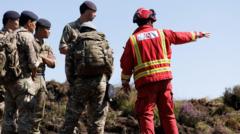
Consider what happens when a military unit is called to domestic duty. These are not professional wildland firefighters who spend their winters clearing brush and studying fire behavior. These are infantrymen, engineers, and support personnel who woke up in a barracks or on a base thinking about standard training rotations, only to find themselves handed a shovel, a Pulaski axe, and a Nomex shroud.
I remember talking to a sergeant named Miller—a young man with dust caked so thickly in the creases of his forehead that he looked like an etching. He told me about stepping off the transport.
"You think you know what hot is," he said, shifting his weight from one blistered heel to the other. "You think basic training in the desert prepares you. But a desert sits still. A fire breathes."
The logistics of fighting a modern wildfire are staggering. It is a war of supply lines, much like any other deployment. Fire camps are small cities requiring millions of gallons of water, heavy machinery, communications relays, and calories—thousands upon thousands of calories consumed by exhausted men and women hacking lines through granite and dry scrub.
When regional emergency declarations are signed, the friction between civilian agencies and military structures usually causes a lag. Bureaucracy is slow. Smoke moves fast.
Yet, last season, something shifted. The coordination between local emergency managers and the dispatched military units achieved a rare, functional grace. Soldiers were integrated directly into mop-up operations and fireline construction alongside veteran hotshot crews.
To understand why this matters, you have to look at the math of burnout. A civilian firefighting crew is lean by design. They are elite athletes of the timber, but their numbers are finite. When a season stretches from three months to six, and then threatens to consume the entire year, the human cost becomes catastrophic. Post-traumatic stress, physical exhaustion, and chronic respiratory damage accumulate silently.
When soldiers step into that breach, they do not just bring extra hands. They bring institutional resilience.
They brought heavy transport vehicles capable of reaching ridgelines that standard pickup trucks would snap axles on. They brought secure communication channels that prevented local radio congestion when multiple valleys were burning simultaneously. Most importantly, they brought a culture of relentless execution.
A civilian commander told me, off the record, about the first morning the troops were assigned to her sector. She expected to spend hours babysitting, explaining the nuances of cutting a firebreak or reading wind shifts in a box canyon.
Instead, a young captain walked up, saluted, and asked two questions: "Where do you need the line, and when does it need to hold?"
Within twenty minutes, forty boots were hitting the dirt.
The work is unglamorous. There are no medals for digging a three-foot-wide trench through six inches of suffocating ash while the wind changes direction and blows embers into your collar. It is repetitive, grueling, and terrifying. It is an exercise in applied geometry against an enemy that obeys no rules.
Yet, the public praise that eventually followed—the headlines praising a "phenomenal job"—missed the deeper reality. It was not just that the job got done. It was how it changed the soldiers doing it.
Military service in peacetime can sometimes feel abstract. You maintain gear you hope never to use. You run drills for scenarios that exist primarily in PowerPoint presentations. But standing shoulder-to-shoulder with a local forester who has lived in the valley for forty years, watching a home they both swore to protect—that grounds the uniform in something undeniable.
Civilians watched young men and women, many of whom had never set foot in the Pacific Northwest or the rugged interior before, hoist heavy chainsaws and work sixteen-hour shifts until their hands bled through their leather gloves. Locals brought coolers of cold lemonade and homemade sandwiches to the checkpoints, leaving sticky notes written by children on the hoods of military humvees: Thank you for saving our trees.
By the time the containment lines held and the rains finally broke the siege, the landscape had changed entirely. Blackened skeletons of Douglas firs stood like charcoal pillars against a gray sky. The soil was fragile, waiting for the autumn mudslides that everyone knew would come next.
The troops packed their gear, loaded the transport trucks, and rolled out as quietly as they had rolled in.
The roads were clear again. The smoke thinned to a hazy memory. But something permanent had shifted in the space where civilian life meets national defense. We learned, or perhaps remembered, that security is not just about borders on a map. Sometimes, security is a twenty-year-old kid from Ohio hauling a water pack up a four-thousand-foot ridge because the house at the top still has a tricycle on the front porch, and nobody wants to see it burn.
The fire is out now. The ash has settled into the earth, feeding the next cycle of growth. But the boots left tracks that won't wash away with the first rain.