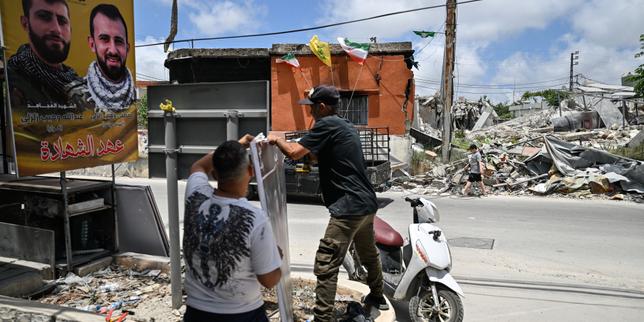
The foundational premise of sovereign diplomacy dictating that a state negotiates from a position of unified intent collapses entirely when the executive branch lacks the monopoly on the legitimate use of violence. When Lebanese Justice Minister Adel Nassar observed that Hezbollah’s unilateral military posture undercuts Beirut’s diplomatic leverage with Israel, he targeted a structural, rather than merely political, pathology. The fundamental flaw in Lebanon’s foreign policy architecture is an asymmetric cost function: one faction commands the strategic veto of initiating kinetic conflict, while the state apparatus is left to shoulder the cumulative financial, structural, and diplomatic liabilities.
This multi-layered structural failure can be systematically broken down by evaluating the mechanisms through which dual sovereignty neutralizes diplomatic leverage, devaluing Lebanon's state assets at the international negotiating table.
The Divergent Objective Functions of Beirut and the South
The primary structural bottleneck in Lebanese diplomatic operations stems from fundamentally mismatched institutional objectives. A sovereign state typically operates on a utility maximization framework centered around territorial integrity, macroeconomic stability, international legal standing, and civil infrastructure preservation.
Conversely, a sub-state ideological militia operates under a proxy-driven ideological framework. Its primary objective function prioritizes regional asymmetric deterrence, cross-border network integration with external patrons, and the preservation of its independent command architecture.
When the state attempts to engage in bilateral or indirect negotiations—such as border demarcation disputes or ceasefire terms—the presence of an independent armed faction alters the perceived credibility of the state’s commitments. In classic game theory, a negotiator cannot offer a credible commitment if a third-party domestic actor maintains the unilateral capacity to defect from the agreement. Consequently, external adversaries price this internal volatility into their diplomatic positioning. Israel, for instance, adjusts its negotiating stance from demanding institutional compliance to executing permanent kinetic containment, rendering standard diplomatic concessions from the Lebanese state effectively worthless.
The Fragmentation of Sovereign Signaling
The core currency of any diplomatic negotiation is the integrity of state signals. Dual sovereignty creates a profound signaling noise that strips the state of its ability to project credible threats or offer stable assurances.
                  [Lebanese State Apparatus]
                             │
                    (Diplomatic Signal)
                             ▼
  [International Negotiating Table / External Adversaries]
                             ▲
                    (Kinetic Action)
                             │
               [Sub-State Military Faction]
This fragmentation produces distinct operational vulnerabilities across three core dimensions:
1. The Disruption of Credible Commitment Mechanisms
When the Lebanese executive branch agrees to the implementation of international frameworks, such as United Nations Security Council Resolution 1701, it does so through formal diplomatic channels. However, because the state lacks enforcement mechanisms over the sub-state faction, the signature of the state functions as a lagging indicator rather than a binding guarantee. The external negotiating partner recognizes that the formal government cannot guarantee compliance, triggering a rational reduction in the value of any reciprocal concessions offered to Beirut.
2. The Internal Veto Power of the Armaments Monopoly
A regular military force is subservient to civil leadership, enabling a government to use its armed forces as an instrument of statecraft—either as a deterrent threat or a bargaining chip. In Lebanon, the quantitative and qualitative superiority of the sub-state arsenal over the Lebanese Armed Forces (LAF) flips this hierarchy. The government does not wield the weapon; the weapon bounds the government's options. This domestic military imbalance creates an implicit internal veto over any diplomatic path that includes factional disarmament or rigorous border monitoring.
3. The Extraction of Sovereign Rents
The coexistence of a formal state and an autonomous military organization creates a structural hazard. The sub-state entity utilizes state institutions—such as ministries, ports, and border crossings—as operational infrastructure and diplomatic shields. When international penalties or kinetic retaliation hit, the state bears the macroeconomic shocks and infrastructure degradation, while the military organization retains its primary assets underground. This externalization of risk removes any rational incentive for the sub-state faction to moderate its behavior for the sake of the national economy.
The Macroeconomic Cost Function of Disunified Diplomacy
The diplomatic degradation observed by the Ministry of Justice directly correlates with macroeconomic erosion. A state lacking a unified command structure faces compounding economic penalties that systematically deplete its domestic strength before negotiations even begin.
- Sovereign Risk Premium Inflation: International capital markets price domestic security contradictions as a permanent existential risk. This prevents debt restructuring, suppresses foreign direct investment (FDI), and halts capital formation. The lack of sovereign control over war-and-peace decisions signals to markets that any capital investment remains highly vulnerable to sudden destruction.
- The Proliferation of Parallel Economies: The persistence of an autonomous armed faction requires an independent, unmonitored financial system to bypass global banking compliance frameworks. This structure starves the formal banking sector of liquidity, shrinks the tax base, and locks the state into a permanent cycle of cash-devaluation and informal gray-market dependence.
- Asymmetric Infrastructure Liabilities: When kinetic escalation occurs, the destruction of civilian infrastructure—including transport links, energy grids, and telecommunications—demands massive state or international funding for reconstruction. Because the state does not control the trigger, it cannot manage its fiscal exposure to these catastrophic losses, destroying its long-term budgetary planning.
Structural Realignment Over Superficial Accords
Resolving this diplomatic deadlock cannot be achieved through short-term ceasefires or minor amendments to border lines. Those adjustments merely delay future conflicts while leaving the core contradiction intact. Achieving true sovereign negotiating leverage requires a systematic re-establishment of institutional authority across three distinct sectors.
First, the monopoly on the legitimate use of violence must be structurally restored to the state. This requires the systematic integration or disarmament of all parallel military structures under the exclusive command of the Lebanese Armed Forces. No state can successfully negotiate external peace treaties while navigating a domestic military veto.
Second, international enforcement mechanisms must pivot from passive monitoring to active compliance verification. Agreements that rely on the voluntary compliance of sub-state actors inherently fail. Future frameworks must tie international financial assistance and sovereign debt restructuring directly to verifiable benchmarks of state territorial control and border consolidation.
Finally, the Lebanese judicial and administrative apparatus must assert regulatory control over all points of entry, logistics hubs, and financial networks. Eliminating the parallel black economy is an operational necessity to cut off the material supply lines that sustain non-state military architectures.
Without executing these fundamental institutional corrections, Lebanese diplomacy will remain trapped in a defensive posture—forced to manage the fallout of actions it did not authorize, while attempting to negotiate deals it lacks the power to enforce.