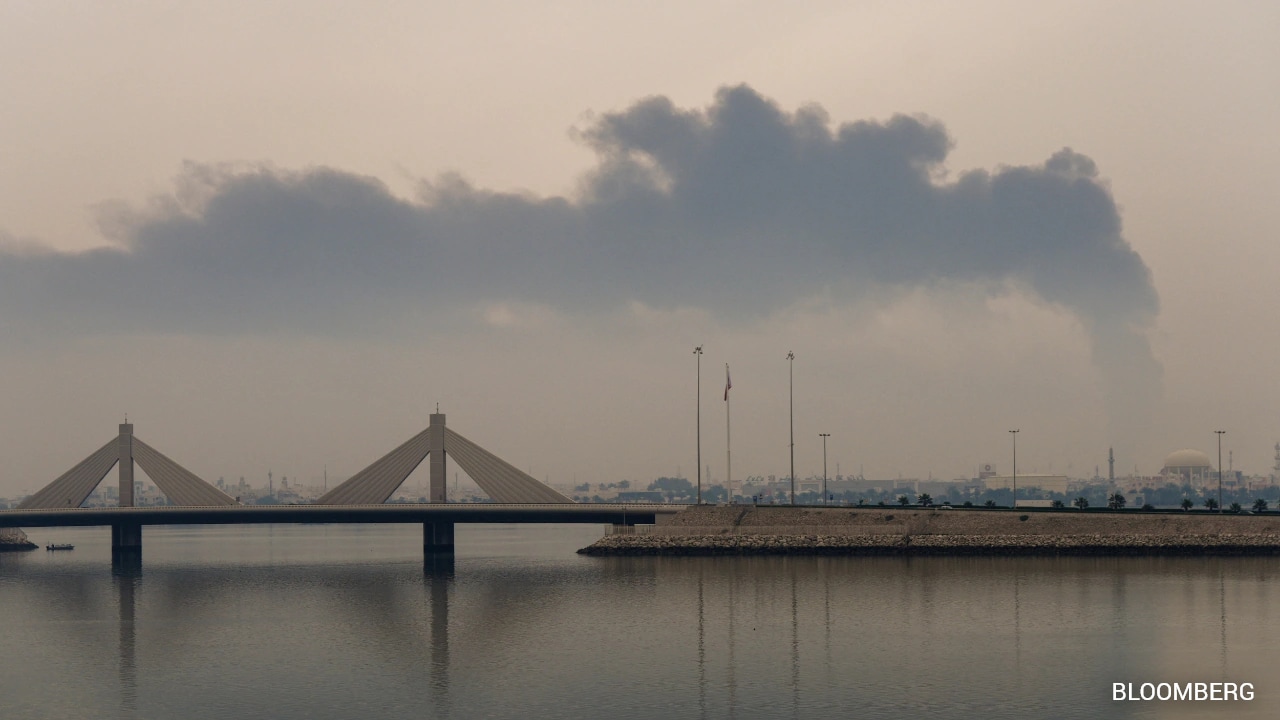
The geopolitical architecture of the Persian Gulf operates on a structural asymmetry where offensive kinetic actions by external actors generate disproportionate economic and infrastructural liabilities for adjacent neutral states. When the United States and Israel evaluate direct military strikes against Iranian targets, Gulf Cooperation Council (GCC) states—specifically Saudi Arabia, the United Arab Emirates, Qatar, Bahrain, Kuwait, and Oman—confront an immediate strategic paradox. These nations rely on the American security umbrella for existential defense while simultaneously remaining geographically exposed to Iranian retaliatory capacity. Analyzing this dynamic requires stripping away diplomatic rhetoric to examine the underlying mechanisms of deterrence failure, infrastructural vulnerability, and macroeconomic contagion.
The Structural Asymmetry of Regional Deterrence
Standard deterrence theory relies on the assumption that the actor initiating a strike bears the primary burden of retaliation. In the Middle East, this mechanism is broken due to geographic proximity and force posture disparities. Israel operates at a strategic distance from Iran, shielded by multi-layered missile defense architectures and separated by hundreds of miles of airspace. The United States projects power into the region through forward-deployed naval assets and hardened installations, maintaining strategic depth in the continental homeland.
Gulf states possess neither geographic depth nor buffer zones. Major population centers, desalination facilities, and hydrocarbon export terminals sit within a 150-to-300-mile radius of Iranian launch sites across the Persian Gulf.
This proximity compresses warning times to minutes, neutralizing the effectiveness of traditional ballistic missile defense systems against saturation attacks. Under these conditions, deterrence operates asymmetrically:
- Offensive Offloading: External actors can execute precision strikes against Iranian nuclear, missile, or command-and-control infrastructure without exposing their core civilian economies to immediate, low-cost retaliation.
- Retaliatory Substitution: When Iran faces direct military pressure that it cannot symmetrically match against the United States or Israel, strategic logic dictates shifting the cost function onto softer, adjacent targets. Gulf infrastructure serves as a proxy pressure point to force Washington to restrain itself or its allies.
- Airspace Complicity: Even if GCC states declare strict neutrality and deny the use of their bases for offensive operations, modern strike packages often require transit through regional airspace or reliance on regional radar and refueling networks. Tehran views any logistical or spatial facilitation as de facto belligerence, erasing the legal distinction between neutral host and active combatant.
The Vulnerability Matrix of Gulf Infrastructure
To understand why Gulf leadership views a wider war as an existential threat rather than a manageable security crisis, one must evaluate the physical fragility of their economic models. Unlike diversified industrial economies, GCC states rely on hyper-concentrated nodes of critical infrastructure.
Desalination as an Existential Bottleneck
Water security represents the single greatest operational vulnerability in the Arabian Peninsula. GCC nations lack significant renewable freshwater aquifers and depend on coastal desalination plants for over 80 to 90 percent of their potable water supply. These facilities are massive, stationary, and impossible to harden against precision-guided munitions or swarm drone attacks.
A coordinated strike on a handful of major desalination complexes—such as Jubail in Saudi Arabia or Jebel Ali in the UAE—would render major urban centers uninhabitable within 72 to 96 hours. Unlike oil production, which can be throttled or rerouted, water distribution has zero short-term elasticity. Military planners in Riyadh and Abu Dhabi recognize that air defense interceptors cannot guarantee a 100 percent success rate against low-altitude cruise missiles and unmanned aerial vehicles.
Hydrocarbon Concentration and Export Chokepoints
Global energy markets price in geopolitical risk based on supply elasticity, yet the physical infrastructure of the Gulf remains vulnerable to single-point failures. The September 2019 attacks on Saudi Aramco’s Abqaiq and Khurais processing facilities demonstrated this mechanism clearly: a relatively low-cost salvo of drones and cruise missiles temporarily knocked out roughly 5.7 million barrels per day of crude processing capacity, equivalent to nearly 5 percent of global supply.
Beyond upstream processing, export logistics depend entirely on the Strait of Hormuz. Roughly one-fifth of global petroleum liquids consumption passes through this narrow maritime chokepoint. In a high-intensity conflict scenario, Iran does not need to achieve naval superiority to close the Strait. Deploying sea mines, coastal anti-ship cruise missiles, and fast-attack craft creates an immediate insurance crisis. Maritime underwriters withdraw war-risk coverage, halting commercial tanker transit without a single vessel needing to be sunk. Alternative pipeline infrastructure, such as Saudi Arabia’s East-West Pipeline or the UAE’s Fujairah pipeline, lacks the aggregate capacity to absorb the full volume of maritime exports, guaranteeing a severe supply shock.
Aviation and Financial Hub Contagion
Over the past two decades, cities like Dubai, Abu Dhabi, and Doha have engineered economic diversification strategies built around global connectivity, tourism, and foreign direct investment. These sectors require absolute perceptions of stability.
- Airspace Closures: Commercial aviation corridors over the Gulf connect Europe, Asia, and Africa. Missile exchanges trigger immediate civil aviation authority bans, grounding flagship carriers and severing supply chains for high-value air freight.
- Capital Flight: Sovereign wealth funds and international institutional investors operate on risk-adjusted return models. Sustained regional kinetic conflict triggers immediate capital outflows, spikes sovereign credit default swap spreads, and freezes real estate and infrastructure megaprojects.
- Expatriate Workforce Retention: Gulf economies rely heavily on foreign technical and managerial labor. Unlike citizens, expatriate populations possess high mobility and will evacuate rapidly if civilian airspace or residential zones face sustained bombardment, causing immediate operational paralysis across banking, healthcare, and logistics sectors.
The Diplomatic Hedging Mechanism
Faced with these operational realities, GCC states have systematically dismantled their previous reliance on a single security guarantor, executing a calculated policy of diplomatic hedging. This shift is often mischaracterized by external observers as appeasement or geopolitical realignment toward China and Russia. In practice, it is a rational risk-mitigation strategy designed to decouple Gulf security from Israeli-Iranian escalation cycles.
The March 2023 Beijing-brokered normalization agreement between Saudi Arabia and Iran exemplifies this operational pivot. By re-establishing diplomatic channels and intelligence-sharing protocols with Tehran, Riyadh sought to create a bilateral firebreak. The objective is not to forge an alliance with the Islamic Republic, as fundamental ideological and regional rivalries remain unresolved. Rather, the goal is to establish direct crisis-communication mechanisms that allow Gulf capitals to signal non-involvement during moments of acute US-Iranian or Israeli-Iranian friction.
This hedging strategy relies on three distinct operational levers:
- Explicit Denial of Basing Rights: Gulf states increasingly restrict the US military from launching offensive strikes against Iran or its regional proxies from bases located on GCC soil, such as Al Udeid Air Base in Qatar or Al Dhafra Air Base in the UAE. By imposing strict rules of engagement on forward-deployed American forces, host nations attempt to preserve plausible deniability.
- Economic Interdependence as Deterrence: UAE-Iran trade networks and Qatari shared management of the South Pars/North Dome natural gas field create mutual economic stakes. Gulf leaders calculate that giving Tehran tangible financial channels reduces the incentive for Iranian hardliners to destroy the regional economic ecosystem.
- Multipolar Diplomatic Engagement: Engaging Beijing and Moscow serves a dual purpose. China is the primary buyer of both Iranian and Gulf crude oil, giving Beijing unique economic leverage over Tehran to prevent a closure of the Strait of Hormuz. Simultaneously, maintaining ties with competing great powers signals to Washington that Gulf alignment cannot be taken for granted if American policy disregards regional survival interests.
The Limits of Strategic Neutrality
While diplomatic hedging reduces day-to-day friction, it contains a fatal structural flaw: neutrality is only viable if all belligerents agree to respect it. In a full-scale military confrontation between the United States, Israel, and Iran, the operational requirements of modern warfare inevitably erode Gulf neutrality.
First, integrated air and missile defense (IAMD) networks create technological entanglement. The United States has spent years integrating Gulf radar systems, early-warning satellites, and Patriot/THAAD interceptor batteries into a unified regional architecture. If Iran launches a massive ballistic missile salvo toward Israel, those trajectories pass directly over Saudi and Jordanian airspace. Even if Riyadh refuses to participate in offensive strikes, the automated or semi-automated activation of regional radar tracking to assist US-Israeli interception makes Saudi territory an active node in the defensive battle network. From Tehran’s operational perspective, blinding those radar installations becomes a military necessity, dragging the host nation directly into the kinetic exchange.
Second, Iran’s asymmetric doctrine—often referred to as the "Axis of Resistance"—relies on decentralized proxy networks across Iraq, Syria, Lebanon, and Yemen. Even if the leadership in Tehran exercises restraint regarding direct strikes from Iranian soil against GCC targets, allied groups like the Houthis in Yemen possess independent launch capabilities and distinct strategic incentives. A wider regional war could trigger Houthi missile and drone attacks against Saudi and Emirati targets to disrupt global energy supplies and pressure Western capitals into halting operations against Iran. Tehran can claim a lack of direct command-and-control over these groups while still reaping the strategic benefits of their escalation.
Third, economic contagion cannot be contained by bilateral treaties. Even if not a single missile lands on Abu Dhabi or Riyadh, a sustained naval blockade in the Persian Gulf or aerial bombardment of Iranian oil infrastructure on Kharg Island would trigger an immediate global recession. Hydrocarbon export revenues would collapse due to physical interdiction, while sovereign wealth fund portfolios would suffer severe valuation losses from global equity market downturns. Gulf states would face simultaneous fiscal deficits and acute security crises, halting their multi-trillion-dollar economic transformation agendas such as Saudi Vision 2030.
Strategic Imperatives for Regional Stabilization
Given that Gulf states cannot eliminate the structural risks posed by external military strikes on Iran, their optimal strategic play shifts from attempting to prevent conflict to hardening their systems against inevitable spillover. Relying solely on diplomatic signaling to Tehran or lobbying in Washington fails to address the physical vulnerabilities of the region.
To survive a high-intensity escalation cycle without catastrophic economic collapse, GCC leadership must execute a three-part operational overhaul:
- Decentralize Critical Infrastructure: Immediately halt the construction of mega-scale coastal desalination and power generation plants. Transition capital expenditure toward distributed, inland, and modular water production facilities paired with underground strategic water reserves capable of sustaining urban populations for a minimum of 30 days without external power or coastal intake.
- Expand Bypass Export Capacity: Accelerate the construction of overland pipeline infrastructure that terminates outside the Strait of Hormuz, specifically targeting ports on the Arabian Sea and Red Sea coasts. Achieving at least 75 percent export bypass capacity removes Iran’s ability to hold global energy markets—and Gulf fiscal solvency—hostage through maritime chokepoint interdiction.
- Establish Hard Kinetic Firewalls: Formalize binding defense protocols with Washington that strictly separate defensive intelligence sharing from offensive force projection. Gulf states must invest in autonomous, non-US-integrated counter-UAS and low-altitude air defense layers—utilizing directed-energy weapons and electronic warfare suites—to defend critical economic nodes independently without triggering broader regional radar entanglement.
Until these physical redundancies are operational, Gulf states remain trapped in a structural vise: economically dependent on absolute stability, geographically positioned inside an active blast radius, and strategically tethered to external actors whose escalation calculus prioritizes objectives other than regional survival.


