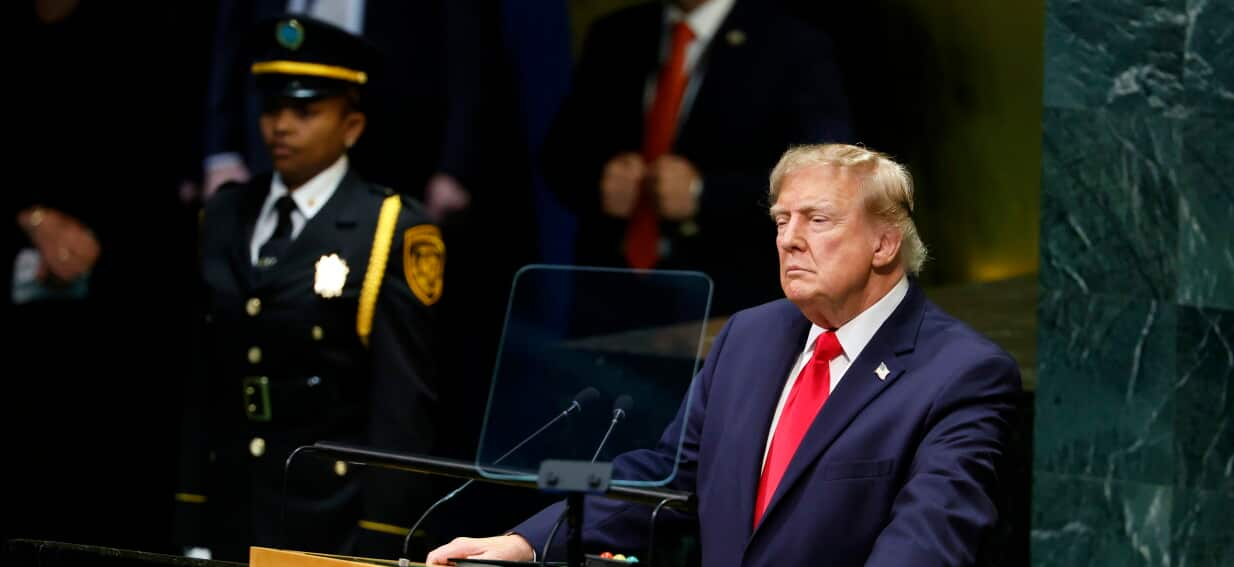
Standard diplomatic coverage treats off-script speeches at the United Nations General Assembly (UNGA) as erratic lapses in decorum or isolated bursts of political theater. That framing misses the structural mechanics of the venue. When Donald Trump stood before the 81st session of the UN General Assembly in September 2026 and threatened to "annihilate" Iran while simultaneously dismissing artificial intelligence risk warnings, announcing new military bases in Greenland, and prompting a walkout from the Cuban delegation, he was executing a repeatable geopolitical maneuver.
Across seven decades of UNGA history, leaders from Nikita Khrushchev and Fidel Castro to Hugo Chávez, Muammar Gaddafi, and Benjamin Netanyahu have deliberately broken institutional protocol. Rather than representing random departures from diplomatic norms, these episodes are calculated applications of asymmetric signaling. The UNGA podium functions as a low-cost, high-visibility broadcast mechanism where political actors bypass traditional bilateral intermediaries to achieve specific domestic, deterrent, or institutional objectives.
Understanding why leaders abandon prepared diplomatic scripts requires mapping the incentive structure of the General Assembly hall, categorizing the mechanics of protocol disruption, and evaluating the downstream operational costs of rhetorical escalation.
The Structural Incentive Matrix of the UNGA Podium
To understand why off-script rhetoric occurs so reliably at the UN, one must examine the institutional architecture of the General Assembly. Unlike the UN Security Council, where five permanent members wield binding veto power over kinetic interventions, sanctions, and peacekeeping mandates, the General Assembly operates on a one-nation, one-vote model that produces non-binding resolutions.
Because the General Assembly lacks direct enforcement mechanisms, the podium serves primarily as an information market rather than a legislative chamber. Within this environment, leaders face three structural incentives that reward norm-breaking over consensus-building:
- Zero-Cost Broadcasting to Dual Audiences: A speaker at the UNGA addresses two distinct constituencies simultaneously—the 193 member-state delegations in the hall and domestic voters watching via state and international media. Standard diplomatic language ("expressing deep concern," "urging restraint") optimizes for the room while generating zero traction at home. High-variance rhetoric, threats, and visual props invert that ratio, capturing domestic media cycles at the expense of multilateral friction.
- Asymmetric Parity: Inside the General Assembly hall, smaller or diplomatically isolated states receive the exact same physical stage and global press pool as nuclear superpowers. For leaders of sanctioned or peripheral regimes, violating protocol is the most efficient method to manufacture temporary status parity with dominant powers.
- Rule-Enforcement Deficit: The UNGA allocates a standard 15-minute speaking window per leader, yet the institution possesses no hard mechanism to cut a microphone or penalize a head of state for exceeding time limits or violating decorum. When enforcement relies entirely on voluntary compliance, actors who defect from the norm capture disproportionate attention without incurring immediate institutional sanctions.
A Taxonomy of UNGA Protocol Disruptions
Historical analysis of major off-script UNGA moments reveals that leaders do not break protocol randomly. Every major disruption falls into one of four distinct operational categories, each engineered to produce a specific political effect.
1. Coercive Deterrence and Escalation Signaling
This mechanism uses the global stage to issue unambiguous, maximalist threats designed to alter an adversary's decision calculus before or during active negotiations. The goal is to establish "madman theory" credibility—convincing the target that the speaker is unconstrained by standard diplomatic guardrails and willing to absorb extreme costs.
Donald Trump’s September 2026 address exemplifies this category. Speaking seven months into an active conflict with Iran, Trump used the UN podium to threaten the rapid annihilation of the Islamic Republic. Crucially, this maximalist public threat occurred on the exact same day that U.S. envoys Jared Kushner and Steve Witkoff held direct, unpublicized sideline meetings with Iranian officials, while Iranian officials signaled potential willingness to reopen the Strait of Hormuz. By pairing extreme public rhetoric with quiet backchannel diplomacy, the speaker attempts to maximize leverage at the negotiating table by raising the perceived cost of stalling.
A historical parallel occurred during the 1974 General Assembly, when Palestine Liberation Organization chairman Yasser Arafat closed his address by declaring he had arrived bearing an olive branch and a freedom fighter's gun, warning delegates not to let the olive branch fall from his hand. Both maneuvers rely on explicit conditional threats delivered to a global audience to force immediate concessions.
2. Visual Prop Anchoring
Complex geopolitical arguments rarely survive the compression of international news cycles. To bypass media filtering, leaders introduce physical props or theatrical gestures that force visual documentation. Once a photograph or video clip becomes the defining artifact of a diplomatic session, the speaker’s framing dominates global coverage regardless of counterarguments made by subsequent speakers.
- Nikita Khrushchev (1960): During a debate on colonialism following sharp criticism of Soviet control over Eastern Europe by Philippine delegate Lorenzo Sumulong, Soviet Premier Nikita Khrushchev pounded his desk with his fists and brandished his shoe. The physical act overwhelmed the substantive debate over Soviet imperialism, projecting raw, uncompromising resistance to Western-aligned criticism.
- Benjamin Netanyahu (2012): Seeking to establish an unambiguous threshold for Iran’s nuclear enrichment program, Israeli Prime Minister Benjamin Netanyahu displayed a large cartoon diagram of a bomb and drew a thick red marker line across the 90 percent enrichment tier. By translating technical centrifuge metrics into a binary visual threshold, Netanyahu simplified a complex intelligence assessment into a globally recognizable ultimatum.
- Muammar Gaddafi (2009): Addressing the General Assembly for the first time after four decades in power, Libyan leader Muammar Gaddafi denounced the Security Council as a "Terror Council" and physically tore a copy of the UN Charter. The gesture visually reinforced his thesis that post-World War II international institutions functioned purely as instruments of superpower hegemony.
3. Exhaustion Filibustering and Temporal Dominance
When a leader represents a state facing diplomatic isolation or severe economic blockades, monopolizing time becomes a primary tactic to demonstrate regime durability and ideological stamina. By ignoring the 15-minute speaking guideline, the speaker forces the entire diplomatic apparatus of the United Nations to operate on their schedule.
In September 1960, Cuban Prime Minister Fidel Castro delivered a speech lasting 4 hours and 29 minutes—the longest General Assembly address in UN history. Castro used the marathon session to catalog grievances against U.S. foreign policy and establish revolutionary Cuba as a permanent fixture in Cold War geopolitics. Nearly half a century later, Gaddafi replicated this tactic in 2009 with a rambling, 96-to-100-minute monologue that ranged from questioning the John F. Kennedy assassination to accusing the United States of manufacturing the H1N1 swine flu virus. In both cases, the duration itself was the strategic message: the regime could neither be silenced nor hurried by international consensus.
4. Domestic Audience Arbitrage and Delegitimization
The fourth category involves using the UN podium not to persuade foreign diplomats, but to attack domestic political opponents, discredit international watchdogs, or rally ideological allies back home. Here, negative reactions inside the General Assembly—such as silence, laughter, or delegation walkouts—are treated as proof of effectiveness rather than diplomatic failure.
Hugo Chávez perfected domestic arbitrage during his September 2006 address. Speaking one day after U.S. President George W. Bush, Chávez crossed himself at the podium and stated that "the devil came here yesterday" and that the room "still smells of sulfur". The remark generated immediate gasps in New York while cementing Chávez’s standing across Latin America as the primary ideological counterweight to the Iraq War and U.S. interventionism.
Similarly, Iranian President Mahmoud Ahmadinejad used his 2010 and 2011 UNGA appearances to promote conspiracy theories suggesting the September 11 attacks were orchestrated by elements within the U.S. government to justify Middle Eastern wars. The resulting mass walkouts by Western delegations provided state media in Tehran with immediate visual evidence of Western intolerance toward Iranian defiance.
Trump’s 2026 speech integrated multiple layers of domestic arbitrage. Alongside geopolitical threats, he used the UN platform to attack U.S. domestic media outlets, dismiss climate change and AI safety concerns as "hoaxes", rebrand artificial intelligence as "superintelligence", and label Cuba a "failed state" on the verge of collapse—triggering an immediate walkout by the Cuban delegation. Each tangent served a domestic constituency rather than a multilateral negotiation.
The Game Theory of Sideline Divergence
The most critical error in surface-level political analysis is taking UNGA podium rhetoric at face value. In international relations, public speeches at the General Assembly and private negotiations in adjacent conference rooms operate as distinct game-theoretic tracks.
When a leader issues an existential threat from the podium, observers often assume diplomacy has collapsed. Operational reality frequently demonstrates the opposite. Public belligerence creates political cover for private compromise. By demonstrating extreme resolve in front of domestic hardliners and international cameras, a leader insulates themselves against accusations of weakness when envoys negotiate pragmatic settlements behind closed doors.
The events of September 22–23, 2026, illustrate this divergence clearly:
- The Public Track: Trump threatened to drive Iran "into hell" and "annihilate" the regime quickly, while Iranian delegates staged walkouts.
- The Private Track: Trump explicitly noted during his remarks that he expected to strike a deal after the U.S. midterm elections, while simultaneously dispatching senior envoys to meet Iranian representatives on the sidelines of the assembly. Meanwhile, Iranian President Masoud Pezeshkian traveled to New York to address the body despite active hostilities, and Iranian officials floated the reopening of critical maritime chokepoints.
This dual-track structure explains why historical off-script tirades rarely trigger immediate kinetic escalation on their own. Khrushchev’s 1960 desk-pounding preceded the 1961 Vienna Summit and eventual backchannel resolution of the Cuban Missile Crisis. Chávez’s 2006 "sulfur" speech did not interrupt Venezuelan crude oil exports to U.S. refineries. Rhetoric at the UNGA functions as a bargaining chip in an ongoing negotiation, not a binding declaration of war.
Operational Costs and Diminishing Returns
While going off-script delivers immediate attention and domestic political dividends, repeated reliance on asymmetric signaling introduces severe operational costs over time. Like any market flooded with high-risk assets, the UNGA information environment suffers from rapid inflation.
- Credibility Decay: Coercive deterrence relies on the target believing that a threat will be executed if conditions are not met. When maximalist threats ("annihilation," "total destruction") are deployed routinely alongside routine domestic grievances, adversaries begin discounting the rhetoric as performative noise. Once credibility erodes, the speaker must escalate even further to achieve the same deterrent effect, narrowing the margin for miscalculation.
- Coalition Friction: Multilateral initiatives—such as coordinating global energy markets, enforcing maritime security, or isolating a sanctioned regime—require sustained buy-in from third-party states. Unscripted attacks on international courts, unilateral announcements regarding allied territories like Greenland, and abrasive rhetoric alienate middle-power nations whose logistical and financial cooperation is necessary to enforce policy objectives.
- Institutional Atrophy: When major powers treat the General Assembly purely as a stage for domestic messaging rather than a forum for conflict resolution, smaller nations accelerate their pivot toward alternative regional blocs—such as BRICS+, the Shanghai Cooperation Organisation, or bilateral security pacts. Over time, this reduces the utility of the UN as a crisis-management mechanism when a genuine superpower standoff requires neutral mediation.
- Unintended Walkout Cascades: While a single delegation walkout (such as Cuba’s in 2026) generates favorable headlines for a domestic base, coordinated walkouts by entire regional blocs deprive the speaker of direct diplomatic signaling channels. You cannot coerce an audience that has physically vacated the room.
Strategic Framework for Evaluating Future UNGA Disruptions
Analysts, policymakers, and market participants tracking future General Assembly sessions must filter out rhetorical noise by evaluating off-script speeches against three operational indicators rather than the surface shock value of the transcript:
- Track Sideline Schedules, Not Podium Transcripts: Measure diplomatic intent by monitoring bilateral meetings occurring in the UN basement and Midtown Manhattan hotels within 24 hours of a speech. High-volume podium hostility paired with high-level envoy meetings signals an active, imminent push for a negotiated settlement.
- Audit Resource Commitments Against Verbal Threats: Cross-reference off-script ultimatums with verifiable force-posture changes, munitions replenishment rates, and congressional or parliamentary budget allocations. Rhetoric untethered from new logistics deployments is optimized for domestic consumption rather than immediate kinetic execution.
- Isolate Third-Party Alignment Shifts: Watch the reaction of non-aligned middle powers (such as Gulf states, India, Brazil, and European NATO members) rather than the direct target of the threat. When off-script speeches cause third-party states to hedge their security or energy commitments, the speaker has suffered a net strategic loss regardless of how strongly the speech played to their domestic base.
The UN General Assembly will continue to produce norm-breaking spectacles because its institutional design rewards disruption with global amplification. Treating those moments as psychological anomalies obscures their true function: they are calculated, high-variance maneuvers in a continuous struggle over leverage, narrative control, and domestic legitimacy. To accurately forecast geopolitical outcomes, ignore the theater at the podium and measure the movement in the corridors behind it.