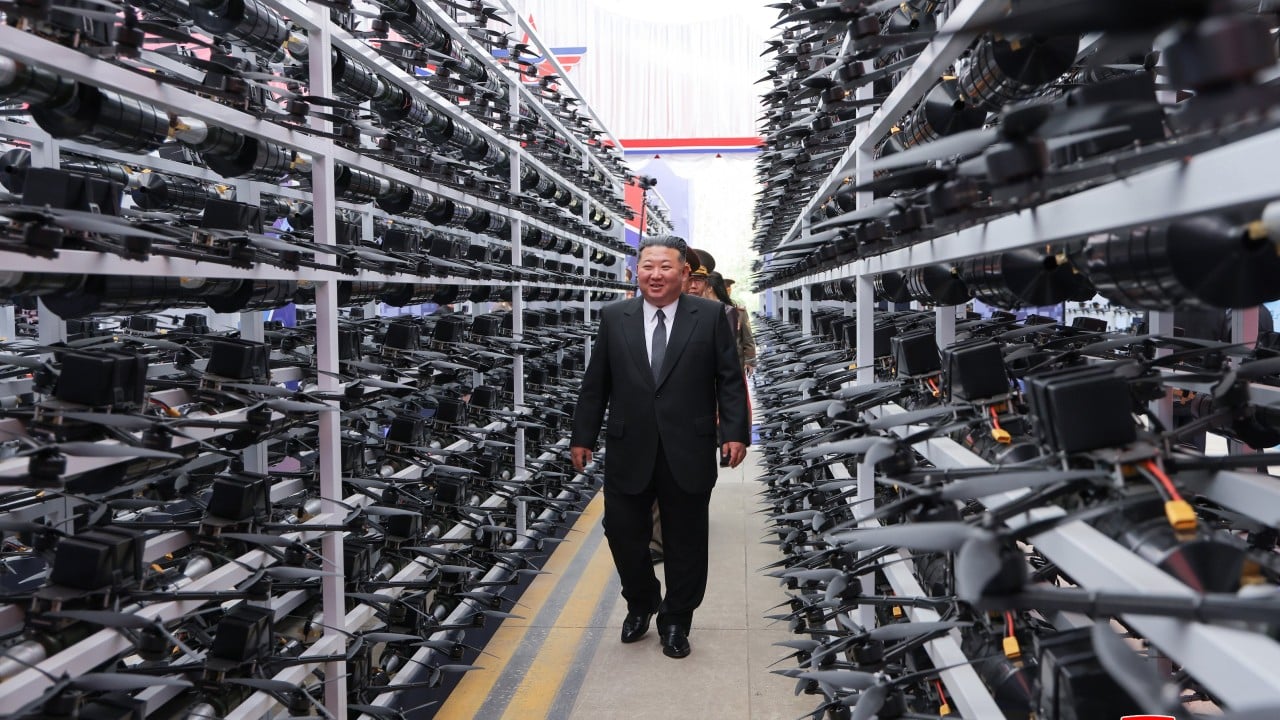
North Korea’s accelerated push into unmanned aerial systems is not a sudden technological breakthrough; it is an industrial adaptation to severe capital and resource constraints. When Kim Jong-un inspects domestic loitering munitions and high-altitude reconnaissance platforms, the operational objective is clear: offset a technologically superior adversary by flooding the battlespace with low-cost, attritable mass. Understanding Pyongyang’s drone doctrine requires stripping away state-media spectacle to examine the underlying supply chain economics, kinetic cost-exchange ratios, and electronic warfare vulnerabilities that govern modern unmanned combat.
Standard defense reporting treats North Korean drone showcases as isolated displays of hardware parity. That framing misses the structural logic driving the Korean People’s Army (KPA). Pyongyang cannot compete with the United States and South Korea in fifth-generation manned aviation, integrated satellite constellations, or precision-guided ballistic missile volume without bankrupting its command economy. Unmanned systems solve this asymmetry by decoupling offensive strike capability from heavy industrial tooling. By shifting manufacturing toward commercial-off-the-shelf (COTS) microelectronics, fiberglass airframes, and small internal combustion engines, North Korea converts an acute sanctions bottleneck into a scalable attrition strategy.
The Three-Tier Operational Architecture
To evaluate the threat profile of North Korea’s unmanned inventory, analysts must separate propaganda prototypes from deployable battlefield assets. The KPA’s expanding fleet divides into three distinct functional tiers, each dictated by specific aerodynamic and payload constraints.
Tier 1: High-Altitude Intelligence, Surveillance, and Reconnaissance (ISR)
Platforms visually modeled after the American RQ-4 Global Hawk—designated domestically as the Saetbyol-4—represent Pyongyang’s attempt to establish persistent, wide-area maritime and border surveillance. These airframes rely on high-aspect-ratio wings to maximize lift-to-drag ratios, enabling extended loiter times at altitudes above 50,000 feet.
The strategic utility of Tier 1 systems is constrained by sensor resolution and data-link survivability. An airframe can replicate the external geometry of a Western strategic drone without possessing its synthetic aperture radar (SAR) or electro-optical stabilization suites. Without access to high-bandwidth, beyond-line-of-sight (BLOS) satellite communications, these platforms remain tethered to terrestrial relay stations, limiting their effective operational radius to the immediate periphery of the Korean Peninsula and the East Sea.
Tier 2: Medium-Altitude Strike and Tactical Reconnaissance
Modeled externally on the MQ-9 Reaper (the Saetbyol-9), this second tier bridges the gap between raw intelligence collection and kinetic execution. These turboprop-driven systems are designed to carry under-wing hardpoints for small-diameter, laser- or GPS-guided munitions.
In practice, Tier 2 platforms face the highest attrition risk in a high-intensity conflict. Lacking stealth shaping, radar-absorbent coatings, or advanced electronic countermeasures, a medium-altitude drone operating near the Demilitarized Zone (DMZ) presents a large radar cross-section to integrated air defense systems (IADS). Their primary operational value lies not in penetrating contested airspace, but in acting as forward target designators for long-range artillery and tactical ballistic missiles during the opening hours of an engagement.
Tier 3: One-Way Attack (OWA) and Loitering Munitions
The most immediate tactical threat resides in North Korea’s mass-produced loitering munitions—expendable, delta-wing or cruciform-wing drones designed to detonate on impact. Visually mirroring Russian Lancet and Iranian Shahed architectures, these systems eliminate the requirement for recovery infrastructure, complex landing gear, or expensive reusable optics.
- Propulsion Simplicity: Utilization of commercial moped or hobbyist two-stroke engines reduces unit manufacturing costs to tens of thousands of dollars, compared to millions for a single cruise missile.
- Modular Warheads: Airframes can be rapidly fitted with high-explosive fragmentation charges for soft targets or shaped-charge tandem warheads for armored vehicles and hardened artillery positions.
- Launch Decentralization: Pneumatic rail launchers mounted on standard flatbed trucks allow KPA units to disperse launch signatures across rugged terrain, complicating counter-battery targeting.
The Cost-Exchange Asymmetry
The core economic driver behind Kim Jong-un’s directive for serial drone production is the inversion of the defensive cost-exchange ratio. In conventional air defense, intercepting an incoming aerial threat requires an effector whose kinetic performance exceeds that of the target. When that target is a low-cost loitering munition, the defender’s economics collapse.
Consider the baseline physics and procurement math of modern air defense. An interceptor missile launched from a Patriot PAC-3 or Cheongung-II (KM-SAM) battery costs between $1.5 million and $4 million per round. A North Korean one-way attack drone built from composite foam, a commercial flight controller, and a salvaged engine costs an estimated $20,000 to $50,000 to assemble. Even if a defending battery achieves a 95 percent interception rate against a salvo of 100 drones, the defender expends upwards of $200 million in finite interceptor inventory to neutralize $3 million worth of offensive hardware.
This dynamic creates an acute magazine-depth problem for South Korean and allied forces. High-end surface-to-air missiles cannot be manufactured at the rate of commercial-grade airframes. By forcing Seoul to burn through its upper-tier interceptor stockpile against low-value drone swarms, Pyongyang degrades the shield meant to stop nuclear-capable ballistic missiles like the KN-23 or Hwasong-11 series. The drone is not the decisive weapon; it is the sponge that absorbs defensive capacity ahead of the primary salvo.
Supply Chain Mechanics and Sanctions Evasion
A persistent analytical error is assuming that international sanctions prevent North Korea from acquiring the components necessary for serial drone production. In reality, modern unmanned aviation relies on dual-use consumer electronics that flow through global grey markets at volumes impossible to interdict completely.
A functional loitering munition requires four primary subsystems: a flight controller, an inertial measurement unit (IMU), a global navigation satellite system (GNSS) receiver, and a telemetry transceiver. None of these components are classified as restricted munitions under standard export control regimes when purchased individually at civilian grade.
- Microcontrollers and FPGAs: Industrial-grade ARM processors and field-programmable gate arrays are widely available through electronics distributors across East Asia. Front companies purchase these chips in small batches under the guise of agricultural or industrial automation projects, routing them through maritime transshipment hubs or overland rail links into North Korea.
- Commercial Optics: Uncooled thermal imaging cores and high-zoom CMOS cameras designed for civilian inspection drones provide sufficient resolution for terminal target acquisition without requiring military-grade cooled infrared sensors.
- Propulsion and Actuators: Brushless electric motors, lithium-polymer battery packs, and digital servos are commodity items produced at massive scale globally.
Once these components enter North Korea’s domestic military-industrial complex, labor costs approach zero. The state’s Second Economic Committee, which oversees munitions production, can allocate thousands of technicians to manual assembly, airframe molding, and basic firmware integration. The resulting system lacks the redundancy, radiation hardening, and mean-time-between-failures (MTBF) of Western defense hardware, but those metrics are irrelevant for a munition designed for a single, sixty-minute flight.
Technology Transfer and the Russo-Korean Feedback Loop
North Korea’s rapid iteration of drone designs correlates directly with its deepening military-technical cooperation with Moscow. Developing reliable autonomous flight control software, terminal guidance algorithms, and hardened data links historically requires years of flight testing and iterative failure. Pyongyang is compressing that development timeline through operational feedback from the conflict in Ukraine.
First, supplying artillery shells and ballistic missiles to Russia provides North Korea with both hard currency and direct access to Russian electronic warfare (EW) and unmanned warfare doctrine. Russian forces have accumulated extensive empirical data on how commercial-grade drones perform under heavy GPS jamming and spoofing. That operational knowledge transfers back to North Korean engineers, allowing them to harden their own navigation systems before deploying them on the Korean Peninsula.
Second, this relationship facilitates physical technology transfer. Reverse-engineering a captured or supplied airframe is significantly faster than designing one from first principles. Examination of North Korean loitering munitions reveals aerodynamic configurations—specifically twin-X-wing layouts—that closely match Russian ZALA Lancet platforms. Whether acquired through direct technical assistance or systematic reverse-engineering, the outcome is identical: North Korea bypasses the research-and-development phase and moves straight to domestic replication.
Structural Vulnerabilities in the KPA Drone Doctrine
Despite the strategic logic of asymmetric saturation, North Korea’s unmanned force suffers from severe operational limitations that constrain its effectiveness against a peer adversary. Recognizing these bottlenecks prevents overestimating KPA capabilities.
The Electromagnetic Spectrum Bottleneck
Every unmanned system relies on the electromagnetic spectrum for navigation, command-and-control (C2), or payload data transmission. South Korea and the United States possess some of the most sophisticated electronic warfare capabilities globally, ranging from ground-based directional jammers to airborne electronic attack platforms.
Low-cost drones built with commercial GNSS receivers are exceptionally vulnerable to signal degradation. When GPS and GLONASS signals are jammed or spoofed along the DMZ, a drone must fall back on its onboard Inertial Navigation System (INS). Low-cost MEMS (micro-electro-mechanical systems) gyroscopes suffer from rapid drift accumulation—often deviating by hundreds of meters over a ten-minute flight. Without continuous satellite updates or high-end fiber-optic gyroscopes, long-range precision strikes degrade into blind area bombardment.
Bandwidth Constraints and Latency
Swarm warfare—where dozens of drones dynamically coordinate target allocation without human intervention—requires robust, low-latency mesh networking. North Korea’s tactical communications infrastructure lacks the bandwidth and frequency-hopping resilience necessary to manage large-scale, real-time video feeds simultaneously.
If fifty drones transmit electro-optical feeds back to ground control stations within a narrow frequency band, they induce severe co-channel interference, effectively jamming themselves. Consequently, the KPA is forced to rely on pre-programmed waypoints rather than real-time human-in-the-loop terminal guidance for mass strikes. Pre-programmed munitions are effective against fixed infrastructure—such as radar sites, fuel depots, and command bunkers—but struggle to engage mobile armored formations or dispersed artillery units.
Airspace Deconfliction Friction
Integrating hundreds of unmanned aerial vehicles into an active battlespace alongside manned aircraft, surface-to-air missiles, and massed tube artillery creates an acute fratricide risk. Effective airspace deconfliction requires digital Identification Friend or Foe (IFF) transponders and centralized battle management software.
Equipping expendable $30,000 drones with encrypted military IFF systems destroys their economic viability. Conversely, launching unmarked drones into contested airspace forces KPA air defense operators to choose between restricting their own SAM batteries—leaving ground forces exposed to allied airstrikes—or firing on their own unmanned assets. In a high-tempo conflict, this command-and-control friction inevitably degrades the operational tempo of both air defense and offensive drone units.
Counter-Doctrine: Shifting the Defensive Curve
Countering North Korea’s unmanned expansion cannot be achieved by scaling up traditional missile procurement. Attempting to match cheap, attritable mass with expensive, exquisite interceptors is a mathematically losing proposition. Allied defense posture must shift toward asymmetric counter-measures that restore a favorable cost-exchange ratio.
- Layered Non-Kinetic Interdiction: Primary defense against Tier 3 swarms must rely on high-power microwave (HPM) systems and directional electronic warfare arrays rather than kinetic missiles. An HPM emitter engages multiple targets simultaneously at the speed of light, overloading the unshielded commercial microelectronics inside cheap drones at a cost of pennies per shot.
- Hardened Sensor Networks: Because low-RCS drones flying at nap-of-the-earth altitudes evade traditional long-range air surveillance radars, perimeter defense requires dense networks of passive radio-frequency (RF) sensors, acoustic arrays, and short-range X-band radars integrated directly into automated short-range air defense (SHORAD) gun systems.
- Upstream Supply Chain Disruption: Rather than waiting to intercept assembled airframes over the DMZ, intelligence and sanction enforcement efforts must target the specific dual-use choke points—namely high-precision MEMS accelerometers, specialized engine carburetors, and telemetry transceivers—at the distributor level in East Asia.
North Korea’s drone program represents a rational, resource-constrained adaptation to modern warfare. By prioritizing serial production of low-cost loitering munitions alongside high-profile ISR prototypes, Pyongyang is building a force designed to exhaust allied air defenses and blind regional surveillance networks. Neutralizing this threat requires abandoning legacy air-defense economics in favor of automated electronic warfare, directed-energy point defense, and aggressive interdiction of commercial microelectronic supply chains.