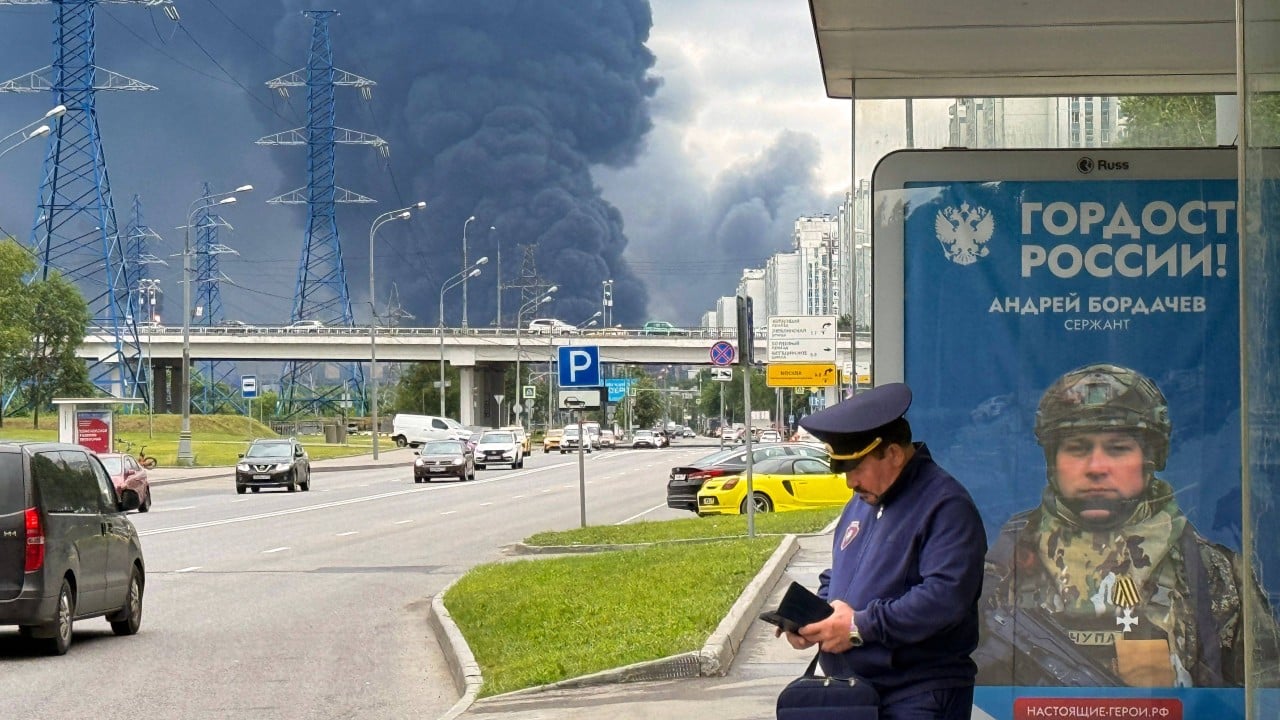
Ukrainian long-range drone strikes against Moscow have fundamentally altered the psychological geography of the Russia-Ukraine war. While mainstream reporting often treats these aerial incursions as mere retaliatory spectacles, the strategic reality runs far deeper. Kyiv is executing a calculated campaign of asymmetric attrition designed to overextend Russia’s air defense networks, puncture the Kremlin’s narrative of domestic security, and impose economic costs on Russia's financial heart. This is not random harassment. It is a highly coordinated effort to force the Russian military into an unsustainable defensive posture far away from the front lines.
The physical damage inflicted by these unmanned aerial vehicles (UAVs) on Moscow's skyscrapers is often superficial, breaking windows and damaging facades in districts like Moscow City. The strategic damage, however, is structural. Every drone that penetrates the capital's airspace exposes a critical vulnerability in how modern nation-states defend vast interior territories against cheap, low-altitude threats.
Shifting the Friction of War Inland
For eighteen months, the civilian population of Moscow remained largely insulated from the physical realities of the conflict raging in Ukraine. That insulation has permanently dissolved. By bringing the war directly to the capital, Ukraine breaks the unwritten social contract between the Russian state and its urban middle class, which traded political compliance for a normal, Western-style existence.
The choice of targets is deliberately symbolic yet functional. Striking government ministries housed in commercial towers highlights the permeability of the state’s most secure zones. It forces ordinary citizens to look up at the sky with apprehension. This psychological friction creates an immediate political problem for local authorities, who must balance reassuring the public with implementing disruptive security measures.
Furthermore, the economic disruption is quantifiable. Each time a drone enters the Moscow airspace region, authorities routinely shut down major international airports like Vnukovo, Domodedovo, and Sheremetyevo. Flights are diverted, schedules are shattered, and commercial logistics stall. For an economy already straining under international sanctions, the compounding cost of halting commercial aviation multiple times a week introduces a volatile variable into corporate planning and tourism.
The Air Defense Dilemma
Defending a metropolis as massive as Moscow requires an extraordinary allocation of military resources. To intercept low-flying, slow-moving drones, Russia has been forced to pull sophisticated air defense systems, such as the Pantsir-S1 and S-400, away from active combat zones in Ukraine and station them on the rooftops of administrative buildings and along suburban rings.
This creates a zero-sum resource problem. A battery deployed to protect a ministry building in Moscow is a battery that cannot protect a supply depot in Rostov or a command post in occupied Zaporizhzhia. Ukraine’s strategy exploits this math. By launching home-grown, inexpensive drones across hundreds of miles of Russian territory, Kyiv forces Moscow to expend expensive interceptor missiles or tie down valuable electronic warfare assets that are desperately needed to counter Ukraine's tactical operations on the front lines.
Moreover, the technical challenges of urban air defense are immense. Shooting down a drone over a densely populated city carries inherent risks. The debris from a destroyed UAV, or a stray surface-to-air missile, can cause more civilian casualties and property destruction than the drone itself. Ukrainian planners understand this operational gridlock, using the very density of Moscow as a shield against aggressive interception techniques.
The Mechanics of Low Altitude Penetration
Most Ukrainian long-range drones, such as the Beaver or the Bober, rely on internal combustion engines and fly at low altitudes to avoid radar detection. They mimic civilian traffic or hug the terrain, navigating through blind spots in the radar net. Russia’s vast territory means that a continuous, unbroken radar curtain is impossible to maintain across thousands of miles of border.
Once a drone clears the border zones, it moves through domestic airspace where tracking becomes a game of cat and mouse. Russian electronic warfare units frequently attempt to jam the GPS signals guiding these drones. While effective in causing some UAVs to lose steering and crash harmlessly into fields, these jamming efforts also disrupt civilian navigation systems inside the capital, further spreading the logistical chaos of the conflict into daily civilian life.
The Cost Equation of Attrition
The financial asymmetry of this campaign heavily favors the attacker. A custom-built Ukrainian long-range attack drone costs anywhere from twenty thousand to one hundred thousand dollars to produce. In contrast, a single interceptor missile fired by a Pantsir or S-400 system costs hundreds of thousands, if not millions, of dollars.
- Attacker Cost: $20,000 to $100,000 per drone.
- Defender Cost: $500,000+ per high-end interceptor missile, plus secondary economic losses from airport closures.
This disparity means Ukraine can sustain this campaign indefinitely, even with a modest manufacturing base. The goal is not to flatten Moscow, but to bleed its defensive reserves dry through a thousand small cuts, ensuring that Russia can never achieve total security at home while waging war abroad.
Intelligence Gathering in Plain Sight
Every strike provides Ukraine and its partners with invaluable data on Russian military readiness and response times. When a drone wave approaches Moscow, Russian radar arrays activate, communication networks light up, and electronic warfare stations begin broadcasting high-power jamming signals.
This radio emissions activity is closely monitored by Western signals intelligence satellites and reconnaissance aircraft operating in international airspace. The data collected allows Ukrainian planners to map out the exact location of Russia’s premier air defense assets, identifying new gaps and weaknesses for subsequent attacks. In essence, each raid acts as a reconnaissance-by-fire mission, mapping the evolution of Moscow’s defensive umbrella in real time.
This constant probing reveals the limitations of Russian military integration. The time lag between identifying an incoming threat at the border and coordinating an interception over the capital suggests bureaucratic friction within the Russian air defense command chain. Ukraine continues to exploit these communication delays by varying launch points, flight paths, and arrival times.
Domestic Industrial Autonomy
A vital aspect of this campaign is its political signaling to Ukraine’s international backers. By utilizing domestically designed and manufactured drones, Kyiv circumvents the strict prohibitions placed on the use of Western-supplied weapons, such as American ATACMS or British Storm Shadows, inside internationally recognized Russian territory.
This domestic production shield insulates Western allies from direct escalation management issues while proving that Ukraine possesses the technological ingenuity to strike deep into Russia independently. It establishes a parallel track of warfare where Kyiv sets its own rules of engagement, utilizing a rapidly expanding network of private drone startups and state-funded defense enterprises to maintain pressure on the Russian interior.
The evolution of these indigenous systems has been swift. Early attempts relied on modified Soviet-era reconnaissance drones, whereas current operations utilize highly optimized composite airframes designed specifically for long-range, low-signature flight. This domestic industrial pivot ensures that regardless of shifts in foreign military aid packages, the aerial pressure on the Russian capital will persist.
The Permanent Insecurity of the Modern State
The normalization of drone strikes in Moscow marks the end of sanctuary in modern warfare. Geography no longer offers the absolute protection it once did for major capitals removed from the front lines of a conflict. The cheap democratization of precision-strike capabilities via unmanned systems means that any state engaging in prolonged conventional warfare must expect its own industrial and political centers to become part of the battlespace.
Moscow residents now live under a sky that requires constant monitoring. Window repair bills, altered morning commutes, and the distant thud of air defense interceptions have integrated into the background noise of the metropolis. By forcing this shift, Ukraine has successfully transformed a distant border war into an inescapable domestic reality for the Russian population, demonstrating that security is an illusion when the sky above can be bought for the price of a used car.