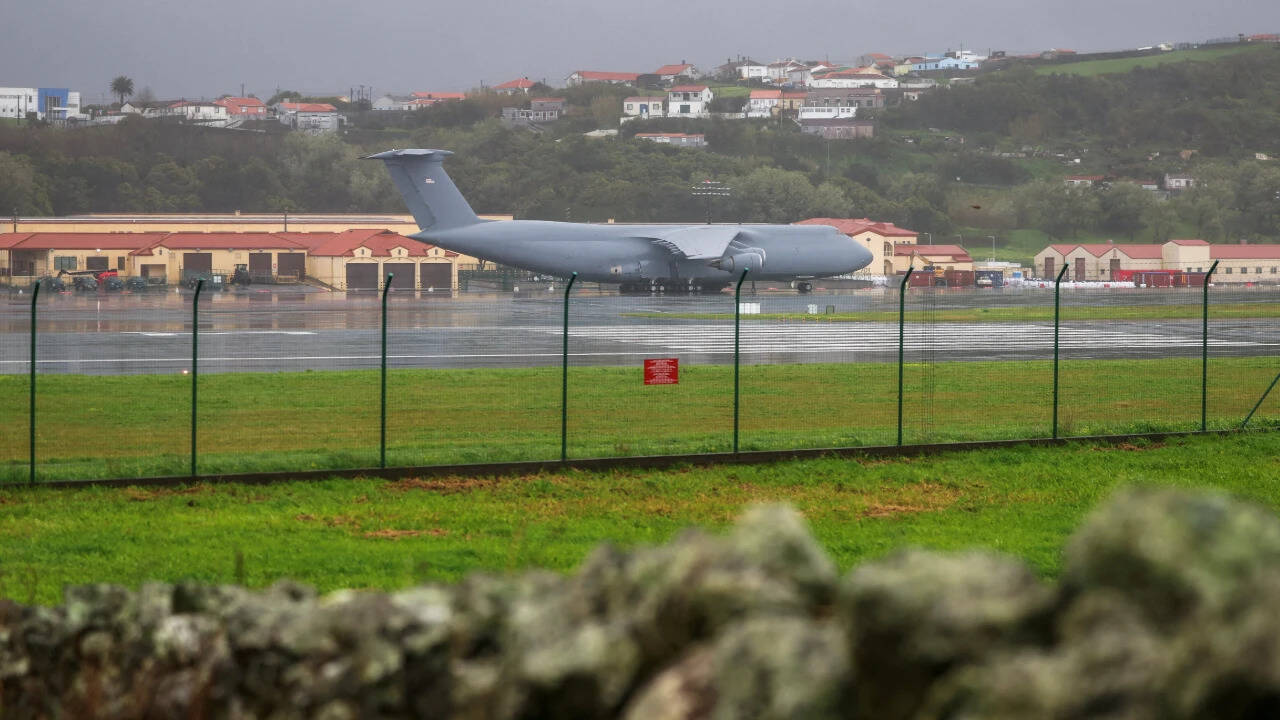
Geopolitical deterrence relies on the clarity of attribution and the credibility of response thresholds. When state actors engage in sub-threshold operations—actions designed to remain beneath the threshold of conventional armed conflict—the primary defense mechanism is not kinetic interception, but forensic transparency. The reported security breach and subsequent attribution linking the Islamic Revolutionary Guard Corps to threats directed against RAF Fairford expose the structural vulnerabilities inherent in modern base security, allied intelligence sharing, and public attribution strategies.
Understanding this incident requires deconstructing it away from diplomatic posturing and into three distinct analytical categories: the strategic geography of forward operating bases, the mechanics of hybrid threat attribution, and the friction points of alliance-level counterintelligence. You might also find this connected article insightful: Why the Christa Pike 911 Calls Expose a Bigger Lie Than Botched Drugs.
The Operational Vulnerability of Forward Operating Sites
Military installations like RAF Fairford in Gloucestershire function as strategic nodes for long-range air power projection, intelligence collection, and strategic bomber task force operations. Their value lies in infrastructure readiness, fuel storage, pre-positioned logistics, and rapid integration with host-nation airspace networks. However, this high strategic utility introduces a corresponding vulnerability profile.
Airbases are open, sprawling facilities bound by civilian infrastructure, regional transport corridors, and public access zones. Unlike hardened underground command bunkers, an airbase depends on a perimeter defense model that is inherently permeable to civilian observation and sub-threshold reconnaissance. Hostile state intelligence services or their proxies exploit this permeability by using local reconnaissance cells, signals intelligence collection points near perimeter fences, and local proxies to map security force rotations, response times, and aircraft deployment cycles. As reported in detailed coverage by The New York Times, the implications are significant.
The structural challenge for security operators is the cost asymmetry of defense. Protecting a perimeter against low-cost, decentralized reconnaissance requires continuous, resource-intensive monitoring. Conversely, an adversary expends minimal capital to gather targeting data, test response protocols, or execute hostile surveillance operations. When a specific facility is identified as the focal point of an active threat, the immediate operational cost is borne by the host nation and tenant forces, who must escalate force protection conditions, disrupt local flight schedules, and divert intelligence assets from broader regional monitoring to local counter-surveillance.
The Mechanics of State-Sponsored Sub-Threshold Operations
Attributing clandestine plots to a specific military apparatus such as the IRGC demands an examination of proxy networks and operational command structures. State intelligence operations conducted below the threshold of war rarely involve uniformed military personnel operating within target states. Instead, they rely on layered proxy architectures designed to provide plausible deniability.
The IRGC, through its external operations arm, manages a portfolio of non-state actors, criminal syndicates, and co-opted intelligence assets across Europe and the Middle East. Executing a surveillance or disruption plot against a sensitive military installation in the United Kingdom does not require a direct operational footprint by Iranian nationals. It requires compartmentalized tasking: financing through informal value transfer systems, recruitment of local criminal elements for low-level surveillance, and digital tasking via encrypted communication channels.
This architecture creates a severe attribution bottleneck for intelligence agencies. While signals intelligence and human intelligence may intercept communications indicating intent, establishing the unbroken chain of command from the operational cell back to Tehran's command structure is methodologically difficult. Tehran's public denial of involvement is a predictable output of this operational model. Plausible deniability is engineered into the very design of hybrid warfare. The denial is not intended to be believed by Western intelligence services; rather, it is designed to provide diplomatic cover for allied states reluctant to escalate tensions or impose severe economic and military sanctions.
Intelligence Sharing Frictions and Public Attribution Dilemmas
When political leaders like Andy Burnham link local security threats to foreign state actors, it signals a strategic shift from covert counterintelligence management to overt public attribution. This shift introduces a complex policy trade-off between deterrence and source protection.
Publicly naming a state sponsor of terrorism or sabotage serves two functions: it rallies domestic political support and establishes a public red line that deters future escalation. However, it forces intelligence agencies to declassify or summarize sensitive methodologies, risking the compromise of sources and methods. If an adversary knows how their communications were intercepted or which regional partner provided the intelligence, they can adapt their tradecraft, closing windows of observation that intelligence agencies spent years developing.
Furthermore, public attribution creates a diplomatic trap. Once a state is formally accused of targeting a domestic military installation, inaction or a purely diplomatic reprimand signals a lack of strategic deterrence. If the response is disproportionately weak, the targeted state invites further probing of its security thresholds. Conversely, over-responding risks triggering economic retaliation, cyber counter-attacks, or kinetic escalation in regions where Western states maintain vulnerable shipping lanes or diplomatic outposts.
The Strategic Cost Function of Hybrid Deterrence
The incident at RAF Fairford is not an isolated security breach; it is a data point in a broader pattern of global grey-zone competition. Hostile states test the resilience of democratic societies by conducting operations that are too small to justify conventional war, yet too persistent to ignore.
Traditional deterrence models built on mutually assured destruction fail in this domain because the stakes are kept deliberately low at each individual touchpoint. An adversary can afford multiple failed or disrupted plots because the cost of failure is negligible compared to the potential intelligence yield or the strategic disruption caused by forcing a superior power to continuously defend its rear echelons.
Elevating national security against this vector requires shifting resources away from reactive perimeter defense and toward preemptive financial tracing, digital asset interdiction, and the dismantling of proxy recruitment networks before they reach the perimeter fence. Until Western security architectures match the persistence and compartmentalization of hybrid threat networks, strategic installations will remain exposed to the friction of sub-threshold coercion.


