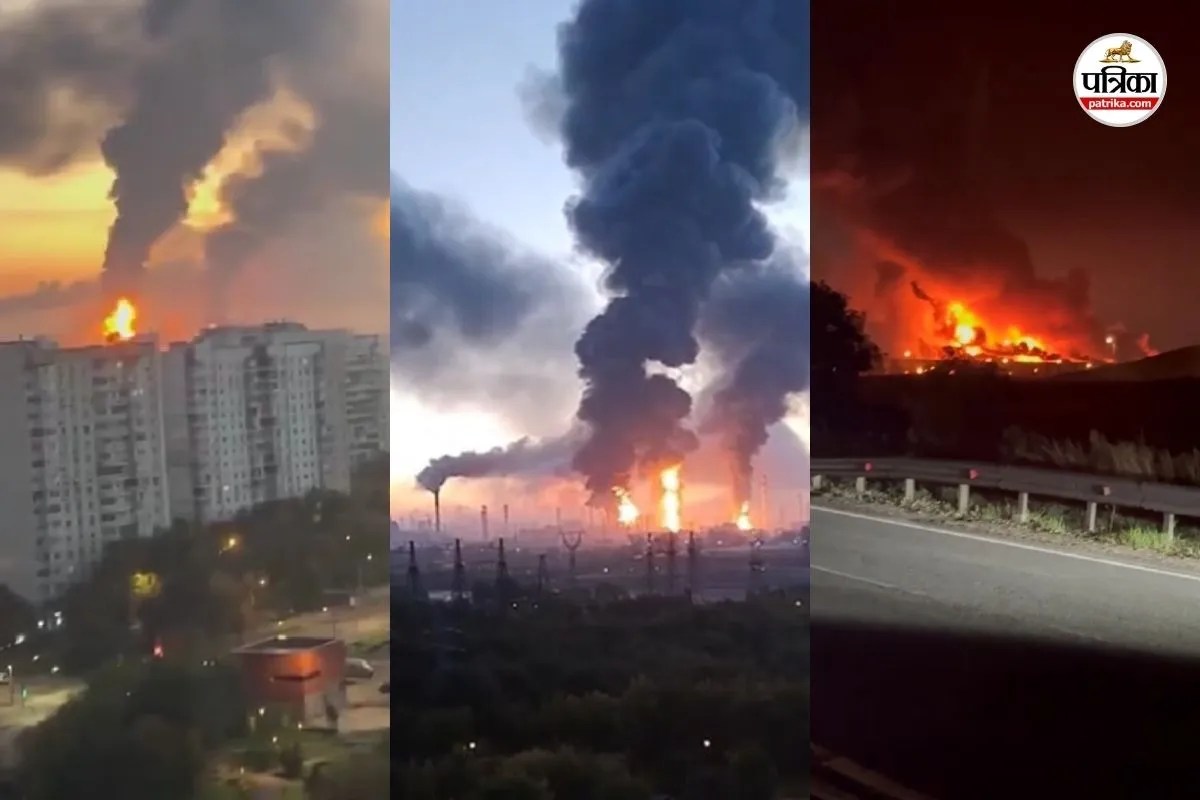
Long-range asymmetric drone campaigns against strategic petroleum infrastructure test the structural limits of territorial air defense and national logistics networks. The execution of massive aerial strikes against critical facilities, such as the Kapotnya oil refinery near Moscow, marks a calculated shift from frontline attrition to structural economic disruption. Evaluating this operational shift requires examining the mechanics of air defense saturation, the economic friction of refining capacity losses, and the systemic vulnerabilities of centralized fuel processing nodes.
The Air Defense Saturation Problem
Defending a major urban-industrial center like Moscow involves layered defensive architecture, including point-defense systems like the Pantsir-S1 positioned in proximity to critical infrastructure. However, large-scale drone swarms exploit fundamental mathematical limits in interceptor-to-target ratios. If you found value in this article, you might want to check out: this related article.
When hundreds of low-cost vector units approach a target simultaneously, defenders face a triage dilemma. The economic asymmetry is stark: interceptor missiles carry a unit cost orders of magnitude higher than the attacking airframes. Deploying these assets drains stockpiles of precision guidance hardware.
Furthermore, the physical footprint of a modern refinery precludes complete point defense coverage. Primary processing units, such as the ELOU-AVT-6 distillation columns, present large, static thermal and physical signatures. Even when interception rates approach high nominal percentages, the absolute volume of unintercepted mass guarantees that high-value structural components remain vulnerable to kinetic impact. For another look on this development, check out the recent coverage from TIME.
The Processing Bottleneck and Refining Friction
Attacking downstream petroleum infrastructure introduces cascading friction across an industrial economy. Refineries are not modular factories with easily swappable parts; they rely on specialized, heavy engineering components—such as large-scale catalytic crackers and primary distillation towers—many of which depend on foreign proprietary manufacturing that faces severe export restrictions.
When a primary unit is forced offline, the operational impact manifests across three distinct vectors:
- Capacity Curtailment: Nominal refining capacity figures often mask operational realities. Facilities rarely run at absolute maximum thresholds, meaning initial losses can sometimes be absorbed by running surviving units harder. However, repeated strikes erode this reserve margin.
- Regional Redistribution Constraints: If a major regional supplier like the Moscow refinery drops output, refined products must be diverted from other domestic districts. This redistributes the supply deficit rather than eliminating it, creating logistical choke points along rail and pipeline networks.
- Military Fuel Logistics: Refineries do not merely supply civilian retail markets; they produce specialized aviation kerosene and diesel variants required for tactical logistics and motorized units. Disrupting these inputs degrades the operational readiness of armed forces stationed far from the immediate theater of conflict.
Collateral Economic Disruption
Beyond structural damage to physical plant assets, large-scale aerial alerts generate immediate secondary economic drag. Sustained drone incursions targeting the capital region force the routine suspension of civil aviation at major hubs like Sheremetyevo, emergency deployment of municipal services, and localized infrastructure shutdowns.
The requirement to continuously activate civil defense protocols imposes a recurring operational tax on the state. Each alert consumes emergency response bandwidth, creates workforce productivity losses due to shelter mandates, and degrades public confidence in domestic security umbrellas.
Strategic Trajectory
The systematic targeting of deep-interior energy nodes demonstrates that geographic depth no longer guarantees operational immunity. As long as the marginal cost of producing and launching long-range autonomous airframes remains significantly lower than the cost of hardening and defending sprawling industrial complexes, the strategic advantage favors the offensive network. Future operational efficiency will depend on the attacker's ability to sustain strike frequencies faster than the targeted state can fabricate replacement high-precision components, transforming industrial resilience into a primary metric of strategic endurance.