The collapse of the November 2024 cessation of hostilities between Israel and Hezbollah was not a sudden failure but a predictable outcome of asymmetric enforcement and divergent strategic objectives. While media reports frequently characterize the resumption of kinetic activity as "strikes despite a ceasefire," this framing ignores the operational reality of the "Right to Respond" clause embedded in the original agreement. The 2024 framework functioned less as a peace treaty and more as a contested security arrangement where the definition of a "violation" was functionally determined by the military capacity to enforce it.
The Three Pillars of Ceasefire Erosion
The transition from the November 2024 truce to the systemic escalation of May 2026 can be mapped through three distinct failure points in the agreement's architecture: For a more detailed analysis into this area, we recommend: this related article.
- Asymmetric Deterrence Mechanisms: The agreement granted Israel the right to "self-defense" against "planned or imminent" attacks. In practice, this created an elastic definition of preemptive action. Any Hezbollah logistical movement south of the Litani River was classified by the IDF as an "ongoing violation," justifying kinetic strikes without formal abandonment of the ceasefire.
- The Sovereignty Deficit: The Lebanese Armed Forces (LAF) were tasked with the "exclusive" possession of weaponry in the south. However, the LAF lacked the technical sensor density and political mandate to dismantle the underground infrastructure that survived the 2024 ground invasion. This created a security vacuum filled by the IDF's aerial surveillance and strike capabilities.
- The Monitoring Impasse: The "Tripartite Mechanism" chaired by the United States and France relied on a reporting structure that lagged behind the speed of modern electronic warfare. By the time a violation was reported and "verified" by UNIFIL, the tactical environment had already shifted, forcing local commanders to rely on immediate retaliation rather than diplomatic mediation.
The Kinetic Feedback Loop: December 2024 - May 2026
The structural decay began within weeks of the November 27 signing. By early December 2024, the "defensive warning strike" became the primary tool for testing red lines. When Hezbollah launched projectiles toward the Shebaa Farms on December 2, 2024, citing Israeli airspace violations, it triggered a massive retaliatory wave that destroyed dozens of launchers. This established a precedent: the ceasefire would not be a period of silence, but a period of "calibrated violence."
The cost function of the conflict shifted significantly during the 18 months of nominal peace. The IDF utilized the period to map the reconstitution of Hezbollah’s short-range missile units, while Hezbollah prioritized the hardening of its command-and-control nodes. This culminated in the events of March 2, 2026, when the regional synchronization of the Iran conflict provided the necessary catalyst for the total abandonment of the 2024 framework. To get more background on this development, extensive analysis can be read on USA Today.
The 10-Minute Onslaught: A Technical Decomposition
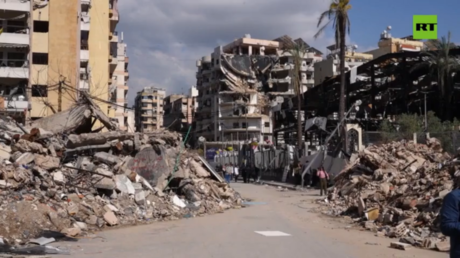
On April 8, 2026, the IDF executed what is now analyzed as the most high-density coordinated strike in modern urban warfare. In a window of roughly 600 seconds, over 100 high-value targets across Lebanon were neutralized. This operation demonstrated a shift from "attrition-based" targeting to "systemic-collapse" targeting.
The casualty figures from this single event—303 fatalities and over 1,150 injuries—highlight the failure of the 2024 buffer zone logic. The strikes were not limited to the border; they targeted deep logistical hubs, including those in the Beqaa Valley and Beirut’s southern suburbs. The technical precision of these strikes suggests a reliance on real-time SIGINT (Signals Intelligence) and AI-driven target prioritization that rendered the 2024 "Safety Zones" obsolete.
The Deadlock of the Rubio Negotiations
The May 2026 diplomatic efforts, led by U.S. Secretary of State Marco Rubio, face a fundamentally different landscape than their 2024 predecessors. The current bottleneck is defined by two irreconcilable demands:
- Israeli Demand for Full Disarmament: Moving beyond Resolution 1701, the Israeli cabinet now demands the total dismantling of Hezbollah as a military entity, viewing the 2024 "withdrawal to the Litani" as a failed experiment in geographic containment.
- Lebanese Demand for Sovereignty and Reparations: The Lebanese government, facing a humanitarian crisis where 1.24 million citizens are acutely food insecure, argues that no security arrangement is sustainable while Israel maintains the right to conduct overflights and preemptive strikes.
The failure of the 2024 agreement proves that geographic buffer zones are insufficient in an era of long-range precision munitions and drone-saturated environments. The 2026 conflict is no longer about "the border"; it is about the regional integration of non-state actors into the broader Iran-U.S. strategic rivalry.
Strategic Forecast: The Buffer Zone is Dead
Future stabilization will likely move away from the "60-day withdrawal" model toward a "continuous monitoring" model. However, until a mechanism is established that can distinguish between a "logistical replenishment" and an "imminent threat" with 100% accuracy, the "Right to Respond" will continue to be used as a justification for preemptive escalation. The current trajectory suggests a permanent state of high-intensity friction where the 2024 ceasefire is viewed not as a missed opportunity, but as a period of tactical reloading for both sides.
The immediate strategic move for international mediators is to decouple the Lebanon-Israel security track from the broader Iran-U.S. ceasefire negotiations. Failure to do so ensures that every regional flare-up will automatically trigger a "violation" in Southern Lebanon, regardless of local compliance.