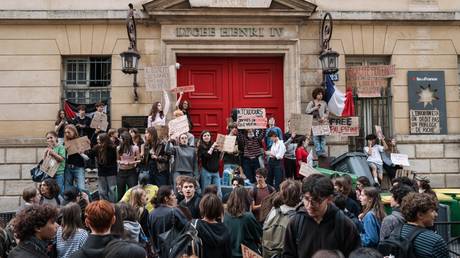
When authorities in Paris implement restrictions or bans on protests near schools and universities, public debate immediately fractures into two competing perspectives. According to French government officials and local police prefectures, these measures are necessary to maintain public order, ensure student safety, and prevent educational disruption. Conversely, student unions, civil liberties organizations, and opposition politicians argue that restricting demonstrations near campuses infringes upon the constitutional right to assembly and weakens a long-standing tradition of French political engagement.
Understanding the reality of protest restrictions around Parisian educational institutions requires looking past simplified narratives. Neither side holds a monopoly on valid concerns, and the legal framework governing public demonstrations in France involves specific balancing mechanisms between public safety and fundamental freedoms.
The Case for Restricting Campus-Adjacent Protests
Proponents of perimeter bans around schools and universities—including the Paris Police Prefecture and the Ministry of the Interior—base their position on operational safety and the continuity of public services.
- Protection of Minors: Secondary schools (lycées) educate students who are largely under the age of 18. According to French education officials, blockades and demonstrations outside school gates can expose minors to crowd surges, property damage, and confrontations between protesters and law enforcement.
- Preservation of the Right to Education: French law guarantees students access to instruction and examinations. During periods of heightened social mobilization—such as pension reform protests or geopolitical demonstrations—university blockades (blocages) have historically forced the cancellation of classes, delayed exams, and restricted access to libraries and administrative buildings.
- Emergency Access and Urban Infrastructure: Many Parisian schools and universities, particularly in historic districts like the Latin Quarter, sit along narrow streets. Law enforcement officials note that large crowds in these areas can obstruct emergency vehicles and create bottlenecks that complicate crowd management.
In administrative orders issuing temporary bans, the Paris Police Prefecture typically cites the risk of troubles à l'ordre public (disturbances to public order), pointing to prior incidents of vandalism, unauthorized occupations, or clashes on the periphery of otherwise peaceful gatherings.
The Case Against Protest Bans
Critics of these bans—including student organizations such as the UNEF (Union Nationale des Étudiants de France), legal scholars, and human rights groups like the Ligue des Droits de l'Homme (LDH)—view spatial restrictions near campuses as disproportionate and politically consequential.
- Erosion of Constitutional Rights: The right to demonstrate is protected under French constitutional principles and Article 11 of the European Convention on Human Rights. Critics argue that preemptive bans around universities effectively neutralize protest movements before they can assemble, shifting the burden from policing unlawful behavior to prohibiting lawful expression.
- Historical Role of Student Activism: From May 1968 to more recent social movements, Parisian universities have served as central spaces for civic debate and political organizing. Opponents of perimeter bans contend that removing demonstrations from the vicinity of campuses isolates students from their primary community hubs and diminishes the visibility of their grievances.
- Concerns Over Selective Enforcement: Civil liberties advocates have raised questions about whether protest bans are applied consistently across different political causes, warning that broad administrative discretion can lead to perceptions of unequal treatment.
The Legal Framework Governing French Protest Restrictions
In France, public demonstrations are not subject to prior authorization, but organizers must submit a déclaration préalable (prior declaration) to the local prefecture at least three days before the event. Under the French Internal Security Code (Code de la sécurité intérieure), a police prefect may prohibit a demonstration only if it poses a genuine threat to public order and if less restrictive measures—such as rerouting the march—are insufficient.
Administrative courts (tribunaux administratifs) frequently review these bans on an emergency basis through a procedure known as a référé-liberté. In several instances, French administrative judges have overturned prefectural bans when authorities failed to demonstrate a specific, imminent risk of violence, reaffirming that restrictions on fundamental liberties must remain strictly proportional to the threat.
Key Questions Surrounding Campus Protest Policies
Are all protests permanently banned outside Paris schools?
No. Under French administrative law, blanket, permanent bans on demonstrations across broad areas are generally unlawful. Restrictions are issued via temporary prefectural decrees (arrêtés préfectoraux) covering defined perimeters and specific timeframes, usually in response to announced mobilizations or ongoing tensions.
What happens inside university grounds versus public streets?
University presidents hold primary responsibility for maintaining order within campus buildings and grounds, known as franchise universitaire. Police generally enter university premises only at the request of the university president or in cases of flagrant offenses. Public streets immediately outside campus gates, however, fall directly under the jurisdiction of the Paris Police Prefecture.
How do European human rights standards apply?
The European Court of Human Rights has consistently held that while states may impose reasonable restrictions on the time, place, and manner of assemblies to protect public safety and the rights of others, authorities must show tolerance toward peaceful gatherings—even when those gatherings cause temporary disruption to daily life or traffic.
Balancing Competing Public Interests
The debate over protest restrictions near Paris schools and universities reflects an ongoing tension within democratic governance. Municipal and state authorities face concrete obligations to protect minors, keep public institutions functioning, and prevent violence in dense urban environments. At the same time, legal experts and civil society groups emphasize that preserving open spaces for dissent—particularly among young citizens—remains essential to democratic participation. How French courts and policymakers calibrate these competing duties continues to define the boundaries of public assembly in Paris.