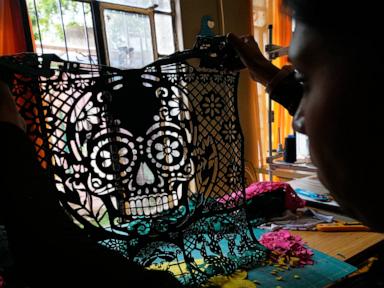
Global sportswear giants are losing their grip on local authenticity as independent creators weaponize deep historical roots. In Cuautitlán Izcalli, a modest workshop near Mexico City run by brothers Hugo and Andrés Rosas is quietly challenging how football culture commodifies national identity. Their brand, Mexclart, has bypassed standard manufacturing templates to craft intricate, hand-cut jerseys inspired by pre-Hispanic deities and traditional papel picado folk art ahead of the World Cup. It is a direct counter-offensive against the sterile, mass-produced kits churning out of corporate design hubs.
The global market for international football merchandise is worth billions, yet the aesthetic has grown increasingly homogenized. Major athletic brands frequently cycle through watered-down cultural motifs, stripping them of historical context to maximize global consumer appeal. The Rosas brothers represent an aggressive turn toward uncompromised heritage, treating the football jersey not as a piece of casual sportswear, but as structural modern armor.
The Industrialization of Heritage
Football shirts have long been an economic engine fueled by tribal loyalty. For decades, multi-national apparel conglomerates have held monopolies over national team kits, relying on massive supply chains to distribute millions of identical polyesters globally. To appeal to a wide demographic, these corporations often rely on surface-level cultural pastiche, printing a simplified pattern here or an abstract geometric block there.
This corporate sanitization creates an opening for hyper-local artisans. The Rosas brothers operate on a strictly manual blueprint. A single jersey can require up to three weeks of conceptual sketching and an additional eight to ten hours of manual cutting and sewing.
Material Conflict
The production process exposes a fundamental tension between ancient form and modern function. The brothers initially attempted to utilize natural, historical fibers to honor indigenous manufacturing traditions. The material simply failed under pressure.
[Raw Natural Fibers] -> Structural failure under tension/sweat
[Industrial Polyester] -> High durability, allows precise laser/manual cuts
To achieve the precise, lace-like negative space characteristic of papel picado without risking immediate structural tearing on the pitch or in the stands, they had to compromise. They adapted modern industrial polyester to serve as a canvas for ancient aesthetics. This marriage of synthetic endurance and traditional craftsmanship allows the fabric to endure the physical rigors of football culture while maintaining the delicate, hollowed-out look of their latest collection, Calados del Alma.
Deities Versus Global Logos
The imagery chosen by independent designers highlights a stark philosophical divide with commercial kit providers. Corporate apparel must remain sanitized, universally palatable, and corporate-sponsor friendly. Independent creators face no such restrictions.
- Quetzalcoatl: The feathered serpent deity represents a cyclical worldview. It views the environment as an interconnected system rather than a resource pool to be extracted for profit.
- Mictlantecuhtli: The skeletal Aztec ruler of the underworld pulls no punches, embracing the macabre reality of mortality.
- Ofrenda Viva: Inspired by the Day of the Dead, this concept transforms a sports garment into a literal offering, dedicated to deceased ancestors through athletic passion.
These complex, sometimes jarring theological symbols stand in opposition to the clean, minimalist branding demanded by modern retail environments.
The Economics of Scale and Authenticity
The market reality for independent operations is brutal. Since launching their World Cup line, Mexclart has produced roughly 30 garments. A multinational corporation can manufacture that volume in less than a second.
| Operational Metric | Global Sportswear Monopolies | Hyper-Local Independent Brands |
|---|---|---|
| Production Time | Seconds per garment via automated lines | 2 to 3 weeks design; 10 hours assembly |
| Primary Canvas | Sublimated prints on standard templates | Hand-stitched panels and physical cutouts |
| Cultural Depth | Broad, focus-grouped national motifs | Direct lineage, specific regional histories |
| Output Volume | Millions of units worldwide | Extremely limited batches |
This massive disparity in scale transforms the product from a commercial commodity into a luxury cultural artifact. The scarcity is the point. Consumers purchasing these independent alternative jerseys are explicitly rejecting the hyper-commercialization of the sport. They are willing to pay a premium for localized craftsmanship over a corporate logo.
The Legacy of Radical Design
This anti-corporate design movement is not without historical precedent. The baseline for radical Mexican kit design was established during the 1998 World Cup in France. At the time, a little-known local domestic brand named ABA Sport bypassed corporate minimalism to splash the Aztec Sun Stone across the entire torso of the national team jersey.
That specific design was initially dismissed by conservative executives as loud and unmarketable. It went on to become one of the most iconic, sought-after, and heavily counterfeited football shirts in sports history. The success of that 1998 jersey proved that football fans crave raw, unapologetic identity over slick, standardized global corporate styling.
The current wave of independent designers is pushing that legacy even further. They are moving past flat sublimation prints to introduce physical, tactile texture through embroidery, layered paneling, and structural cutouts.
The Co-Optation Risk
The success of alternative, culturally dense football apparel creates an inevitable corporate feedback loop. Major brands regularly monitor independent subcultures for aesthetic inspiration. When a small workshop gains traction by utilizing authentic historical art forms, global design teams quickly take note.
The danger is the inevitable dilution of the message. An independent brand can dedicate weeks to studying indigenous ceremonies and historical texts to ensure a deity is depicted with theological accuracy. A multi-national corporation looking to copy that trend will inevitably run the design through marketing committees, focus groups, and legal departments. The result is a watered-down product that captures the surface look while completely discarding the underlying cultural soul.
The defensive line against this corporate co-optation is the physical limitation of mass production. A factory setup designed to produce five million units cannot easily replicate ten hours of individual hand-stitching or intricate, manual fabric ventilation. The physical labor itself becomes the barrier protecting the authenticity of the garment.
Reclaiming the Armor
For the modern football supporter, choosing what to wear has become a highly politicized act of identity. The soccer shirt functions as a modern iteration of communal armor. Wearing a mass-manufactured shirt signaling a multinational corporation is increasingly viewed as passive consumption. Wearing a garment laced with deep historical narrative is an active statement of cultural resistance.
The impending global tournament will test whether hyper-local operations can survive the crushing commercial weight of corporate marketing campaigns. The Rosas brothers do not possess the capital to secure official stadium placement or multi-million dollar player endorsements. They possess something far more volatile: a direct, uncompromised pipeline to the ancient roots of the community.