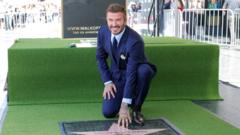
The induction of David Beckham as the 2,849th star on the Hollywood Walk of Fame on June 12, 2026, is not an isolated celebratory event, but the logical culmination of a deliberate 25-year asset conversion strategy. While public commentary treats the ceremony—staged on green turf to coincide with the opening of the 2026 FIFA World Cup in the United States—as a traditional entertainment milestone, it serves as a case study in converting athletic performance equity into long-term commercial intellectual property.
The Hollywood Chamber of Commerce’s "Sports Entertainment" designation, established in 2021, codifies a fundamental economic shift: the decoupling of a sports figure’s monetization potential from on-field physical depreciation. Beckham’s induction presents a highly replicable operational blueprint for high-net-worth athletes seeking to survive the natural decline of their primary athletic output. If you found value in this article, you might want to check out: this related article.
The Three Pillars of the Beckham Capital Conversion Framework
The institutional permanence achieved by the Beckham brand relies on three distinct business operations that systematically transitioned him from an active athlete to an enterprise asset.
1. Physical Capital to Media IP Conversion
Active athletic careers operate under a strict biological expiration date. To hedge against this inevitable capital depreciation, Beckham initiated an intellectual property migration strategy. The establishment of Studio 99 in 2019 serves as the operational engine for this pillar. Rather than acting as licensing talent for third-party production houses, the studio internalizes production margins by developing, owning, and selling premium documentary features and unscripted formats directly to global distribution networks including Netflix, Disney+, and Amazon Prime Video. For another perspective on this story, refer to the recent coverage from Financial Times.
This model extracts value from past athletic legacy and converts historical narrative into recurring licensing revenue, entirely independent of current physical performance.
2. Strategic Franchise Equity Allocation
The transition from an employee within a sports franchise to an equity-holding operator represents the most critical step in long-term capital preservation. The structural foundation for this was negotiated in Beckham’s 2007 Major League Soccer (MLS) player contract with the LA Galaxy. The agreement contained a highly structured financial derivative: a fixed-price expansion option allowing him to purchase an MLS franchise for $25 million upon retirement.
By executing this option to establish Inter Miami CF in 2018, Beckham shifted his position from a wage earner subject to a salary cap to a principal owner capturing the macro-economic upside of North American soccer. The strategic culmination of this equity play occurred in 2023 with the signing of Lionel Messi, an operational move that directly accelerated franchise valuation, leading up to the club's MLS Cup victory in 2025. This move proved that athlete-owners can generate immense asset appreciation by utilizing their personal industry networks as cheap acquisition capital.
3. Cross-Industry Network Synchronization
The presence of non-sporting figures like actor Tom Cruise and fashion executive Victoria Beckham at the presentation ceremony highlights an intentional network strategy. The operational objective here is the systematic expansion of the brand's Total Addressable Market (TAM).
[Athletic Core: On-field Performance]
       │
       ▼ (Contractual Options / Media IP Creation)
[Corporate Equity: Franchise Ownership & Studio 99 Production]
       │
       ▼ (Strategic Cross-Industry Alignments)
[Global Lifestyle Brand: Permanent Monetization]
By explicitly aligning a sports brand with elite Hollywood film networks and luxury fashion houses, the enterprise insulates itself against the cyclical volatility of any single consumer market. The brand ceases to index exclusively on sports consumer sentiment, diversifying its revenue streams across entertainment, luxury goods, and corporate sponsorships.
The Cost Function of Global Celebrity Monopolies
The elevation of an individual to a permanent institutional brand requires continuous, capital-intensive maintenance of their public and professional narrative. This maintenance is governed by a strict set of strategic demands and operational costs.
- The Narrative Premium: Brand equity is highly sensitive to domestic or internal instability. The operational protocol requires immediate containment of any non-performing brand elements, such as personal or familial disputes. Public messaging must strictly prioritize structural stability over short-term media engagement to preserve multi-year corporate partnerships.
- The Geographic Liquidity Disadvantage: Achieving global brand institutionalization demands geographic flexibility. Beckham’s multi-decade trajectory required moving capital and physical operations across disparate regulatory and media markets: Manchester, Madrid, Los Angeles, Milan, Paris, Miami, and London. Each transition carries massive compliance, tax optimization, and localization costs.
- The Capital Allocation Floor: The Hollywood Chamber of Commerce selection process requires an upfront financial commitment, including nomination fees and a structural maintenance cost of $75,000 to manage the physical asset. This dynamic clarifies that the Walk of Fame is an explicit commercial marketing channel where capital is deployed to secure an permanent physical billboard in a high-foot-traffic tourist district.
Structural Limitations of the Sports Entertainment Asset Class
While the Beckham enterprise presents a highly successful model of brand institutionalization, scaling or replicating this framework across the broader sports industry introduces severe execution bottlenecks.
The first limitation is the extreme scarcity of early-stage contractual leverage. The structural engine of Beckham’s wealth generation—the fixed-price $25 million MLS expansion option—relied on a highly unusual market-entry concession by a nascent league desperate for international validation in 2007. Modern sports leagues operating at mature valuation levels rarely grant such underpriced call options to active talent, heavily restricting current athletes to minority equity tranches or traditional venture capital investments.
The second bottleneck is the structural reliance on continuous, high-margin media distribution. Studio 99 succeeds because global platforms are willing to pay a premium for authenticated, legacy-driven IP. For mid-tier or emerging sports figures, the production overhead of creating an independent studio outweighs the content's market demand. This reality forces most athletes to remain dependent on third-party media conglomerates, returning them right back to a standard talent-for-hire compensation structure.
The final risk factor is brand dilution driven by aggressive commercialization. An elite brand must constantly balance broad consumer monetization with prestige scarcity. Over-indexing on low-tier corporate sponsorships or high-volume consumer goods can erode the premium positioning required to attract top-tier global partners or institutional co-investors for major franchise acquisitions.
The optimal strategy for modern high-net-worth athletes requires moving away from traditional transactional endorsement deals. Talent must demand structural equity, co-ownership rights, or media production control during their peak physical output years. The Beckham model demonstrates that the ultimate value of an athletic career is not the cumulative sum of player salaries, but the volume of permanent, non-physical corporate assets that can be extracted, owned, and scaled long after the final whistle.