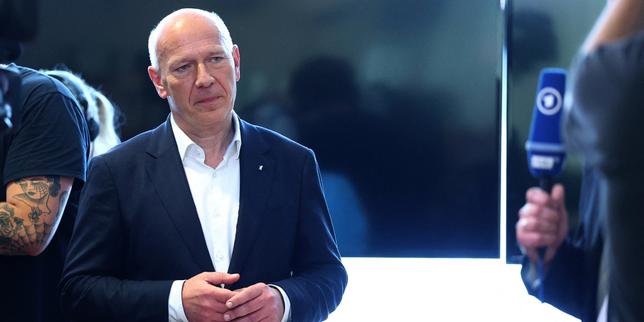
The mainstream political commentary has found its latest consensus chew toy: Kai Wegner’s administration in Berlin. The conventional narrative, splashed across European headlines, is remarkably predictable. They claim that the conservative mayor’s local stumbles, coalition frictions, and Berlin's notoriously chaotic administration are drag anchors on the federal Christian Democratic Union (CDU) as it prepares for national leadership.
They are looking at the wrong map.
The belief that a turbulent Berlin city hall weakens the federal party ignores the fundamental mechanics of German voter psychology and federal dynamics. The national media treats Berlin as a microcosm of the state, assuming that local policy friction translates directly into national vulnerability. It does not. In reality, the friction in Berlin is the best proof of concept the CDU has had in a decade.
The Illusion of the Flawless Capital
Political analysts love to view Berlin through the lens of national governance. When a local conservative mayor faces backlash over infrastructure, budgeting, or immigration rhetoric, the immediate conclusion is that the brand is damaged.
This view misunderstands what voters actually want from the CDU in Berlin. They did not elect Kai Wegner to run a smooth, frictionless machine. Nobody expects Berlin to run smoothly; it is a city defined by its operational dysfunction, a legacy left by decades of left-wing coalitions. Wegner was elected to break the monopoly of the status quo, to be a counterweight.
Every time the local media outlays a new crisis in the Berlin senate, it reinforces the national CDU narrative: governing the capital is a brutal, necessary cleanup operation. The friction isn’t a sign of failure; it is the sound of the gears finally engaging after years of spinning in neutral. Federal voters do not look at Berlin and think, "The CDU is unstable." They look at Berlin and think, "Finally, someone is trying to manage the unmanageable."
The Local Coalition Myth
The loudest critics point to the tension between the CDU and their Social Democratic (SPD) coalition partners in the city-state. They argue that this daily bickering signals a party incapable of stable governance, projecting weakness onto the national stage where Friedrich Merz seeks a clear mandate.
Let’s dismantle this premise. A coalition between the CDU and the SPD in a deeply left-leaning city like Berlin is inherently adversarial. It is not supposed to be a marriage of love; it is a transactional arrangement.
- The Left’s Retreat: For years, Berlin was the playground of RRG (Red-Red-Green) coalitions that prioritized ideological experiments over basic infrastructure.
- The Reality Check: The current friction exists because the CDU is actively pushing back against entrenched bureaucratic interests.
- The National Signal: For national voters who are exhausted by the ideological gridlock of the federal "traffic light" coalition, the Berlin CDU’s willingness to fight its partner to get things done looks like strength, not weakness.
I have watched political strategists misread these dynamics for twenty years. They assume voters want harmony. Voters don’t want harmony; they want results, or at the very least, they want to see their chosen party fighting for their priorities. Wegner’s public disagreements with his own coalition partners show a refusal to capitulate to the progressive Berlin establishment. That plays incredibly well in Bavaria, Saxony, and North Rhine-Westphalia.
The Misplaced Fear of the Margins
The core argument of the competitor’s perspective is that Wegner’s missteps alienate centrist voters and drive them toward the fringes, thereby weakening the CDU’s federal position. This is a profound misreading of where the political gravity is shifting.
The federal CDU does not win by pretending Berlin is a sanctuary of centrist calm. It wins by showing it can confront urban decline, migration pressures, and economic stagnation head-on. When Wegner takes a hard line on law and order or criticizes the slow pace of administrative reform, the metropolitan elite cringes, but the broader electorate nods.
"The true risk for the CDU is not local friction in Berlin, but national irrelevance through over-caution."
If the CDU attempts to govern Berlin like a sterile technocratic corporate board, it loses its identity. The internal drama, the public debates, and the sharp policy pivots are exactly what keeps the party relevant in an era defined by political polarization. The national party under Merz needs a gritty, real-world example of the struggle against urban progressivism. Berlin provides that exact stage.
The Cost of the Contrarian Stance
To be fair, this strategy carries distinct operational liabilities. If the Berlin administration completely freezes due to infighting, or if the budget collapses entirely, the narrative shifts from "tough cleanup crew" to "incompetent managers." There is a fine line between productive friction and outright chaos.
Furthermore, Wegner’s aggressive posture occasionally forces the federal leadership to defend local statements that do not align perfectly with national campaign messaging. This creates short-term media headaches.
But these headaches are the price of admission for political relevance. A party that risks nothing in the capital city cannot claim the mantle of national renewal. The assumption that the CDU needs a placid, quiet Berlin to win the chancellorship is a fantasy born from an outdated era of consensus politics.
Stop looking at the minor fractures in the Berlin senate as a sign of national decay. They are the growing pains of a party learning how to fight in hostile territory. The disruptions in the capital aren't breaking the CDU; they are hardening it.