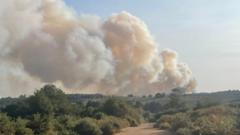
Another stretch of asphalt closes. Smoke billows across the tarmac. The headline writes itself before the embers even cool. Whenever a vehicle bursts into flames on a major artery like the A31, the digital pitchforks emerge in unison, pointing directly at lithium-ion batteries. People love a simple villain. It provides comfort to point at a technological shift and declare it a public menace.
Stop buying the panic.
I have spent two decades analyzing transportation infrastructure, vehicular safety standards, and incident response logistics across Europe and North America. I have watched municipal authorities and mainstream media outlets repeatedly misdiagnose the root causes of roadside thermal events simply because a high-voltage badge makes for a better clickbait narrative.
The lazy consensus claims that electric cars are turning our highways into tinderboxes. The data tells a starkly different story.
Let us look at the actual physics of transport fires. Internal combustion engines carry dozens of liters of highly volatile, pressurized liquid petroleum directly beneath the passenger cabin, sitting adjacent to hot exhaust manifolds. Every single day, fuel lines degrade, oil drips onto scalding components, and neglected maintenance turns a sedan into a roadside torch. Yet, a petrol car burning to the chassis barely makes local radio traffic updates. When an electric vehicle experiences a thermal runaway, however, it triggers breathless national coverage.
Why? Because human beings possess an innate cognitive bias toward new risks while catastrophically underestimating familiar hazards. We fear the unfamiliar.
Statistically, traditional combustion vehicles catch fire at a rate significantly higher per capita than battery-electric platforms. Data compiled by transportation agencies and insurance syndicates consistently demonstrates that petrol and diesel powertrains are involved in fire incidents at multiples of their electrified counterparts. Gasoline is inherently unstable. Electricity stored in a chemical matrix requires a specific failure cascade to ignite.
That does not mean electric vehicle fires are trivial. Far from it.
When a lithium-ion pack does experience catastrophic failure, the resulting fire burns hotter, lasts longer, and demands specialized tactical approaches from fire crews. You cannot simply dump a few gallons of water on it and walk away. The chemistry creates its own oxygen supply during thermal runaway, meaning the pack can re-ignite hours or even days later if not thoroughly cooled. This is where municipal emergency services face a genuine operational bottleneck. Fire departments across the globe are still catching up to the specific training required to handle heavy energy storage systems safely and efficiently.
Blaming the technology itself misses the operational reality of our aging vehicle fleet.
The Real Culprit Is Maintenance Neglect and Weight
The conversation surrounding modern highway incidents completely ignores the elephant in the room: vehicle weight, deferred maintenance, and the sheer volume of commercial traffic punishing our road networks.
Look closer at the vehicles causing major infrastructure shutdowns on regional routes. A significant percentage of sudden roadside fires involve commercial freight carriers, poorly maintained haulage trucks, or aging commercial vans running on diesel. These commercial workhorses log punishing mileage under relentless schedules, often operating with worn brake systems, seized wheel bearings, or neglected electrical looms. When a commercial truck suffers a catastrophic brake seizure or an electrical short at highway speeds, the resulting friction ignites nearby rubber, hydraulic fluid, and cargo.
The A31 and similar arterial corridors carry immense volumes of cross-border freight. Yet, public outrage consistently misdirects its fury toward private passenger cars—whether hybrid, electric, or fossil-fueled—while ignoring the systemic neglect plaguing commercial logistics.
Imagine a scenario where municipal transport ministries invested half the energy they spend drafting sensationalist press releases into enforcing strict commercial maintenance audits and roadside safety inspections. The reduction in highway closures would be instantaneous.
Instead, we get breathless reporting about closed lanes and delayed commuters, wrapped in a narrative that discourages the transition toward cleaner transport infrastructure. This is not just bad journalism; it is active regression.
Dismantling the Thermal Runaway Myth
Let us define terms precisely, because the public discourse is drowning in technical illiteracy.
Thermal runaway is an exothermic chain reaction within a battery cell where rising temperature triggers further heat release, eventually causing adjacent cells to fail sequentially. It is violent, dramatic, and notoriously difficult to extinguish once fully established.
However, thermal runaway does not happen spontaneously in a properly manufactured and undamaged cell. It requires a trigger:
- Severe mechanical penetration or structural crush of the battery pack.
- Internal manufacturing defects that go undetected over years of vibration.
- Severe electrical overcharging or catastrophic cooling system failure.
Contrast this with a gasoline leak. A microscopic crack in a fuel injection line spraying atomized petrol onto a six-hundred-degree exhaust pipe requires no complex chain of events. It is a design vulnerability inherent to internal combustion from the moment the key turns.
We accept the statistical risk of petrol because we have lived with it for a century. We normalize burning fossil fuels on our daily commute to the tune of thousands of vehicle fires annually worldwide. But introduce a new energy storage medium, and every single incident becomes an indictment of the entire industry.
The Cost of Media Sensationalism
This knee-jerk alarmism has real-world consequences. When media outlets frame every roadside fire as an existential threat posed by new technology, it breeds defensive policy-making. Local councils panic. Parking facilities ban electric vehicles from underground structures based on unfounded fears, creating absurd logistical hurdles for drivers and discouraging sustainable infrastructure adoption.
Insurance providers, spooked by volatile headlines rather than actuarial reality, begin hiking premiums on electrified vehicles. This creates an artificial economic penalty for buyers trying to transition away from fossil fuels, entirely decoupled from actual risk assessment.
I have watched logistics firms abandon fleet electrification initiatives mid-stream simply because a single high-profile fire in their region triggered a wave of corporate risk aversion and employee pushback. They abandoned superior efficiency metrics because the public relations cost of an unprecedented battery fire outweighed the long-term operational savings.
That is the price of unmitigated panic.
What We Should Actually Be Demanding
If we genuinely care about keeping our highways open, protecting emergency responders, and modernizing transport safety, we need to completely reframe our demands.
Stop asking whether a vehicle was electric or petrol when it caught fire. Start asking whether the transport authority has equipped regional fire stations with high-capacity puncture nozzles, thermal imaging drones, and specialized containment blankets designed to suppress battery fires in minutes rather than hours.
Start asking why commercial vehicle inspection intervals are being stretched to save corporate fleets money while infrastructure crumbles beneath heavy loads.
Start demanding accountability from manufacturers regarding battery management software that detects cell degradation long before thermal events can occur.
The next time a major transport artery shuts down, do not fall for the knee-jerk narrative. Look past the smoke, ignore the sensationalist headlines, and look at the structural failures of an aging logistics ecosystem that refuses to modernize its safety protocols.
The future of transport is not dangerous because it uses electrons instead of hydrocarbons. It is dangerous because we refuse to prepare for it rationally.
Clear the lane, fix the trucks, and stop blaming the battery.


