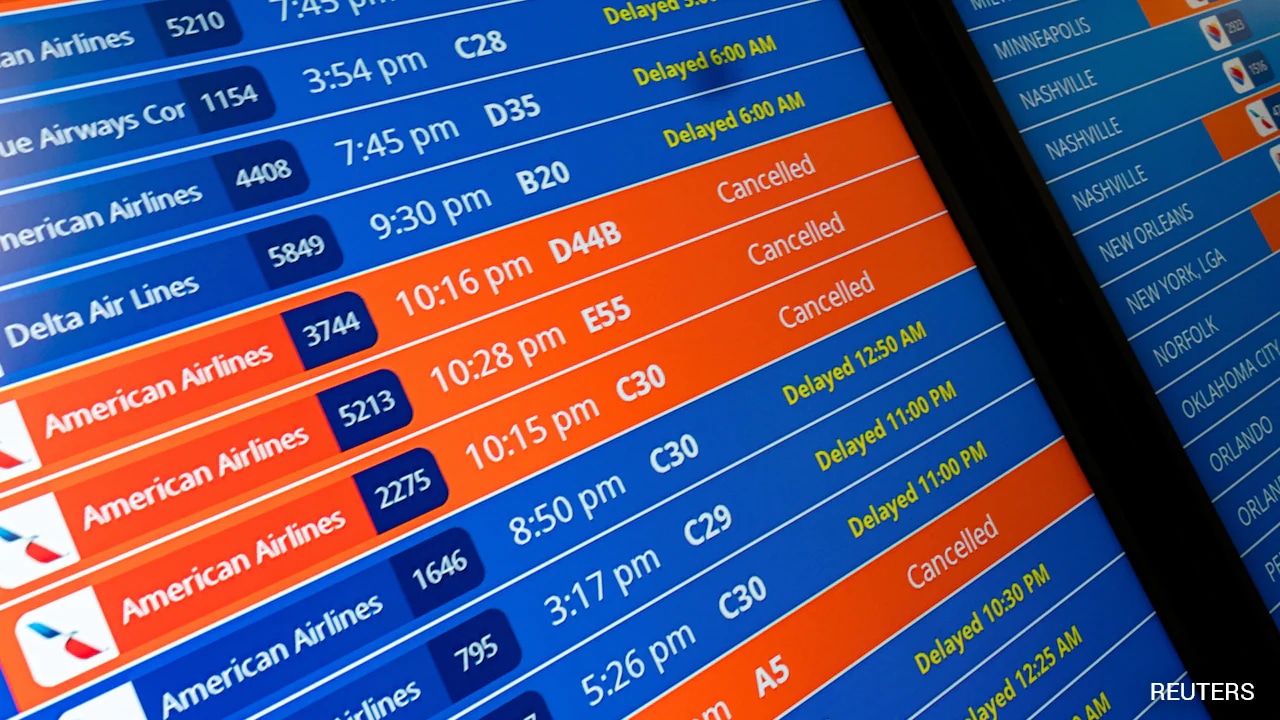
Every time air traffic control implodes, Washington dusts off the same scapegoat. They point at a frayed bundle of 1970s copper telecom lines, sigh heavily for the cameras, and tell stranded passengers that a routine repair went sideways.
It is a neat, tidy excuse. It is also completely backwards.
The lazy consensus sweeping through aviation coverage right now—the idea that an isolated repair of aging copper wiring caused hours of cascading flight delays—misses the real structural rot. Blaming a broken copper wire for a national airspace meltdown is like blaming a blown fuse for burning down a house built out of dry kindling and kerosene. The wire didn't cause the chaos. A brittle, centralized, single-point-of-failure architecture did.
If you want to understand why thousands of travelers end up sleeping on terminal floors whenever a technician touches a junction box, stop looking at the copper. Look at the software logic, the routing monopolies, and the bureaucratic cowardice that keeps the entire system wired together like a cheap string of Christmas lights.
The Myth Of The "Freak" Infrastructure Glitch
Let's dissect the official narrative first. Whenever a telecom outage knocks out radar feeds or voice communications between pilots and controllers, officials immediately frame it as an unavoidable hardware hiccup. A technician was upgrading or repairing an old copper trunk line, something severed or shorted, and suddenly aircraft spacing had to be doubled or tripled for safety.
On the surface, that sounds plausible. The Federal Aviation Administration (FAA) still relies heavily on Time Division Multiplexing (TDM) circuits running over legacy copper lines leased from commercial telecom providers. Anyone who has spent five minutes inside a legacy network operations center knows that copper degrades. Moisture gets in. Insulation cracks. Finding someone who actually knows how to splice and troubleshoot high-capacity TDM hardware is getting harder every year because those engineers are retiring faster than they can be replaced.
Here is the problem with stopping your analysis there. Copper is not inherently unreliable. In fact, properly maintained copper infrastructure has carried critical defense and aviation telemetry for decades with five-nines reliability.
The real failure isn't that a copper wire broke during maintenance. In high-stakes engineering, you assume components will fail. You assume a backhoe will cut a fiber line. You assume a technician will pull the wrong patch cord. You assume a circuit card will fry at 2:00 AM.
When a single repair brings regional or national air traffic to its knees, the failure isn't hardware. The failure is an architecture completely devoid of graceful degradation.
Why Modernizing To Fiber Won't Save Your Flight
Ask any pundit or politician how to fix this mess, and you will hear the exact same knee-jerk demand: Rip out the copper and replace it with fiber optics.
They are asking the wrong question entirely. Upgrading the physical transport medium from copper to fiber without fixing the underlying network topology just gives you faster outages.
I have watched enterprise telecom teams spend tens of millions of dollars migrating legacy networks onto shiny new IP-based fiber backbones, only to experience worse downtime than they had in 1995. Why? Because when you replace dedicated physical circuits with virtualized software-defined routing, you trade predictable physical failures for catastrophic logical ones.
Look at how aviation communications actually work:
- Dedicated Copper (TDM): A point-to-point physical circuit. If it goes down, you lose that specific link, and an engineer can physically trace the path from point A to point B.
- Modern IP/Fiber Networks: Traffic is packetized, routed dynamically across shared switches, and governed by complex software protocols like BGP (Border Gateway Protocol) or MPLS (Multiprotocol Label Switching). If a routing table corrupts or a central authentication server chokes, the entire regional network goes dark simultaneously.
Even when the FAA transitions facilities onto its Enterprise Network Services (FENS) architecture, the fundamental bottleneck remains. You still have massive regional hubs—Air Route Traffic Control Centers (ARTCCs)—acting as giant choke points. If the primary and backup paths into one of those facilities share the same physical conduit under a highway three miles away, it does not matter whether those conduits hold copper, glass fiber, or gold bullion. One mistake severs both.
The Dirty Secret Of "Redundant" Telecom Routing
In aviation, redundancy is supposed to be sacred. Aircraft have triple-redundant flight computers. Engines have dual ignition systems. Yet the ground infrastructure guiding those planes routinely violates basic survivability rules.
Imagine a scenario where a critical air traffic facility pays a major telecom carrier for "diverse routing." On paper, the facility has a primary line and a backup line. The executives sign off on the compliance audit. Everyone feels safe.
In reality, those two lines often converge in the exact same municipal manhole, run through the exact same carrier central office, or terminate on the exact same multiplexer shelf. Telecom carriers have spent the last twenty years consolidating their physical plant to cut costs. They quietly groom circuits onto shared backbones without telling the end customer.
So when a technician goes out to repair an aging copper bundle, they aren't just touching an isolated branch. They are often working inside a heavily consolidated splice case where the "primary" circuit and the "diverse backup" circuit are sitting three inches apart.
When that splice goes bad, both feeds vanish at the exact same millisecond. Radar screens freeze. Ground-to-air frequencies go dead. Controllers are instantly forced to revert to procedural separation—using stopwatches, paper strips, and massive distance buffers to keep jets from colliding. Capacity drops by 70 percent overnight, and your flight gets canceled.
Answering The Questions Nobody Wants To Ask
When travelers get stuck in these meltdowns, they flood search engines with the same predictable questions. Let's look at what people actually want to know—and strip away the PR spin.
Why is the FAA still using copper wiring in the first place?
Because ripping and replacing live safety-of-life infrastructure without turning off the national airspace is like performing open-heart surgery on a marathon runner mid-race. Legacy TDM circuits are deterministic. Engineers know the exact latency down to the microsecond. Moving radar and voice feeds onto packet-switched networks introduces jitter and latency variables that have to be rigorously engineered out. Keeping the copper wasn't just laziness; for decades, it was the safest way to guarantee zero packet loss. The mistake wasn't keeping copper—it was failing to maintain physical path diversity as the surrounding telecom grid decayed.
Can't air traffic controllers just use backup radios or satellite links?
They do, and that is precisely why planes don't fall out of the sky during these outages. Controllers immediately fall back on Emergency Transceivers (ETs) and backup frequencies. However, backup radios don't carry full-resolution, multi-sensor radar data or automated handoff telemetry. Without automated data links between adjacent sectors, controllers have to coordinate every single aircraft handoff via landline phone calls. You cannot run modern, densely packed hub-and-spoke airline schedules over manual telephone handoffs. The system slows down because safety protocols demand it.
Would privatizing air traffic control fix these infrastructure failures?
No. Anyone claiming privatization is a magic bullet is selling you ideology, not engineering. Look at NATS (National Air Traffic Services) in the UK—a public-private partnership that suffered a massive, nationwide flight meltdown in August 2023 caused by a single corrupted flight plan processing sub-system. Look at major private airlines like Southwest or Delta, whose internal crew-scheduling and operations networks have collapsed spectacularly under routine stress. Private corporations optimize for quarterly margins, which almost always leads to deferred infrastructure maintenance until something breaks.
The Real Culprit Is Monoculture And Centralization
To understand why aviation infrastructure keeps tripping over its own shoelaces, look at the principles championed by engineers like Dr. Nancy Leveson at MIT, who has spent decades studying system safety in complex aerospace environments. Her research proves over and over that catastrophic failures in modern systems rarely come from a single broken component. They come from tight coupling and interactive complexity.
We have built an airspace system that runs at 99 percent capacity during peak hours, leaving zero slack to absorb routine maintenance errors.
- Tightly Coupled Schedules: Airlines schedule arrivals and departures down to the minute at major hubs like Newark, Atlanta, and Chicago. There is no buffer. A 20-minute telecom hiccup at 8:00 AM doesn't stay contained to 8:00 AM; it ripples across four time zones until midnight.
- Vendor Monoculture: A tiny handful of massive defense contractors and legacy telecom giants hold near-monopolies on FAA infrastructure contracts. When a single vendor designs both the primary network and the failover logic, shared blind spots get baked into the foundation.
- Maintenance Starvation: Politicians love ribbon-cutting ceremonies for brand-new multi-billion-dollar modernization programs. Nobody gets re-elected for funding unglamorous, recurring line-item budgets to inspect manholes, audit physical circuit paths, and replace corroding splice cases before they fail.
What Actually Needs To Happen (And Why It Hurts)
If we want to stop hours-long flight meltdowns, we have to abandon the fantasy that one big technology upgrade will cure everything. Real resilience requires messy, expensive, unsexy operational changes—and it comes with real trade-offs that nobody in Washington or Wall Street wants to accept.
First, audit physical layer diversity down to the trench level. No federal agency or airline should accept a carrier's word that two circuits are redundant. Engineers need verified GIS mapping proving that primary and backup links enter buildings from opposite sides, travel through separate underground conduits, and terminate on independent power grids.
Second, decouple local failures from national gridlock. Modern air traffic software needs true decentralized failover. If a regional terminal radar approach control (TRACON) facility loses its primary data feed, adjacent facilities should be able to seamlessly ingest the raw sensor streams and assume partial sector control without forcing a ground stop across three states.
Third, admit the downside of true resilience: higher ticket prices and lower peak capacity. You cannot have rock-bottom airfares, packed runways every 45 seconds, and triple-redundant physical infrastructure all at the same time. Building true slack into the national airspace means capping peak hourly movements at congested hubs and forcing carriers to maintain expensive, underutilized backup networks. Consumers will pay more per seat, and airlines will fly fewer planes during rush hour.
Until taxpayers, passengers, and politicians are willing to pay that price, nothing changes. The next time a backhoe clips a cable or a technician botches a splice in an aging vault, the flights will stop, the talking heads will blame the copper, and you will still be stuck at Gate B14.