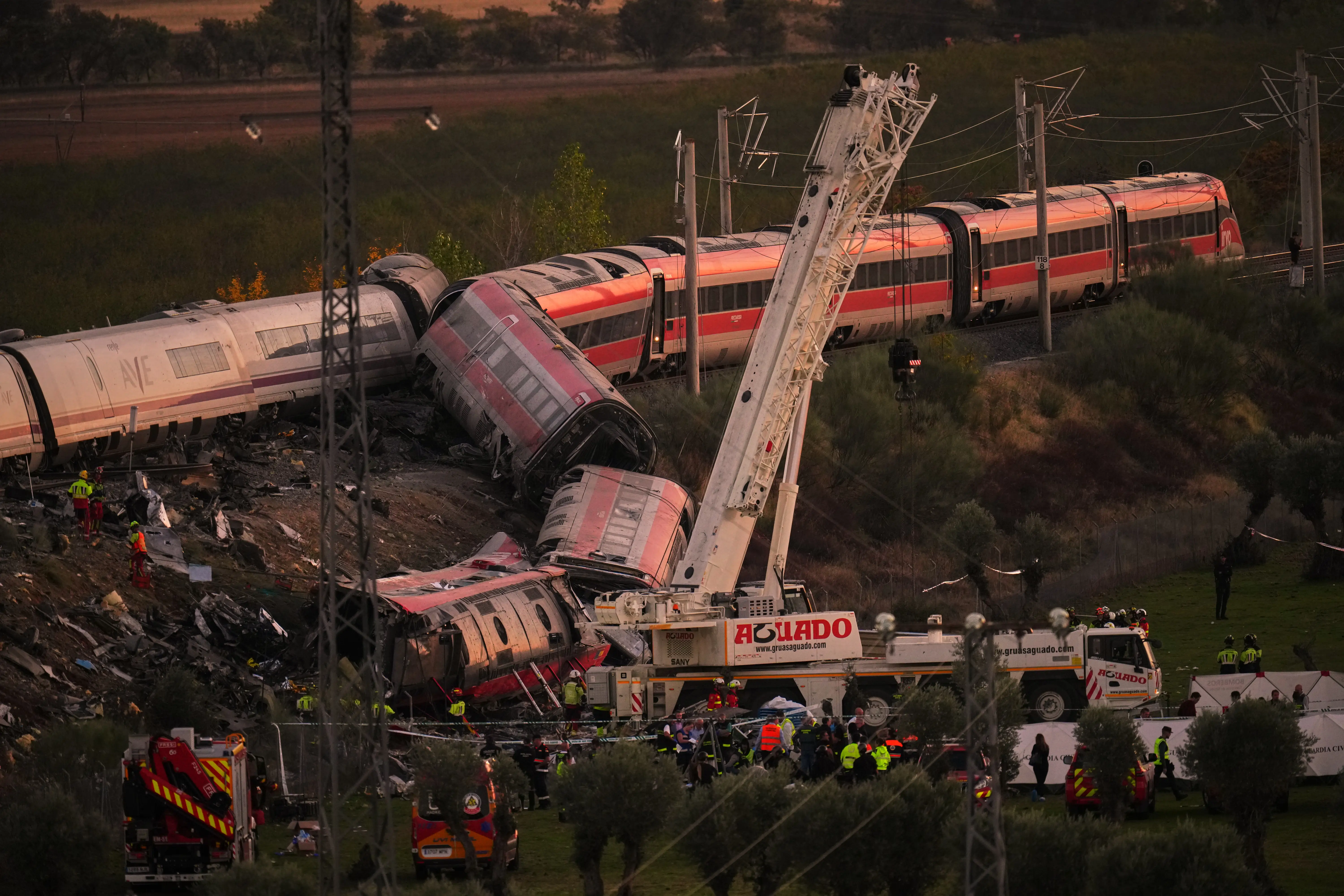
Every time steel meets concrete on a European rail line, the news cycle follows the exact same script. Point at the person in the control room. Pull the audio logs. Scrutinize the seconds between a warning light flashing and a button getting pushed.
That is the lazy consensus driving the coverage of Spain’s rail crash investigations. Reporters see investigators examining the actions of train traffic controllers, and they immediately frame the story around individual human error. They want a villain in a swivel chair. They want a simple narrative where one distracted operator missed a signal, and firing or prosecuting that operator restores order to the tracks. If you enjoyed this piece, you should read: this related article.
It is comforting. It is tidy. And from an engineering and safety standpoint, it is dead wrong.
When a modern rail network suffers a catastrophic collision or derailment, looking at the traffic controller is like blaming a smoke detector for a house fire. By the time a human operator inside a Centralized Traffic Control (CTC) center has to make a split-second life-or-death decision, multiple layers of automated infrastructure, maintenance protocols, and regulatory oversight have already collapsed. For another angle on this development, check out the recent update from NBC News.
If you want to understand why trains crash in a country boasting one of the most extensive high-speed and conventional rail networks in Europe, stop staring at the dispatchers. Start looking at the architecture of the trackside systems that were supposed to make human error impossible in the first place.
The Myth of the Omnipotent Dispatcher
Public perception of rail traffic control is stuck in the 1950s. People imagine a solitary signalman pulling heavy iron levers, personally guiding every locomotive safely past switches and junctions. In reality, modern rail dispatchers operate inside highly automated environments governed by interlocking systems—complex networks of track circuits, axle counters, and electronic signals designed specifically to prevent conflicting train movements.
An interlocking system does not care if a traffic controller is tired, distracted, or overwhelmed. Mechanically and electronically, the system is engineered to lock out dangerous routes. A controller cannot simply throw a switch under a moving train or clear a signal into an occupied block of track unless the underlying safety architecture is either bypassed, degraded, or absent.
Yet, whenever investigators announce they are reviewing controller communications—standard procedure in every single transport inquiry under European Union Agency for Railways (ERA) protocols—headlines twist routine fact-finding into an indictment.
I have spent years dissecting post-incident reports across European transport networks, and the pattern never changes. The initial press leaks focus on operator transcripts because human dialogue makes for dramatic copy. Meanwhile, the dry, damning technical realities—deferred track circuit maintenance, incompatible signaling transitions, and chronic underfunding of conventional commuter lines—sit buried on page eighty of a technical annex released two years later.
Investigators looking at Spain’s traffic controllers are not necessarily hunting for a scapegoat. They are mapping the timeline of a system breakdown. There is a massive difference between a controller causing an accident and a controller failing to rescue a system that was already in freefall.
The Two-Tier Trap in Spanish Rail Infrastructure
To understand the real vulnerability in Spain’s rail network, you have to look at the glaring divide between its flagship high-speed lines and its conventional commuter and regional corridors.
Spain poured tens of billions of euros into building the AVE network, equipping it with the European Rail Traffic Management System (ERTMS) Level 1 and Level 2. Under ERTMS Level 2, continuous radio communication via GSM-R feeds movement authorities directly to the train’s onboard computer. If a driver exceeds the speed limit or approaches an occupied block, the train brakes itself automatically. The human in the cab and the human in the control room are supervised by relentless mathematical logic.
Step off the high-speed showcase lines onto conventional Cercanías or regional tracks, and the technological reality shifts dramatically.
Many conventional stretches still rely on ASFA (Anuncio de Señales y Frenado Automático), an older, intermittent cab-signaling system introduced in the 1970s and upgraded incrementally over the decades. While ASFA Digital added crucial speed-curve monitoring after the tragic 2013 Angrois derailment near Santiago de Compostela, legacy gaps remain across the broader network. Unlike continuous ERTMS supervision, intermittent systems rely on trackside beacons (balises) placed at specific points. Between those beacons, the system is blind to changes in signal aspects until the train passes the next physical sensor.
When a track circuit fails—say, due to rusted rails, water ingress, or worn insulating joints—the signaling system defaults to a restrictive state, turning signals red. In technical terms, this is a "wrong-side" operational disruption that triggers a "right-side" safety stop. Everything halts.
This is where the trap snaps shut.
When automated signals drop to red due to infrastructure faults, the system forces humans back into the loop. Controllers must issue verbal authorizations—known as autorización de rebase—allowing drivers to pass red signals at restricted speed ("marcha a la vista," or driving on sight).
Think about what happens at that exact moment. The multi-million-euro automated safety net is switched off. Safety now depends entirely on clear radio communication, accurate manual verification of track occupancy by an overworked dispatcher managing dozens of screens, and a driver’s ability to spot an obstacle through a windshield in time to stop several hundred tons of steel.
Blaming the controller when something goes wrong during a degraded-mode operation is absurd. The real failure happened months or years earlier, when infrastructure managers allowed recurring track-circuit faults and aging relays to turn emergency manual overrides into a daily routine.
Why "Human Error" Is an Engineering Cop-Out
In safety science, blaming the front-line operator is known as the "Bad Apple Theory," a term dismantled decades ago by human factors researchers like James Reason and Sidney Dekker.
Reason’s famous "Swiss Cheese Model" demonstrates that catastrophic accidents rarely stem from a single blunder. Instead, every complex system has multiple defensive layers—hardware interlockings, automated braking, maintenance inspections, staffing ratios, and procedural rules. Each layer has holes. A disaster only occurs when the holes align momentarily, allowing a hazard to pass straight through every barrier.
When an investigation stops at the traffic controller, it acts as if the controller were the only slice of cheese in the entire system.
Consider the working conditions inside regional rail control centers across Europe:
- Alarm Fatigue: Modern CTC panels bombard controllers with hundreds of auditory and visual alerts per hour. Most are minor telemetry glitches, false track-circuit occupations, or routine schedule deviations. When an interface cries wolf fifty times a shift, human neurobiology adapts by filtering out the noise. That is not negligence; it is basic cognitive psychology.
- Degraded Mode Normalization: When infrastructure maintenance lags, equipment faults become normal. Controllers learn to work around broken axle counters and flaky radio links just to keep commuter trains moving on time. Management silently rewards them for keeping delays down—until the day a workaround collides with an unexpected train movement.
- Transition Zones: The most dangerous points on any rail network are the borders where different signaling technologies meet, or where high-speed lines merge onto conventional tracks. Here, automated protection often steps down, dumping cognitive load onto both the driver and the controller simultaneously.
If a system design requires a human being to maintain 100% vigilance for eight straight hours without a single lapse in memory or perception, the system design is defective. Humans are phenomenal at adapting to novel, unscripted emergencies. We are terrible at monotonous monitoring tasks. Any rail engineer who builds a safety case around infallible human attention should have their license revoked.
What Investigators Are Actually Looking For (And What Headlines Miss)
When official bodies like Spain’s Comisión de Investigación de Accidentes Ferroviarios (CIAF) examine traffic controllers, reporters hear "criminal negligence." Rail insiders hear something completely different.
Investigators look at controller logs to answer four structural questions:
- Did the control panel display accurate telemetry? There have been documented cases in European rail history where a CTC screen showed a track section as clear when a train was actually sitting on it, due to leaves on the line, sand buildup, or a shorted track circuit. If the screen lied to the controller, the controller’s actions were rational based on faulty data.
- Were there active engineering works or maintenance possessions? Track maintenance is the single deadliest operational phase in railroading. When crews are working on the tracks, automated interlockings are routinely bridged out or overridden. Miscommunication between trackside foremen, dispatchers, and drivers accounts for a disproportionate share of collisions.
- What was the controller’s workload at the time of the crash? Investigators pull staffing rosters and screen-interaction logs to see how many workstations were combined into a single desk. During night shifts, weekends, or staffing shortages, one controller is frequently forced to monitor territory normally handled by two or three people.
- Was the controller pressured by punctuality metrics? Rail operators face intense political and financial pressure to avoid delays. When a signal fails, holding a train for twenty minutes to follow rigid verification protocols ruins on-time performance statistics. Investigators look closely at whether organizational culture subtly encouraged controllers to rush verbal authorizations.
Notice how none of these questions boil down to "Was the controller bad at their job?" They all point upward toward management, engineering, and capital allocation.
Dismantling the Public’s Biggest Misconceptions About Rail Safety
Whenever a train crash hits the front page, the same flawed assumptions flood public debate. Let’s clear them out with actual operational reality.
"Why don't they just automate everything and remove humans completely?"
Full Grade of Automation 4 (GoA 4)—unattended train operation—works brilliantly in closed, sterile environments like airport shuttles or modern underground metro lines with platform screen doors. It fails miserably on open mainline railways exposed to weather, wildlife, trespassers, level crossings, and mixed freight-and-passenger traffic.
You cannot automate your way out of physical reality. Even the most advanced GoA 3 or GoA 4 systems still require human traffic controllers to manage disruptions, reroute trains around fallen trees, and coordinate emergency rescues. Removing humans does not eliminate risk; it simply shifts the risk from real-time operation to software engineering and hardware maintenance.
"Trains run on tracks, so how can two trains possibly end up on the same line?"
Because railways are dynamic networks, not static loops. Trains constantly cross paths at junctions, enter sidings, reverse direction at termini, and share tracks during maintenance bottlenecks. Preventing collisions relies entirely on strict block separation—ensuring only one train occupies a defined stretch of track at any given moment.
That separation depends on sensors detecting every axle of every train. If a single carriage detaches, or if an axle counter miscounts due to electromagnetic interference, the signaling logic can falsely conclude a block is empty. Once the computer thinks the track is clear, it will happily route another train straight into the danger zone.
"If Spain has high-speed rail, why isn't the whole network just as safe?"
Money and political vanity. Ribbon-cutting ceremonies for sleek 300 km/h bullet trains win elections. Replacing thirty-year-old relay rooms, upgrading track circuits, and installing continuous cab signaling on unglamorous suburban commuter lines do not make good campaign commercials.
Across Europe—not just in Spain—infrastructure managers have starved conventional networks of capital upgrades for decades while pouring billions into prestige corridors. The safety gap between flagship lines and regional arteries is a deliberate policy choice, not a technological limitation.
The Uncomfortable Truth About Over-Automating Control Rooms
Here is where the contrarian reality cuts both ways. While blaming traffic controllers for systemic failures is wrong, pretending that throwing more software at control rooms will solve the problem is equally dangerous.
Over the past fifteen years, rail infrastructure authorities have rushed to centralize traffic control. Instead of dozens of local signal boxes staffed by operators who knew every curve, gradient, and quirk of their ten-mile stretch of track, countries have consolidated control into massive regional nerve centers. One room now controls hundreds of kilometers of railway.
On paper, this looks efficient. In practice, it creates a brittle system.
Local signalmen used to possess deep, tacit knowledge of their territory. They knew which switch froze in January, which crossing had poor visibility in fog, and how heavy freight trains handled on wet rails. Centralized controllers staring at abstract schematic lines on a wall of monitors lose that physical intuition. Everything is reduced to green, red, and yellow pixels.
Furthermore, when centralized software crashes—or when a fiber-optic cable is severed by a construction crew—an entire region goes blind at once. The fallback procedures are so complex and rarely practiced that controllers face an immediate cognitive cliff.
The honest downside of advocating against pure automation and centralization is cost and complexity. Maintaining distributed human expertise alongside redundant hardware is expensive. It slows down peak throughput. It requires hiring and training more controllers, paying them well, and accepting that running a railway safely means leaving slack in the schedule.
Governments and rail executives hate slack. They want maximum capacity at minimum operating cost. So they squeeze the margins, centralize the desks, defer the trackside upgrades, and pray nothing breaks.
How to Actually Fix Rail Safety Before the Next Crash
If transport ministries and rail regulators want to prevent the next headline-grabbing disaster, they need to stop treating investigations as PR exercises aimed at punishing front-line staff. Real reform requires brutal structural changes:
- Criminalize the Suppression of Safety Data, Not Honest Mistakes: In aviation, the "Just Culture" framework protects pilots and air traffic controllers from prosecution when they report errors or near-misses, provided there was no willful recklessness. This transparency is the single biggest reason commercial aviation became extraordinarily safe. Rail networks in several European jurisdictions still lag behind, allowing criminal prosecutors to seize technical evidence and threaten controllers with jail time. When controllers fear prison, they hide near-misses. When near-misses are hidden, the system never learns until people die.
- Audit Degraded-Mode Frequency as a Core Safety Metric: Regulators should treat every manual red-signal override (rebase) as a mini-failure of infrastructure. If a specific junction requires controllers to issue verbal authorizations ten times a month because of faulty track circuits, that junction should face mandatory speed restrictions until the hardware is permanently repaired.
- Enforce Hard Caps on Controller Workload: Aviation enforces strict sector limits and mandatory rest breaks for air traffic controllers based on traffic density and complexity. Rail control centers frequently stretch staffing during off-peak hours or staff shortages. Dynamic workload monitoring—triggering automatic traffic throttling when a controller’s cognitive load hits a threshold—should be legally binding.
- Accelerate ETCS Rollout on Commuter Lines: Stop treating continuous automated train protection as a luxury reserved for high-speed rail. Dense commuter networks, where trains run minutes apart and interact with complex junctions, carry more passengers daily than high-speed lines and face far higher operational complexity.
The next time a rail crash dominates the news and commentators immediately zero in on the voice recordings from the traffic control room, recognize the sleight of hand. You are watching institutions protect their budgets, their management structures, and their political reputations by narrowing the frame to a single human being in front of a screen.
A railway is a giant machine stretching across hundreds of miles of steel, copper, concrete, and code. If one tired human in a control room is the only thing standing between two trains and a fireball, the machine was already broken before they ever clocked in for their shift.