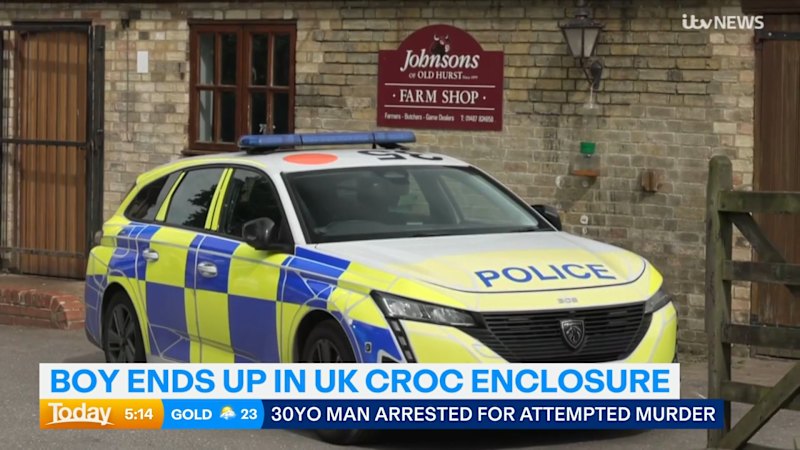
The internet loves a good villain, especially when a child’s safety is involved. When news broke that a boy had managed to breach security and end up inside a crocodile enclosure, the media instantly deployed its standard, copy-paste playbook. Outraged headlines demanded to know how zoo security could fail so catastrophically. Pundits called for heads to roll, demanding taller fences, motion sensors, and multi-million-dollar infrastructure overhauls.
It is a comforting narrative. If we blame the infrastructure, we can fix the infrastructure. If we blame the institution, we can sue the institution.
But it is also entirely wrong.
As someone who has spent two decades analyzing public safety infrastructure and behavioral risk management, I can tell you that the lazy consensus surrounding this incident misses the fundamental reality of human architecture. You cannot engineer away deliberate, high-effort bypasses of safety systems without turning our public spaces into sterile, concrete bunkers.
The frantic rush to demand "foolproof" exhibits ignores a harsh, undeniable truth of modern engineering: a system built to be entirely foolproof underestimates the ingenuity of fools.
The Illusion of Total Security
Every time an incident like this occurs, the public demands what engineers call "zero-risk architecture." It does not exist.
Zoo enclosures are not designed to withstand a determined, active human breach from the outside. They are designed to keep the animals in. A crocodile does not possess the cognitive ability or physical leverage to scale a standard perimeter fence, nor can it operate a latched gate. The engineering parameters required to contain a 500-pound reptile are entirely different from the parameters required to stop an agile, motivated human being who is actively ignoring warning signs.
Let us look at the mechanics of exhibit design. Standard zoological barriers utilize a combination of psychological deterrents, physical stand-offs, and structural barriers.
- Psychological Deterrents: Low hedges, clear signage, and symbolic railings that signal to a rational mind where public space ends and restricted space begins.
- Physical Stand-offs: Garden beds, moats, or dry ditches designed to create distance between the viewing public and the primary containment wall.
- Structural Barriers: Heavy-gauge mesh, tempered glass, or vertical steel pickets engineered specifically to withstand the impact and force of the animal inside.
When an individual intentionally hops a stand-off barrier, pushes through dense landscaping, and climbs a primary containment structure, that is not a failure of zoo security. That is a deliberate bypass of a multi-tiered safety system.
If we build fences so high that a human cannot climb them, we destroy the very purpose of a zoological park: education and observation. We end up with concrete cells and tiny viewing slits. The asset is ruined because we attempted to build a prison to protect people from their own lack of judgment.
Risk Homeostasis: Why Taller Fences Fail
Mainstream commentators argue that adding more layers of security will inevitably make people safer. This logic ignores a foundational principle of behavioral science: Risk Homeostasis Theory.
Coined by Gerald J.S. Wilde, a professor of psychology at Queen's University, Risk Homeostasis states that individuals have a target level of risk they are willing to accept. When a system is made visibly safer, people do not simply become safer; instead, they alter their behavior to recalibrate back to their preferred level of risk.
Think about it in terms of traffic safety. When you introduce anti-lock brakes and airbags, drivers do not necessarily become safer; many simply drive faster, tailgating more closely because they feel insulated from danger.
Apply this to a zoo environment. If a facility installs massive, military-grade netting over every enclosure, parents and visitors relax their vigilance. They assume the environment is entirely padded. They allow their children to climb higher on guardrails, or they pay less attention to what those children are doing, assuming the architecture will save them.
The moment you tell the public that an environment is 100% safe, you invite the exact type of reckless complacency that leads to disasters. The presence of visible, surmountable barriers serves a vital psychological purpose: it signals that danger exists. Eradicate the signal, and you elevate the danger.
The Real Cost of Liability Shifting
I have consulted for municipal parks and private attractions that spent millions chasing the myth of absolute liability protection. The script is always the same. A high-profile incident occurs, the legal team panics, and the facility installs ugly, expensive, counter-productive barriers that alienate their customer base and do absolutely nothing to stop the next highly determined individual.
Consider the data on public attraction breaches. The overwhelming majority of unauthorized entries into dangerous animal habitats globally do not occur because a gate was left unlatched or a fence fell down. They occur because a human being made a conscious, active choice to violate multiple explicit warnings.
In 2016, when a three-year-old boy fell into the gorilla enclosure at the Cincinnati Zoo, triggering the tragic shooting of Harambe, the subsequent federal investigation found that the exhibit was in full compliance with the Animal Welfare Act and Association of Zoos and Aquariums (AZA) standards. The barrier had worked successfully for 38 years without a single breach. Yet, the public outcry forced a total redesign, replacing a functional, natural barrier with a generic, four-foot-tall solid wood wall topped with nylon mesh.
Did it make the world safer? No. It just made the exhibit look like a construction site.
When we shift 100% of the moral and operational liability onto institutions, we create a toxic cultural precedent. We teach people that personal accountability is an outdated concept. We tell parents that if their child scales a barrier, it is the barrier's fault for being scaleable, rather than the parent's fault for failing to supervise.
Dismantling the PAA Fallacies
The questions dominating search engines and media panels right now are entirely wrongheaded. Let us dismantle them one by one.
"Why didn't the zoo have motion sensors or alarms?"
This sounds smart in a boardroom, but it is operationally absurd. A zoo is an open-air environment filled with moving animals, wind-blown debris, birds, and thousands of guests moving along the periphery. The rate of false positives on outdoor motion sensors in a crowded park would render them utterly useless. Within forty-eight hours, security staff would experience alarm fatigue, ignoring the pings because 99.9% of them are caused by a stray pigeon or a child dropping a stuffed animal over the rail.
"Shouldn't there be security guards stationed at every major predator exhibit?"
To deploy a dedicated guard at every single potentially dangerous enclosure during all operational hours would bankrupt most zoological institutions. Zoos operate on razor-thin margins, with the vast majority of their budgets allocated to veterinary care, conservation efforts, and specialized nutrition. Diverting millions of dollars to pay for human bollards to watch people who should be watching themselves means cutting funding for the actual welfare of the animals.
"Are children fundamentally unsafe at modern zoos?"
No. Millions of people visit accredited zoos every year without incident. The system works flawlessly for anyone who follows the basic, intuitive rules of civil society: stay on the path, keep your children within arm's reach, and do not climb structures that are clearly not designed for climbing. The danger is not the architecture; the danger is the complete abdication of common sense.
The Trade-off We Refuse to Face
Here is the uncomfortable truth that nobody wants to publish: there is a direct trade-off between absolute safety and human liberty.
If your goal is to ensure that no human being ever enters a crocodile enclosure under any circumstances, the solution is simple. You close the zoo. You move the crocodiles to an underground bunker with no windows, surrounded by a razor-wire perimeter and manned by armed guards.
But if your goal is to maintain an open, educational, inspiring space where urban populations can connect with the natural world, you must accept a baseline level of risk. You must accept that out of every ten million visitors, there will occasionally be an individual who acts with such spectacular recklessness that the physical environment cannot save them from themselves.
Stop looking at the height of the fence. Stop analyzing the reaction time of the staff, who responded with incredible speed and professionalism to save a life in an impossible situation. Start looking at the culture of entitlement that demands a world completely devoid of personal risk while refusing to take personal responsibility.
The barrier did not fail. The human did.


