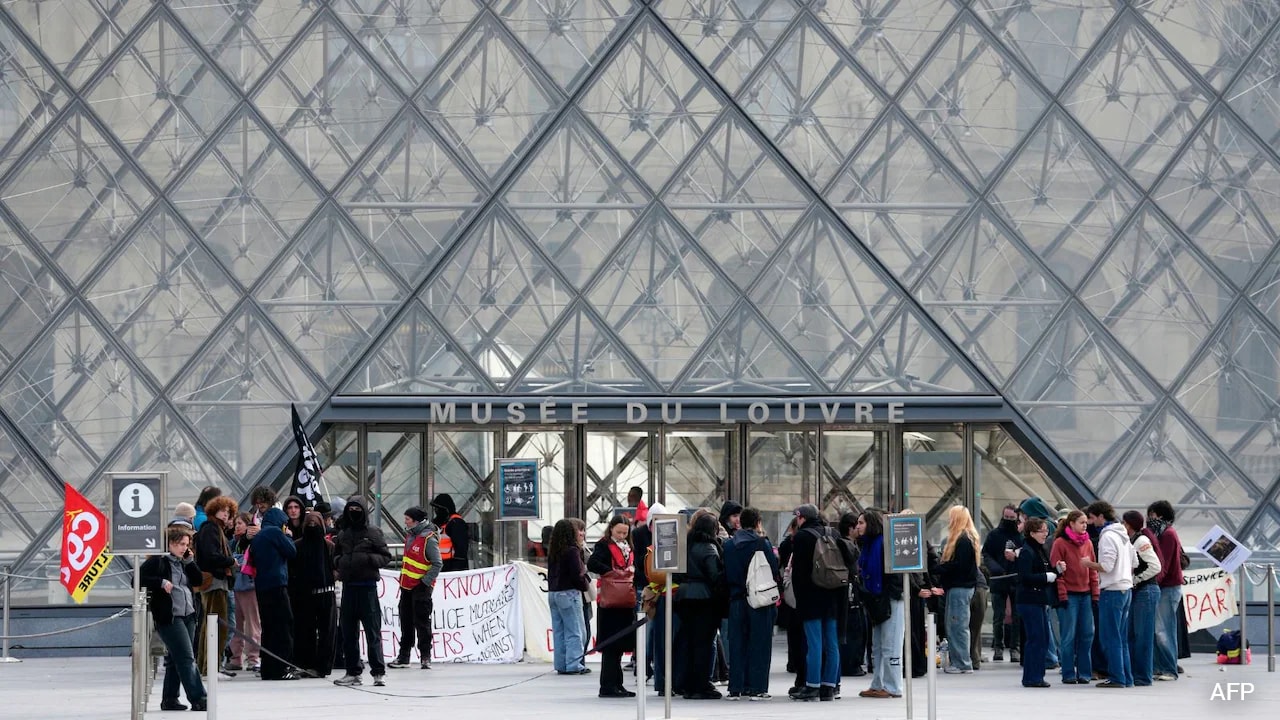
Fifty students stood in front of the Louvre. They held up signs. They blocked the entrance. And the wire services dutifully pumped out another predictable story about "France's unrest" shutting down a national treasure.
Lazy reporting loves a shiny target. Slap "iconic" onto the Louvre, quote a shivering tourist from out of town, mention the cost of living, and call it a day. That narrative is comfortable. It is also mostly wrong.
Shutting the doors of the world's most visited museum does not force a ministry to rewrite a budget. It does not scare a finance minister into freezing diesel or food prices. What it actually does is hijack the plans of ordinary travelers who had zero say in French domestic politics while leaving the real levers of state power untouched.
The Lazy Consensus Around Museum Blockades
Standard coverage treats a blockade at the Louvre as a barometer of national collapse. The formula is always the same. Unrest flares across France over rising prices, strained public services, or classroom conditions. Demonstrators—often students from art and heritage institutions like the École du Louvre—park themselves at the entrance. Cameras zoom in on the glass pyramid. Headlines declare that the crisis has reached the heart of French identity.
That framing confuses symbolic visibility with economic or political leverage.
A strike on a freight corridor hurts supply chains. A walkout at a port or a power station creates immediate, compounding friction across an economy. Blocking a museum entrance mostly delays ticket holders, frustrates tour guides, and gives television crews a tidy visual backdrop. Even when wider demonstrations involve hundreds of thousands of people, thousands of arrests, and fierce clashes in city centers, a handful of protesters standing outside a museum is a PR move, not a choke point.
Museum administrators call it a "chamber of echo" for broader grievances. That phrase is more revealing than management probably intended. An echo repeats sound. It rarely changes the acoustics of the room where policy gets made.
Why You Are Asking the Wrong Question
Most coverage asks whether protesters have the right to block cultural landmarks during a wider crisis. That is a debate over etiquette and optics. It misses the sharper strategic question: Who actually pays the cost when activists pick a cultural monument instead of an institutional target?
When demonstrators target a museum, the immediate friction lands on visitors who flew across an ocean, booked non-refundable slots, and spent months planning a trip. Some travelers shrug and say the complaints are real. Others stand in the cold wondering why guests are being punished for disputes they cannot vote on.
Meanwhile, decision-makers in ministries and parliament buildings keep their schedules. A closed museum creates a media headache for the culture ministry and a talking point for opposition politicians trading blame over disorder and economic pain. It does not create the kind of sustained operational paralysis that forces rapid concessions.
People Also Ask, Answered Without the Fluff
Does blocking a famous museum actually pressure the government?
Rarely in a direct, measurable way. Governments move when sustained disruption threatens fiscal stability, critical infrastructure, or broad voter coalitions—not when a small group delays art lovers for a morning. Political theorists and protest researchers, including scholars who study contentious politics like Charles Tilly and Sidney Tarrow, have long drawn a distinction between disruption that alters bargaining power and performance designed to attract media attention. Museum blockades lean heavily toward performance.
Why do students and activists keep picking cultural institutions?
Because they are easy to stage and impossible to ignore on camera. An art history student standing outside a world-famous museum gets instant international press coverage without needing a massive crowd. Contrast that with trying to shut down a regional rail depot or a tax office under heavy security. Cultural sites offer high-contrast imagery—historic stone, glass, security barriers, baffled tourists—that editors love to run alongside stories about national turmoil.
Is it fair to inconvenience tourists over domestic grievances?
Fairness is not how protest works, which is why asking whether it is "fair" is a trap. Disruptive politics almost always spills onto bystanders. The real test is strategic effectiveness. If an action alienates potential allies, generates zero material pressure on policymakers, and reduces a complex movement over living costs and education to a quarrel outside a ticket line, the tactic is weak even when the underlying grievance is rock solid.
Battle Scars From Watching High-Profile Disruptions
I have spent years watching organizations, campaigns, and public institutions misread loud moments as real power. I have seen advocacy groups pour energy into splashy stunts that trended for twenty-four hours and vanished by Tuesday without moving a single law. I have also watched institutions burn credibility by acting as though a temporary shutdown meant the end of civilization.
The mistake is identical on both sides. Loud does not mean decisive. Visible does not mean leveraged.
If you want to understand whether a movement has teeth, stop counting cameras outside landmarks and start looking at sustained participation, economic friction, and organizational endurance. When diesel prices spike, food bills climb, and classrooms feel under-resourced, people feel that pressure every week. A one-day blockage at a museum entrance does not match the weight of that daily grind.
A Thought Experiment in Real Leverage
Imagine a scenario where, instead of gathering fifty people at a museum gate, organizers spend three weeks building coordinated walkouts across municipal logistics, transit maintenance, and school support staff in two major cities. No dramatic photo in front of a famous pyramid. Less glamorous footage. Far less novelty for foreign news desks.
Now watch what happens to local mayors, transport authorities, and budget officials. Suddenly routine operations stall. Vendors miss deliveries. Commutes break down. Officials cannot wave it away as a brief staging stunt; they have to negotiate or escalate.
That thought experiment highlights the trade-off nobody in the "iconic landmark" headline machine wants to admit: high-glamour symbolism often buys low actual leverage.
Where This Contrarian Take Can Burn You
Going hard against symbolic protest has its own blind spots, and pretending otherwise would be dishonest.
First, symbols do shape culture over long stretches. Monuments carry national stories, and contesting how a country treats its youth or workers in front of its most celebrated spaces can spark conversations that dry policy debates never reach. Second, dismissing a small blockade too quickly can blind observers to a much bigger fire burning a few blocks away—as happened when museum closures coincided with widespread street unrest, heavy policing, and steep cost-of-living anger across France.
The error is not noticing the blockade. The error is mistaking the spark in the frame for the whole blaze.
What Actually Works If You Want Real Change
If you are organizing a campaign—or analyzing one—skip the theatrical shortcuts and focus on mechanics that compound:
- Target choke points, not photo ops. Pick places where daily operations stop until someone at the negotiating table feels the squeeze.
- Give bystanders a clear reason to care. If ordinary people get caught in the crossfire, explain the stakes plainly rather than treating inconvenience as a virtue by itself.
- Measure endurance, not headlines. A single morning's blockage makes a neat news clip; weeks of disciplined organizing changes policy.
- Separate optics from outcome. Never confuse getting on the evening news with winning the argument.
A locked museum door makes a great headline. Power moves somewhere else.